

How to Create Website Mockups People Actually Love
Learn how to create website mockups that bridge the gap between idea and reality. Our guide covers tools, principles, and developer handoff.

EXAMPLES
Build beautiful websites like these in minutes
Use Alpha to create, publish, and manage a fully functional website with ease.
Picking a domain name is more than just a technical chore; it's the first real step in carving out your space on the internet. This isn't just about getting a web address—it's about laying the cornerstone for your entire brand. The name you choose will affect everything from how easily people find you to how credible you appear.
Your Domain Is Your Digital First Impression
Think of your domain name as your digital handshake. Long before anyone sees your logo, reads your "About Us" page, or tries your product, they see your domain. That single line of text sets the stage. A great domain feels professional and builds instant trust, while a clunky, confusing one creates friction right from the start.
Let's say two new bakeries open. One chooses sweetpetalsbakery.com, while the other goes with sues-best-cakes-4-you.net. The first name is clean, memorable, and sounds like a legitimate business. The second one? It feels amateurish and is a pain to remember, putting that bakery at an immediate disadvantage. That’s the power of a first impression.
The Pillars of a Powerful Domain
Choosing the right domain isn't about luck; it's a strategic decision. A solid name rests on four key pillars that work together to support your brand's long-term growth. We'll dive deep into each of these throughout this guide.
Brand Alignment: Does the name truly fit your business? It should echo your mission, personality, and the value you offer.
User Experience: Is it simple? Can someone hear it once and type it correctly? You want it to be easy to remember and share.
SEO Value: Does it give search engines a clue about what you do? While exact-match keywords aren't the magic bullet they once were, relevance still helps.
Legal Defensibility: Is it unique and free of trademark issues? This is critical for avoiding expensive legal battles later on.
Your domain name is the most important piece of real estate you'll own online. It's the permanent address for your business, so the choice requires careful thought and strategic planning.
To help you balance these elements, here's a quick breakdown of what to focus on.
Quick Guide to Domain Name Factors
This table gives you a snapshot of the essential elements to consider, highlighting the impact of each on your brand and visibility.
Factor | Why It Matters | Example of Good vs. Bad |
|---|---|---|
Length & Simplicity | Shorter names are easier to remember, type, and share without errors. | Good: |
Memorability | A catchy, intuitive name sticks in customers' minds and encourages word-of-mouth. | Good: |
Keyword Relevance | Including a relevant term can help with SEO and user understanding. | Good: |
Brandability | A unique, brandable name is more ownable and stands out from the competition. | Good: |
Extension Choice (.com) |
| Good: |
Choosing the right combination of these factors is key to creating a domain that serves you well for years.
With around 364.3 million domain names registered worldwide, the competition for a clear, memorable name is intense. This figure alone shows why getting it right from the start is so important. While the market's growth has steadied, new businesses continue to come online, making the search for a perfect name a real challenge. You can discover more insights about this trend and see how it affects your options.
Ultimately, your goal is to find a name that becomes a long-term asset. The right domain makes marketing feel more natural, helps build a loyal customer base, and solidifies your authority in your field.
Finding a Name That Aligns With Your Brand

Alright, let's get to the creative part. Choosing a domain name is more art than science, and it starts with thinking bigger than just a few keywords. The real goal here is to land on a name that not only explains what you do but also captures the vibe of your brand. It has to feel authentic and connect with the exact people you’re trying to reach.
This alignment is what separates a forgettable web address from a true brand asset. A great domain gives people a hint of who you are before they even see your logo or read a single line of your website. It’s the first chapter of your story.
Brandable Versus Descriptive Names
As you start jotting down ideas, you’ll quickly notice they fall into two camps: brandable or descriptive. Neither is inherently better, but they serve very different strategic purposes. The right one for you really boils down to your long-term vision.
A descriptive domain is exactly what it sounds like. It's direct and leaves no room for confusion. Think of names like denverautorepair.com or buyusedlaptops.com. They’re packed with keywords, which can give you a small, early leg up in search results and immediately tell visitors what you’re all about.
On the flip side, a brandable domain is unique, often made-up, and memorable. Names like Zillow, Etsy, or Google don't literally describe their function. Instead, they’re catchy, distinctive, and give you a blank canvas to build an entire brand identity around.
Let's look at how they stack up.
Characteristic | Brandable Names | Descriptive Names |
|---|---|---|
Memorability | High; unique and catchy. | Moderate; relies on keyword recall. |
Flexibility | High; allows for business expansion. | Low; can be restrictive if you pivot. |
Initial SEO | Lower; requires building brand recognition. | Higher; contains relevant search terms. |
Example |
|
|
While a descriptive name offers instant clarity, it can box you in. If atlantacoffeeroasters.com decides to start selling tea or opens a shop in Savannah, their brand name suddenly becomes a hurdle. A brandable name doesn't have that problem.
Brainstorming Your Shortlist
Now it's time to actually generate some names. The trick is to go wide at first before you start narrowing things down. My biggest piece of advice? Don't start by immediately checking if a name is available. That’s a surefire way to kill your creativity.
Instead, kick things off with a simple word association game.
Core Concepts: List words that define your business, your industry, and your core values.
Customer Feelings: How do you want people to feel when they interact with your brand? (e.g., trust, excitement, relief).
Related Terms: Crack open a thesaurus (or an online one) and find interesting synonyms or variations of your core words.
Once you have a solid list of raw materials, start mashing them together. Try adding prefixes or suffixes. Heck, even invent a word. This stage is all about exploration, not finding the perfect answer on the first try.
A powerful domain name is a conversation starter. It should be easy to say, simple to spell, and impossible to forget. Think of it as the title of your business's story.
Using Generators for Inspiration, Not Imitation
Domain name generators can be a lifesaver when you hit a wall, but they come with a warning label. These tools often just smash keywords together, which can result in some pretty generic and uninspired suggestions.
The best way to use a generator is as a brainstorming partner. Plug in a few of your core concepts and see what it spits out.
Look for unexpected word pairings you hadn't thought of.
Pay attention to which prefixes or suffixes sound good attached to your main idea.
Use it to rapidly check dozens of variations for availability all at once.
The idea isn’t to let a robot pick your name. It’s to use the tool to expand your own list of possibilities. The perfect name will always come from a genuine understanding of your brand and your audience—it’s a key piece of your business identity. You can dig deeper into this by exploring these foundational small business branding tips.
By the time you're done, you should have a solid shortlist of five to ten contenders. These are the names you'll take into the next phase of vetting—checking availability, avoiding legal trouble, and making sure they’re easy for people to use.
How Domain Extensions Impact SEO and Trust
That little bit after the dot in a web address—the .com, .org, or .net—is called a Top-Level Domain (TLD), or extension. It might seem like a small detail, but it speaks volumes to both your visitors and search engines, signaling what your brand is all about and how trustworthy it is.
For as long as the web has been around, .com has been the undisputed king. It’s what people type by default, and it comes with a built-in sense of authority. If you're aiming for a national or global audience, grabbing the .com version of your name should be your number one priority. Anything else can just create confusion.
The Power of .com
Put yourself in your customer's shoes. They hear about your brand, "AquaWidgets," on a podcast. Their immediate reflex is to go to aquawidgets.com. If you own aquawidgets.net or aquawidgets.biz, you've just put a roadblock in their path and might be sending free traffic to a competitor or a dead end.
While hundreds of new extensions are available, .com remains the gold standard for commercial credibility. It’s the safest bet for most businesses because it requires zero explanation.
The data backs this up. Out of roughly 368.4 million domain registrations worldwide, .com domains account for a staggering 157.2 million of them. Despite over 1,200 new extensions like .shop and .xyz popping up, .com is still the one everyone wants.
When Niche and Local Extensions Are the Smart Play
Of course, this doesn't mean .com is the only choice. In some cases, a different extension can be a brilliant strategic move, especially for local businesses or highly specialized industries.
Country-Code TLDs (ccTLDs) like .ca (Canada) or .de (Germany) are a perfect example. Using one sends a clear message to users and search engines that you’re focused on a specific country. A bakery in Berlin with a .de domain will likely build more trust with local customers and may even get a boost in local search results.
Likewise, some of the newer generic TLDs (ngTLDs) can create a strong brand identity if they fit your niche.
.ai: The go-to for artificial intelligence startups.
.io: Hugely popular in tech and gaming circles.
.shop or .store: A crystal-clear choice for e-commerce sites.
.org: Still the trusted standard for non-profits.
The table below breaks down the most common types of TLDs to help you weigh your options.
Choosing the Right Domain Extension
A comparison of different TLD types to help you decide which extension best fits your website's purpose and target audience.
Extension Type | Best For | Pros | Cons |
|---|---|---|---|
gTLD (.com, .net, .org) | Most businesses, global brands, commercial ventures | Highly recognized, trusted, and memorable. | The .com version of your name is often already taken. |
ccTLD (.uk, .ca, .de) | Local or country-specific businesses and services | Signals local focus, can improve local SEO, builds trust with a national audience. | May limit perceived global appeal; some have residency requirements. |
ngTLD (.shop, .ai, .io) | Niche industries, startups, e-commerce, tech | Creative, descriptive, and memorable; better availability. | Less recognized by the general public; some can be associated with spam. |
Ultimately, your choice should align with who you are and who you're trying to reach. A .com is a safe, powerful bet, but a niche or local TLD can be a smarter move if it fits your brand perfectly.
A look at the sheer variety of TLDs available today, from country codes to industry-specific extensions.
The Bottom Line for SEO and User Perception
So, what does Google think of all this? Officially, Google says it treats most generic TLDs equally. However, the indirect impact on SEO is what really matters. A familiar, trusted extension like .com tends to get more clicks in search results, and that higher click-through rate is a positive signal to search engines.
There's also the human element. Some newer, cheaper TLDs have unfortunately gotten a reputation for being spammy. A less-savvy user might hesitate to click on a .zip or .xyz link, which is a risk you don't want to take. To get a better handle on how all these little details add up, check out our guide on what search engine optimization is.
Over time, the credibility of your domain is reinforced by your website's backlink profile. A strong, professional-looking TLD can make it that much easier to earn quality links from other reputable sites. It all starts with choosing the right extension.
Making Your Domain Easy to Type and Remember
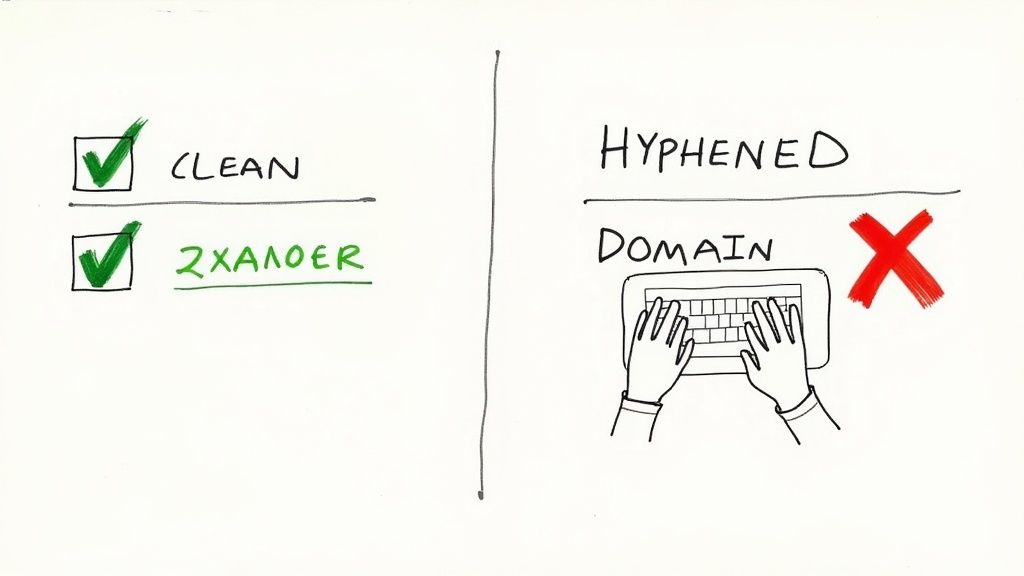
The best domain names all share one crucial trait: they require zero effort from the user. They’re intuitive to type, a breeze to recall, and simple to pass along to a friend. This is more than just being catchy—it's about knocking down every possible barrier between someone hearing about your brand and actually landing on your website.
Think about it this way: if a potential customer has to pause and ask, "Wait, did you say the number 4 or the word 'for'?" you've already lost momentum. Every moment of confusion is a chance for them to give up or, even worse, land on a competitor's site.
The Radio Test
A timeless rule of thumb I always come back to is the radio test. Picture hearing your domain name announced on the radio or mentioned in a podcast. Could you type it into your browser, right then and there, without a second thought? If the answer is a confident "yes," you're on the right path.
Names like Stripe.com or Mint.com pass this test perfectly. They're short, phonetic, and have no ambiguous spellings. In contrast, something like my-biz-solutions4u.net would be an absolute nightmare, forcing your audience to solve a puzzle just to find you.
Your domain name should be a simple instruction, not a complex password. If it needs a spelling guide, it’s too complicated and will cost you valuable traffic.
Keep It Short and Sweet
When it comes to domains, length really does matter. Shorter names almost always win out for a few simple reasons:
Easier to Remember: A concise name sticks in your head. Think about it:
Dropbox.comis far more memorable thansecurecloudfilestoragesolutions.com.Fewer Typos: Less is more. Fewer characters mean fewer chances for someone to make a mistake, especially mobile users tapping away on tiny keyboards.
Looks More Professional: Short domains just look cleaner on business cards, social media bios, and marketing materials. They convey confidence.
As a solid guideline, I always advise clients to aim for a domain under 15 characters. It’s not a rigid rule, but it’s a great benchmark that encourages you to be disciplined and focused.
Avoid Hyphens and Numbers
I get it. Your first choice is taken, and it's tempting to just toss in a hyphen or a number. Don't do it. From my experience, this is almost always a mistake that creates unnecessary confusion.
Take a domain like top-chef-recipes.com. When you say it out loud, you're forced to say "top dash chef dash recipes dot com," which is clunky and unnatural. Your listener will likely forget the hyphens and type in topchefrecipes.com, sending traffic directly to the competitor who was smart enough to grab that name first.
Numbers are just as bad. Does "5" mean the numeral or the word "five"? That tiny bit of doubt is enough to create a roadblock. Unless a number is a non-negotiable part of your brand name (like 1800flowers.com), steer clear. Your goal is clarity, and these characters only muddle the message.
How to Check If Your Domain Is Legally Safe and Available
So you've found a great domain name that’s available. It’s a fantastic feeling, but don't rush to hit that "buy" button just yet. This next step is crucial—it’s where you make sure the name is not just technically available, but also legally safe for you to build a business around.
Honestly, skipping these checks is one of the biggest and most costly mistakes I see people make. It can lead to everything from nasty legal battles to being forced to rebrand, throwing away all the hard work you've put in. A few minutes of due diligence now can save you a mountain of headaches later.
Avoiding Trademark Troubles
First things first: you have to check for existing trademarks. A trademark is a legally protected word, phrase, or symbol that identifies a specific company's products or services. If you accidentally use a name that's already trademarked, you could find yourself in a world of legal trouble.
Imagine pouring your heart and soul into building a brand around zenithfitness.com, only to get a cease-and-desist letter from Zenith Fitness Inc. a year down the line. It's a total nightmare scenario, and it happens more often than you'd think.
Here’s how to do a proper search:
Start with Google: A simple search is your first line of defense. See if another business in your industry is already using a similar name.
Search Official Databases: If you're in the US, the U.S. Patent and Trademark Office (USPTO) has a free tool called TESS (Trademark Electronic Search System). Use it to look for your name and any close variations.
Look at Regional Registries: Every country has its own system. For example, in Canada, you'll need to do a specific search to ensure your business name is clear. You can learn more by understanding the NUANS name search process.
Key takeaway: Just because you can register a domain doesn't mean you have the legal right to use the name. Only a trademark offers that kind of protection, so making sure your name is clear is non-negotiable.
Secure Your Brand Across All Platforms
Your brand isn't just your website anymore. It's your social media handles, your YouTube channel, and your app store presence. Having a consistent username everywhere you have a presence looks professional and makes it dead simple for customers to find you.
Before you commit to your domain, check if your preferred username is available on the big platforms:
Facebook
Instagram
X (formerly Twitter)
LinkedIn
TikTok
YouTube
You can use a tool like Namechk to check hundreds of sites at once, which saves a ton of time. If yourbrand.com is free but the Instagram handle @yourbrand is already taken by an active account, you might want to pause and rethink. Juggling different handles across platforms can confuse your audience and weaken your brand identity.
What to Do When Your First Choice Is Taken
It’s bound to happen: you land on the perfect name, but the domain is already registered. Don't sweat it. With approximately 378.5 million domain names registered worldwide, the competition is stiff. The good news is, a little creativity goes a long way.
Given that the renewal rate for .com domains is around 75.3%, it's clear that people hold onto good names. You can read the full industry report to get a sense of just how active the market is.
If the domain is parked (meaning it's registered but not being used), you could try to buy it from the owner through a broker, but that can get pricey fast. A much more practical approach is to go back to your brainstorming list and try some simple tweaks.
Try adding a relevant word to your name:
Add a verb:
getyourbrand.comAdd your industry:
yourbrandmedia.comAdd your location:
yourbrandnyc.com
This final set of checks ensures the name you settle on isn't just catchy and memorable, but also legally sound and available everywhere it needs to be. Once you've cleared these hurdles, you can register your domain with confidence, knowing you’re building your brand on a solid foundation.
A Practical Guide to Registering Your Domain
You’ve done the hard work of brainstorming, checking for conflicts, and finally landing on the perfect domain name. Now for the exciting part: making it officially yours.
Registering your domain is the final piece of the puzzle. It’s a pretty simple process, but a few smart choices here can save you from major headaches and hidden costs down the road. This isn't just about grabbing the cheapest option—it’s about finding a reliable partner to manage your online identity.
Selecting the Right Domain Registrar
A domain registrar is the company you pay to reserve your name on the internet. You'll see a lot of them advertising dirt-cheap introductory offers, but the real cost often lurks in the renewal rates. That tempting $2.99 first-year deal can easily shoot up to $21.99 or more when it's time to renew.
So, what should you actually look for?
A Clean User Interface: You'll need to manage your domain settings eventually. A confusing, clunky dashboard is the last thing you want to deal with when you're trying to make a quick update.
Real Customer Support: When something goes wrong (and it can), you want to talk to a knowledgeable person, not a chatbot. Good support is worth its weight in gold.
Easy Transfer Policy: You should always have the freedom to move your domain to another provider. Some registrars make this process deliberately difficult or expensive, effectively locking you in.
Don't get lured in by a low initial price. A registrar with sky-high renewal fees and nonexistent support is a long-term liability. Always look at the total cost of ownership, not just the flashy first-year discount.
The Importance of WHOIS Privacy
Here’s something many people overlook. When you register a domain, your personal details—name, address, email, and phone number—are automatically published in a public database called WHOIS. Without any protection, this information is a goldmine for spammers, scammers, and marketers.
That's where WHOIS Privacy comes in. This service, often called Domain Privacy, masks your personal information, replacing it with the registrar's generic contact details instead. Many good registrars now offer this for free, but some still try to tack on an extra annual fee. My advice? Always enable it.
If you want to dive deeper into the technicals, our guide explains everything you need to know about what domain name registration entails.
This process flow hits on all the key checks to run before you commit.
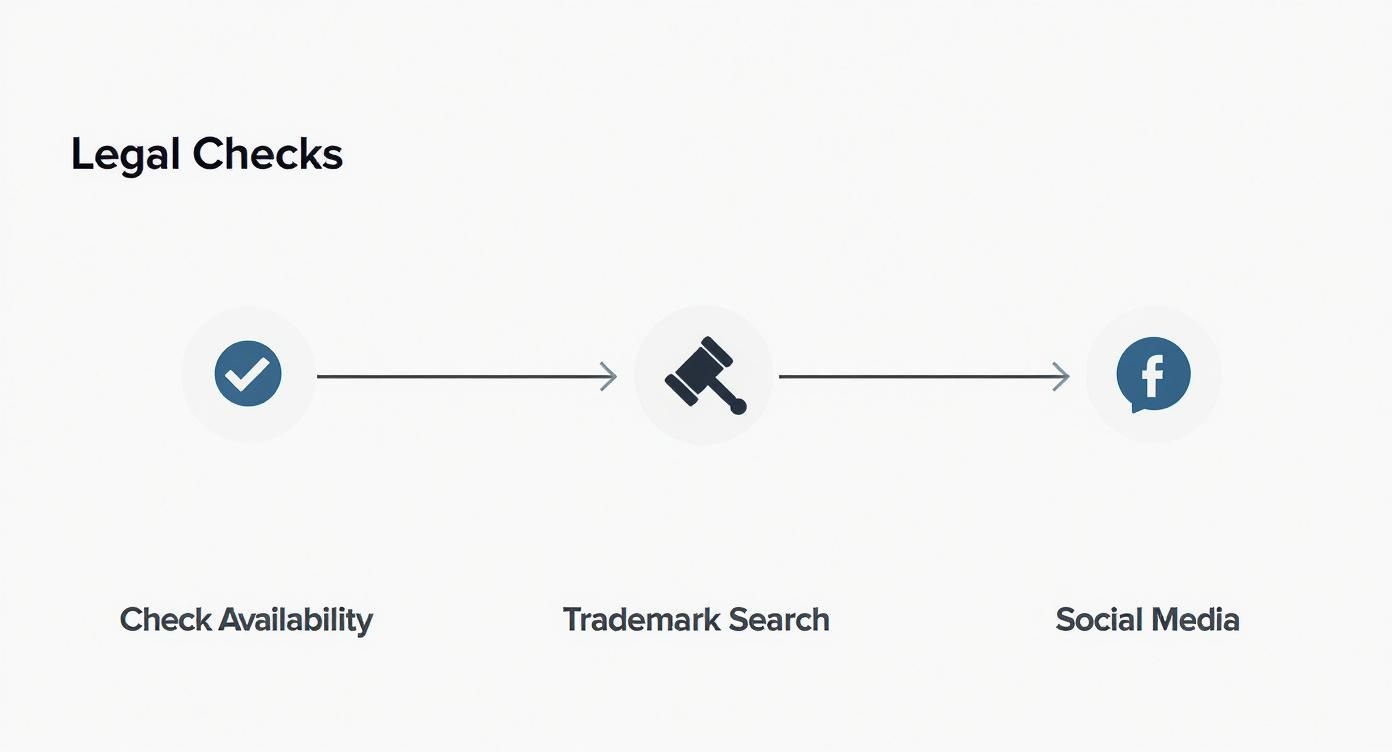
As the visual shows, confirming availability, clearing trademarks, and checking social media handles are all crucial for building a strong, defensible brand.
Connecting Your Domain to a Website Builder
Once you've registered your domain, it’s basically an empty address waiting for a house to be built on it. The final step is pointing that address to your actual website. Thankfully, modern tools have made this incredibly easy.
For example, connecting your new domain to an AI website builder like Alpha is a breeze. Inside your site settings, you just enter the domain name you bought and follow a few simple, guided steps to update the records with your registrar.
The whole process usually takes just a few minutes, getting you online quickly so you can focus on what really matters—building out your site's content.
Common Questions About Choosing a Domain Name
As you get closer to making a final decision, a few common questions always seem to pop up. Let's tackle them head-on so you can register your domain with confidence.
What If My Perfect .com Is Taken?
This happens all the time, so don't get discouraged. The first thing to do is a quick check: is the domain being used for a real website, or is it just "parked" with a "for sale" sign? If it's for sale, you could try to buy it, but be prepared—premium domains can cost a small fortune.
A much better approach is to get a little creative. Think about adding a simple, intuitive word. If "Mintly" is taken, what about getmintly.com or trymintly.com? For local businesses, adding your city or state can be a game-changer, like mintlyboston.com. This not only solves the availability problem but can also give your local search rankings a nice little boost.
How Important Are Keywords for SEO?
Back in the day, having a keyword-stuffed domain like bestplumberphoenix.com was a golden ticket for SEO. Those days are long gone. Today, Google and other search engines are much smarter; they value brand signals and user experience far more than an exact-match keyword.
Your focus should be on a name that’s short, catchy, and builds a brand people remember. A strong brand is what earns links, gets shared on social media, and keeps customers coming back. In the long run, that kind of brand recognition is a much more powerful SEO asset than a clunky, generic domain.
A memorable brand will always outperform a generic, keyword-focused domain. Your goal is to be remembered, not just categorized.
Should I Register Multiple Domain Extensions?
For most new businesses or personal projects, just grabbing the .com is perfectly fine. You can always expand later.
However, if you've landed on a truly unique brand name and have big plans for growth, it's a smart defensive move to also register other popular extensions like .net, .org, or .co. This simple step prevents competitors or opportunistic cybersquatters from snagging those domains and potentially confusing your customers or tarnishing your brand down the road. It's a small investment that acts like an insurance policy for your brand's future.
Ready to bring your perfect domain name to life with a stunning website? With Alpha, you can build a professional, high-performing site in minutes using the power of AI. Just describe your vision, and watch it become a reality. Start building your website for free today!
EXAMPLES
Build beautiful websites like these in minutes
Use Alpha to create, publish, and manage a fully functional website with ease.