
How to Create Website Mockups People Actually Love
Learn how to create website mockups that bridge the gap between idea and reality. Our guide covers tools, principles, and developer handoff.

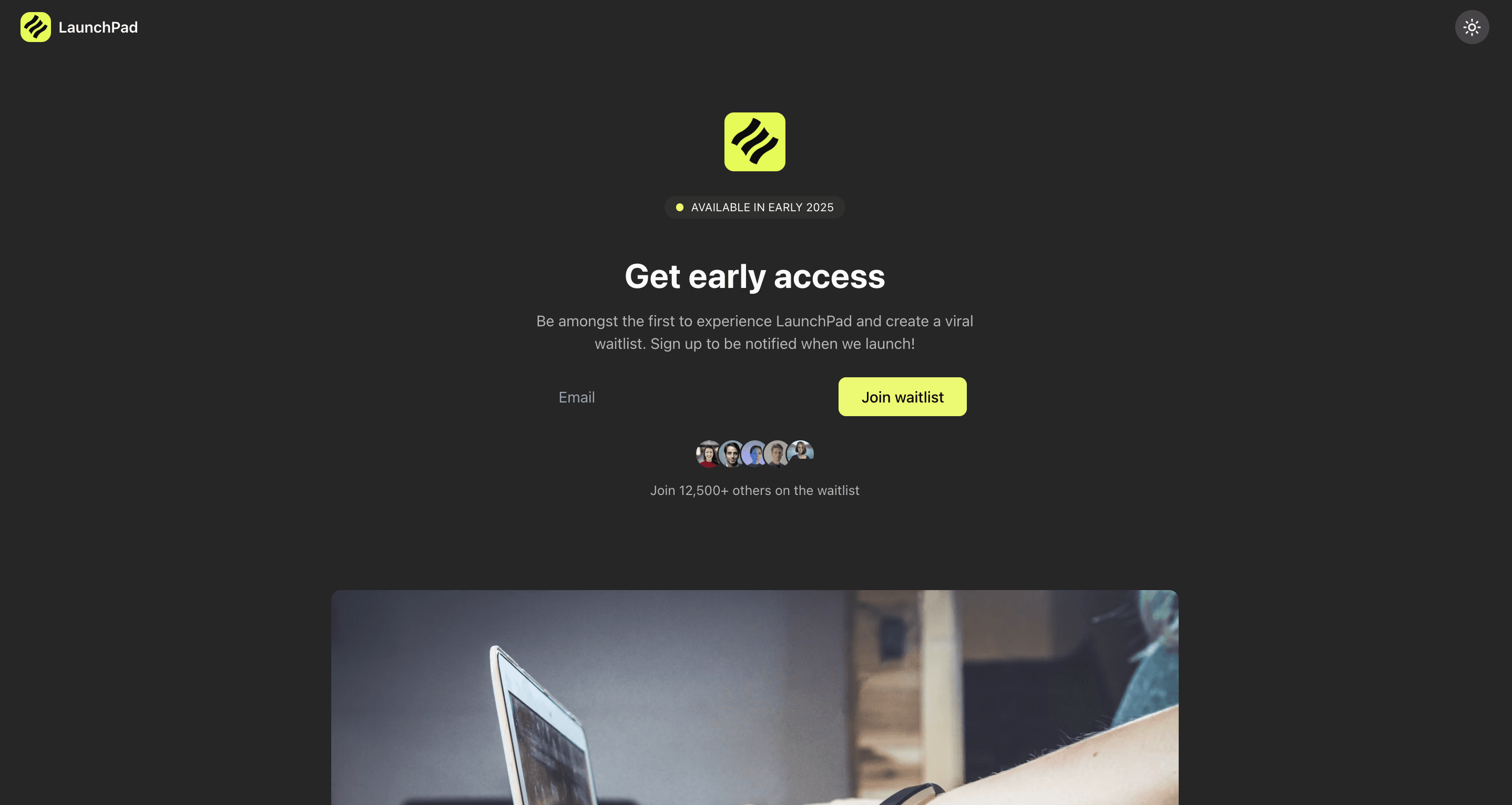
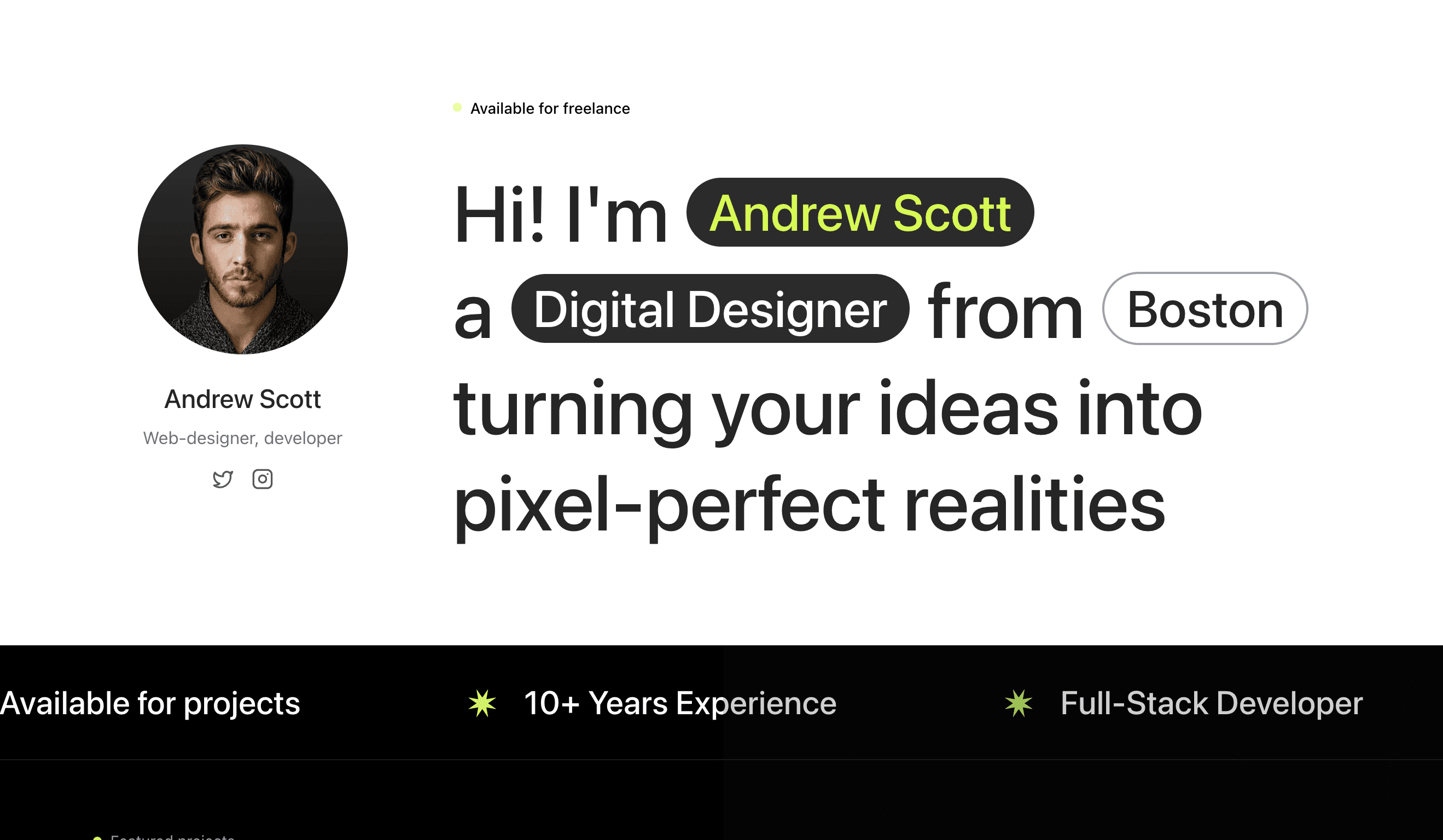
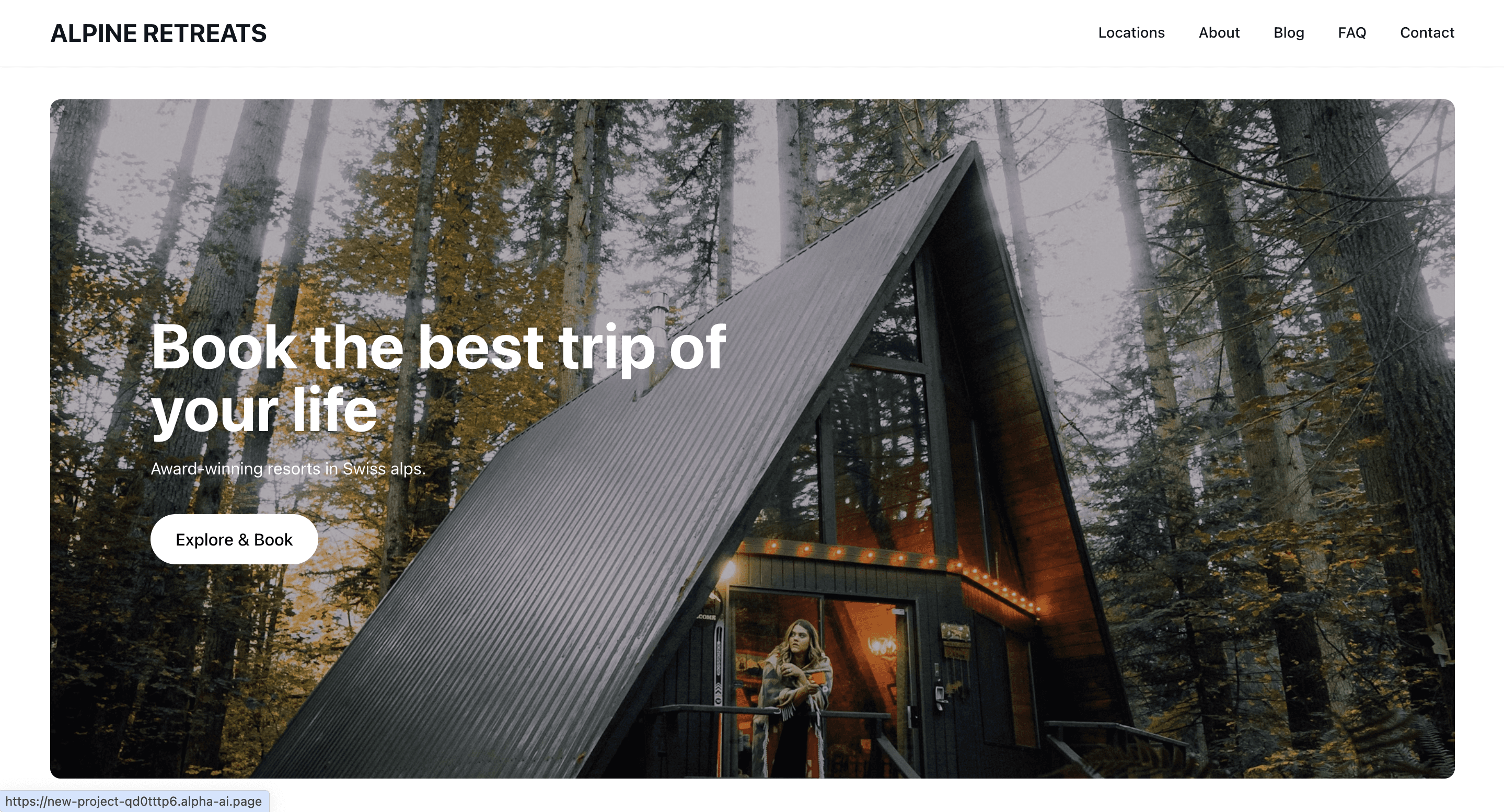
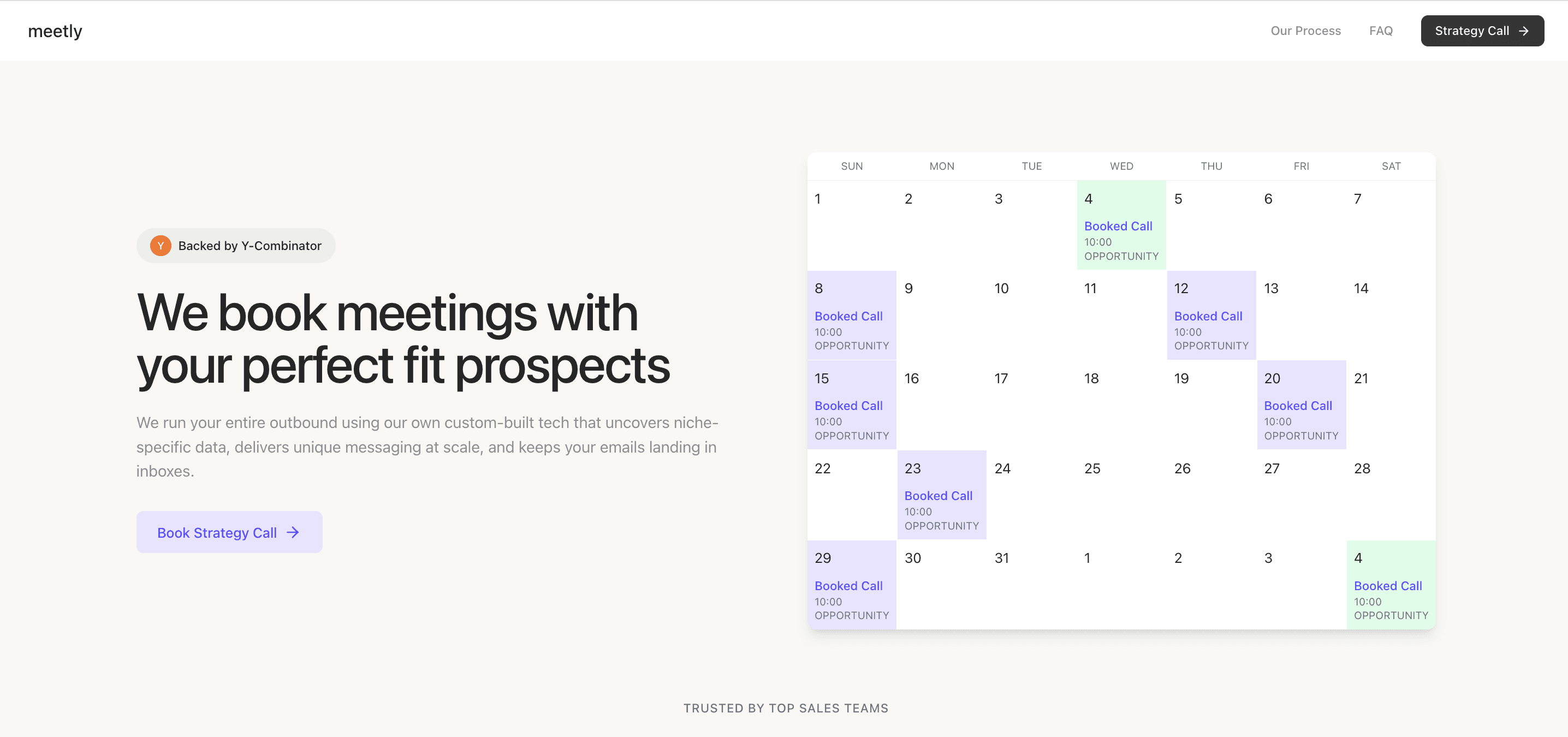
EXAMPLES
Build beautiful websites like these in minutes
Use Alpha to create, publish, and manage a fully functional website with ease.
Your portfolio website needs to be your hardest-working employee—a 24/7 sales tool that proves your value, not just a pretty place to hang your work. It's a fundamental shift in thinking: you're moving from simply showing what you've done to demonstrating how you solve real problems for potential clients. And thanks to modern AI tools like Alpha, pulling this off is faster and more effective than ever before.
Your Portfolio Is More Than Just a Gallery
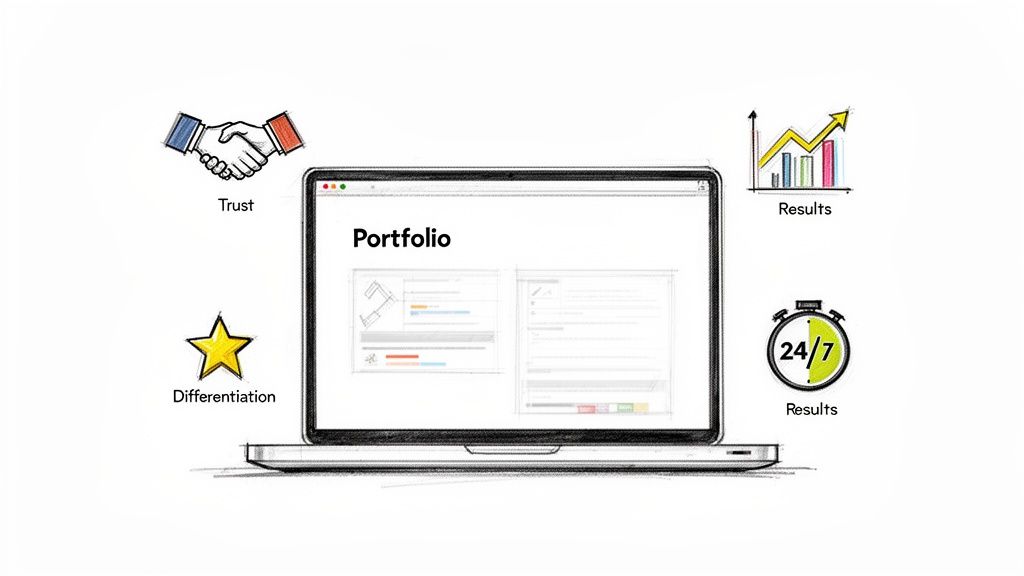
Let's get past the outdated idea of a portfolio as a digital C.V. In today's market, your website is your single most important business asset. It's out there around the clock, working to build trust with prospects, setting you apart from the crowd, and turning curious visitors into paying clients.
Think of it as your direct line to new business—an active, client-generating machine. The market for these tools is booming for a reason. In fact, the portfolio website market is projected to hit $9.7 billion USD by 2033, growing at a compound annual rate of 11.10%. That number tells you just how vital a professional online presence has become.
From Passive Display to Active Sales Tool
A passive gallery just shows off the final product. An active sales tool, on the other hand, tells a story. It frames your work within the context of a client's problem and guides a visitor through a narrative that leads them directly to your contact form.
You make this happen by weaving in a few key elements designed for conversion:
Compelling Case Studies: Go beyond static images. Detail the client's challenge, walk through your process, and show off the tangible results you delivered.
Clear Value Proposition: A punchy statement right on your homepage that instantly tells visitors who you are, who you help, and how you do it.
Strategic Social Proof: Sprinkle in testimonials, reviews, and client logos to build instant credibility. If you're new to the concept, understanding https://www.alpha.page/blog/what-is-social-proof-in-marketing is a great starting point.
Effortless Contact Forms: Make it dead simple for an interested lead to take that next step and get in touch.
Your portfolio shouldn't just answer "What can they do?" It needs to answer "What can they do for me?" This subtle shift in perspective is what separates a good portfolio from a great one that consistently brings in new business.
Below is a quick-reference table that breaks down these essential components and how Alpha helps you implement them.
Key Elements of a Conversion-Focused Portfolio
Element | Purpose | Alpha Feature |
|---|---|---|
Case Studies | Showcases problem-solving skills and tangible results. | Pre-designed sections for outlining challenges, solutions, and outcomes. |
Value Proposition | Instantly communicates your unique value to visitors. | AI-powered copy suggestions to help you craft a compelling headline. |
Social Proof | Builds trust and credibility with potential clients. | Easy-to-add testimonial blocks, client logo carousels, and review sections. |
Call to Action (CTA) | Guides visitors toward the next step (e.g., contacting you). | Built-in contact forms and conversion-optimized button styles. |
Putting these pieces together turns your site from a simple brochure into a lead-generation powerhouse.
How Modern Tools Simplify the Process
Thankfully, building a high-impact portfolio no longer requires you to be a coding expert. For those who prefer a more hands-on approach, a practical guide to WordPress for portfolios offers a solid walkthrough of the essentials.
For a more streamlined path, AI-powered platforms like Alpha are designed to do the heavy lifting for you. You can generate a stunning foundational design just by dropping in the URL of a site you admire or by using simple text prompts to make design edits. This frees you up to focus on what really matters: curating your best work and telling your story.
Plan Your Portfolio Strategy Before You Build
Jumping straight into a website builder without a clear plan is a classic mistake. It's like trying to build a house without a blueprint—you might end up with something that stands, but it won't be functional, and it certainly won't attract the clients you want. The portfolios that consistently win high-value work are built on a solid strategy, long before a single design element is chosen.
This upfront thinking is what separates a generic, forgettable gallery from a powerful, client-attracting machine. It all comes down to answering a few critical questions that will steer every decision you make, from the layout you choose to the words on your homepage. The whole point is to build a website that speaks directly to the people you want to work with.
Pinpoint Your Ideal Client
Before you can convince anyone to hire you, you have to know exactly who you're talking to. Vague goals like "getting more clients" won't get you anywhere. You need to get specific. Who is your dream client?
Are you a graphic designer targeting fast-moving tech startups that need bold branding and quick turnarounds?
Or maybe you're a writer who thrives on long-term partnerships with established enterprise marketing managers looking for deep industry expertise.
Perhaps you're a photographer specializing in product shoots for independent e-commerce brands.
Each of these profiles has completely different needs, pain points, and expectations. The language that gets a startup founder excited is totally different from what an enterprise manager needs to see. Defining this person first is non-negotiable; it ensures your portfolio’s message will actually connect.
A portfolio built for everyone is a portfolio built for no one. Your power lies in specificity. By defining your ideal client, you can tailor every element of your site to attract exactly the kind of work you want.
Define One Primary Goal for Your Website
Okay, you know who you're talking to. Now, what do you want them to do? Your portfolio needs one primary, crystal-clear objective. If you try to make it do too many things at once, you’ll just confuse visitors and weaken your message.
A few common goals for a portfolio site are:
Booking discovery calls: Your main call-to-action would be a prominent "Schedule a Call" button that links out to your calendar.
Generating quote requests: Here, you'd guide users toward a detailed project inquiry form to gather all the necessary info.
Selling digital products: Your design would need to showcase products effectively and make the checkout process as smooth as possible.
Growing an email list: You could offer a high-value freebie, like a checklist or guide, in exchange for an email sign-up.
Pick one main goal and build your entire user experience around it. This focus will naturally inform your site's layout and flow, which is a huge part of the planning phase. For a much deeper look at this, our guide on how to plan your website structure walks you through the entire process.
Curate and Frame Your Best Work
It’s finally time to think about the work you’ll feature, but there’s a catch: quality over quantity. I see so many freelancers make the mistake of showcasing everything they've ever done. Your portfolio is not an archive; it's a highlight reel, precision-engineered to prove your expertise.
Select 5-10 of your absolute strongest projects that align perfectly with the ideal client you just defined. If you want to attract e-commerce brands, it makes sense to feature your best e-commerce work, right?
But don't just show the final product—that’s only half the story. You need to frame each project as a compelling case study that demonstrates your real value.
The Problem: Kick things off by clearly outlining the client's challenge or goal. What were they struggling with?
Your Process: Briefly walk them through your unique approach. What steps did you take to solve their problem? This is where you show your thinking.
The Result: End with the tangible, positive outcome. Did you increase their sales by 30%? Did your redesign lead to a 50% boost in user engagement? Use real numbers whenever you can.
This simple narrative structure transforms your work from a pretty picture into hard proof of your problem-solving skills. It shows potential clients not just what you can do, but the real-world business value you deliver.
Bringing Your Portfolio to Life with an AI Website Builder
Alright, you've done the hard work of planning and strategizing. Now for the fun part: actually building your portfolio website. This is where a lot of people hit a wall, getting tangled up in complicated design software or code. But that's the old way of doing things.
With an AI-powered platform like Alpha, the entire process is different. Forget spending hours fighting with a drag-and-drop editor. You can get a professional, fully functional website up and running without ever touching a line of code. It’s not just about moving faster; it’s about getting a better, cleaner result without the headache.
Think of it like this: your strategy—targeting your audience, defining your goals, and curating your work—is the blueprint. The build phase is simply the execution of that plan.
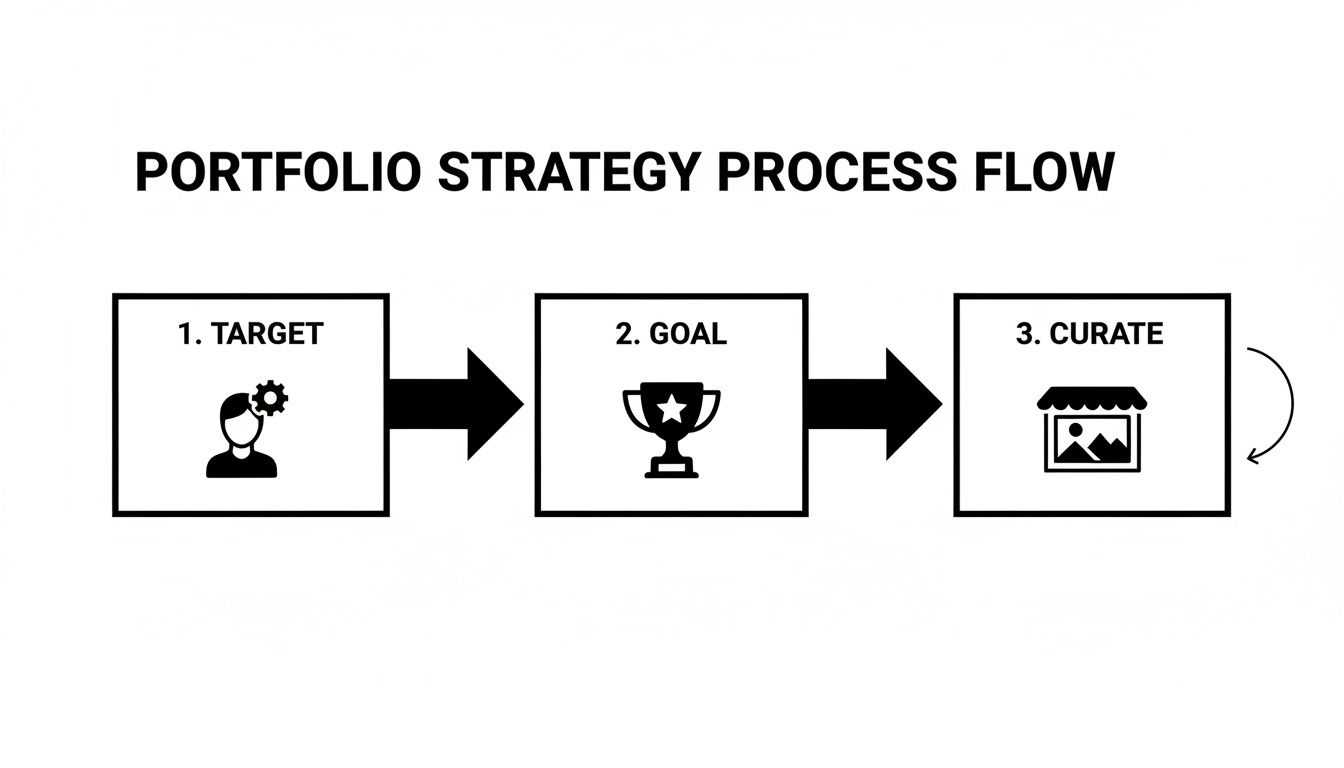
This is where the AI takes over and turns your vision into reality.
From Inspiration to Instant Draft with a Single URL
One of the most powerful features in Alpha is the ability to create a starting design from a website you already like. Let's say you've stumbled upon a portfolio that just nails it—the layout is perfect, the gallery is slick, and it has the exact professional vibe you're after.
Instead of trying to piece it together yourself, you just give Alpha the URL. The AI scans the site’s structure, colors, and layout and then generates a unique, totally customizable draft for you. It’s an incredible time-saver.
This isn't about copying. It's about using a great example as a launchpad. The AI builds a functional wireframe and style guide inspired by the reference site, saving you from all that tedious initial setup.
Customizing Your Site with Simple Instructions
Once you have that first draft, refining it is as easy as sending a text message. You don't need to hunt through menus or settings. You just tell the AI what you want in plain English, and it happens.
Want to tweak your homepage? Try telling the AI, "Make the headline bolder and change the button text to 'View My Work.'"
Need to adjust your project display? Just say, "Change the gallery to a three-column grid with a hover effect on each image."
Adding testimonials? Ask it to, "Add a new section for client testimonials with a light grey background."
The AI interprets your commands and makes the changes on the spot. It feels less like web design and more like you're directing your own personal designer. This fluid process lets you experiment and get your site looking just right without any of the usual frustration.
Letting AI Handle the Heavy Lifting
A modern portfolio has to do more than just look good. It needs to work flawlessly on every device, from a giant desktop monitor to a smartphone. This is another place where an AI builder is a lifesaver.
Responsiveness is handled automatically. The platform takes care of all the complex code and adjustments required to make your site look great on different screen sizes. You don’t have to worry about a thing.
This is huge, especially since over 50% of all web traffic now comes from mobile devices. You can focus entirely on your work and your message, confident that the tech side of things is completely sorted.
The website builder market has gotten incredibly competitive, with a few big names capturing most of the users. Wix, for instance, powers around 8 million live websites, giving it nearly 45% of the market—a share that's 176% larger than its nearest rival. AI builders are the next step in this evolution, offering an even more direct path to a professional online presence.
If you're curious about how different platforms stack up, we've put together a guide on the best AI website builders. And if you plan to include video in your portfolio, you can find some great top AI video generator tools for creators to make your work shine. Ultimately, this approach lets you launch a high-quality site in a fraction of the time, so you can get back to what matters: attracting your next client or opportunity.
Writing Content That Sells Your Services
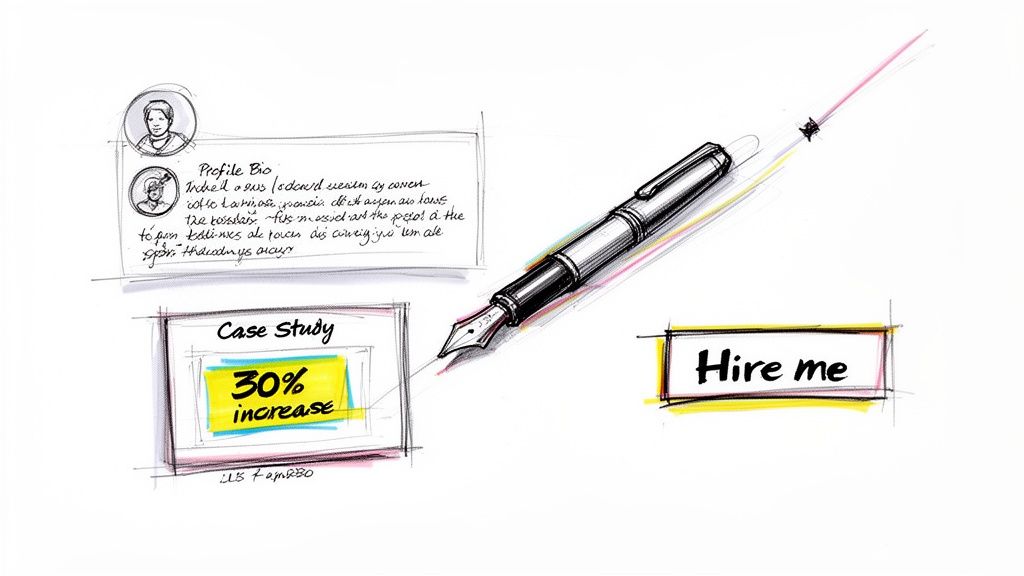
A killer design and gorgeous visuals will definitely grab someone's attention. But it's the words on the page that do the heavy lifting—convincing a potential client that you're the one to hire. Your website copy is the glue that turns a simple gallery of your work into a genuine sales tool. It's how you frame your value, build trust, and nudge visitors toward that final, crucial step.
Without strong copy, even the most beautiful design can feel empty. This is your chance to tell your story, prove you know your stuff, and make it crystal clear how you solve real-world problems for your clients.
Crafting a Bio That Builds a Real Connection
Your "About Me" page is a bigger deal than you might think. It’s often the second-most-visited page on a portfolio, right after the homepage. This isn't just a spot to dump your resume; it's where you make a human connection. People hire people, not just a list of skills.
Start with a hook that gets straight to the point: who you are and who you help. Instead of a generic "Graphic Designer," try something with more personality and focus, like, "I'm a brand identity designer who helps wellness startups build a tribe of loyal fans."
From there, tell a short story. What got you into this field? What's your professional philosophy? Sharing a bit of your personality makes you relatable and memorable. A fantastic bio is the perfect blend of professional credibility and personal authenticity.
Turning Projects Into Powerful Case Studies
The real meat of your portfolio is in the case studies. This is where you graduate from just showing the final product to demonstrating your strategic value. A potential client isn't just buying a logo; they're buying a solution to a business problem.
Think of each case study as a short story with a clear beginning, middle, and end:
The Challenge: Kick things off by clearly explaining the client's problem. Was their old website leaking potential customers? Did their branding feel stale and lost in a crowded market?
Your Solution: Briefly walk them through your process. What specific steps did you take? This is where you get to show off your unique approach and strategic thinking without getting lost in the weeds.
The Outcome: Finish strong with the results. This is the most important part. Whenever you can, use hard numbers to back up your claims.
Instead of just saying, "I redesigned their website," frame it with impact: "The e-commerce platform redesign led to a 30% spike in user engagement and a 15% lift in average order value within the first three months."
Your case studies are your proof. They are the evidence that you don't just create beautiful things—you deliver real business results. Focusing on outcomes shifts the conversation from your skills to the value you provide for your clients.
The Undeniable Power of Social Proof and Testimonials
Nothing builds trust faster than a glowing review from a happy client. Testimonials are pure social proof—they validate everything you claim about yourself and lower the risk for someone thinking about hiring you.
When you ask for a testimonial, don't just ask for a generic "review." Guide your past clients with specific questions to get better, more detailed responses. Ask them about the specific results they saw or what their favorite part of working with you was.
Once you have these gems, don't just bury them on a testimonials page. Weave them throughout your site:
Drop one on your homepage to make a strong first impression.
Place a relevant one right next to the project it's about.
Add one near your contact form to give visitors that final nudge of confidence.
Writing Calls to Action That Actually Work
Finally, every single page on your site needs a purpose. You have to tell people what to do next. These are your calls to action (CTAs). Without them, a visitor might love your work, close the tab, and forget all about you.
Your CTAs should be direct, punchy, and make sense for where they are on the page. Ditch the passive "Contact" and try something more compelling:
"Let's Build Your Brand Together"
"Schedule a Free Discovery Call"
"Get a Custom Quote for Your Project"
These small tweaks can make a huge difference in how many people actually reach out. The goal is to make it incredibly simple for an impressed visitor to take the next step. If you're building your site on a platform like Alpha, you can use the built-in, conversion-focused layouts to easily add effective CTAs and forms right where you need them.
Optimizing Your Portfolio to Attract Clients
Getting your website live is a fantastic first step, but the work isn't quite done. A stunning portfolio is useless if the right people can't find it. This is where a little bit of search engine optimization, or SEO, comes in, and trust me, it can make all the difference.
You don't need to become an SEO master overnight. For a portfolio site, nailing the fundamentals is usually more than enough to get you noticed. It all starts with putting yourself in your ideal client's shoes and thinking about what they'd type into Google to find someone just like you.
Finding and Using the Right Keywords
So, how do your clients search? Are they looking for a generic "graphic designer," or are they getting specific with something like "logo designer for tech startups"? The more targeted the search, the more likely that person is ready to hire. This is the heart of keyword research.
Your goal is to pinpoint the exact phrases that align with what you do best. Let's brainstorm a few examples to get the gears turning:
Your Service + Your Niche: "product photographer for e-commerce brands"
Your Skill + Your Location: "wedding videographer in Austin Texas"
Your Role + Industry Focus: "UX writer for SaaS companies"
Once you've zeroed in on a primary keyword for your services, weave it in naturally. It belongs in your homepage title, your main headline, and somewhere in your "About Me" section. And when you're adding projects, give them descriptive titles like "Brand Identity for a Local Coffee Shop" instead of a generic "Project 1." Little changes like this give search engines powerful clues about what your work is all about.
Optimizing Images for Speed and Visibility
As a creative professional, your portfolio is probably loaded with gorgeous, high-resolution visuals. The problem? Those large files can make your site painfully slow, which is a huge red flag for both visitors and search engines.
Image optimization isn't optional—it's essential. Before you upload a single image, run it through a free online compression tool. This will shrink the file size without totally wrecking the quality. Also, get into the habit of giving your files descriptive names. A file named ecommerce-product-photography-skincare.jpg tells a much better story to Google than IMG_9876.jpg.
Pro-Tip: Always fill out the alt text for every image. It’s just a short, simple description of the picture, but it helps search engines understand the content and is crucial for making your site accessible to visually impaired users.
Using Simple Analytics to See What's Working
So your portfolio is live and optimized—now what? How do you know if it's actually bringing in business? Analytics hold the answers. You don't need to get lost in complex dashboards; just a few key numbers will tell you the story of your site's performance.
Most modern website builders, Alpha included, offer simple, built-in analytics. Here’s what you should keep an eye on:
Traffic Sources: Where are people coming from? Google, social media, a link from another site? This shows you which marketing efforts are paying off.
Most Popular Pages: Are visitors flocking to a specific case study? If one project is a clear winner, figure out why and try to replicate that magic elsewhere.
Time on Page: Are people sticking around to read your content, or are they leaving immediately? More time on page is a great sign that your work is captivating.
Conversion Rate: This is the big one. Of all the people visiting, how many are actually filling out your contact form? This metric tells you if your site is successfully turning visitors into potential clients.
Having a strong digital presence is more important than ever, and it's fueling massive growth in the web design world. In the United States alone, web design services brought in an estimated $43.5 billion in revenue, and the global market is expected to skyrocket to $100 billion by 2031. You can dive deeper into these trends by checking out the full web design statistics.
By paying attention to these simple metrics, you can make smarter decisions to constantly improve your portfolio. Think of it as a feedback loop—a continuous process of tweaking and refining that turns a good portfolio into an incredible client-attraction machine.
Answering Your Top Portfolio Questions
Once you’ve got a strategy mapped out, a few nagging questions always seem to surface right when you’re ready to build. They’re the little details that can feel like big hurdles, but the solutions are usually pretty straightforward. Let's clear up some of the most common ones I hear from creatives and professionals.
Getting these things right is what separates a good portfolio from a great one. It’s all about making confident choices that show off your skills and experience in the best possible light, ensuring your site actually does its job: landing you ideal clients.
How Many Projects Should I Actually Include?
This is the big one, and my answer is always the same: quality over quantity. I know it's tempting to throw everything you've ever worked on in there, but your portfolio is a highlight reel, not a dusty archive.
A good rule of thumb is to aim for 5-10 of your absolute best projects. More importantly, pick the ones that are most relevant to the work you want to be doing. If you’re aiming to design for SaaS companies, then your portfolio should be packed with your best SaaS design work. Simple as that.
Think of each project as its own mini-story or case study. It needs a beginning (the client's problem), a middle (your brilliant solution), and a clear end (the successful outcome). Five killer case studies will always beat twenty mediocre examples.
This is where a platform like Alpha really shines. Its layouts are designed to make each project a star, which naturally encourages you to be selective and give your strongest work the spotlight it deserves.
Do I Really Need to Know How to Code to Build a Portfolio?
Nope. Not anymore. The days of needing to be a developer to get a professional, polished website are long gone. Modern site builders have torn down that wall, putting great design within everyone's reach.
AI-powered platforms have taken this even further. You can build a stunning, fully responsive, and high-performing portfolio without ever looking at a line of code. There’s no complex software to learn and zero technical headaches to worry about.
For example, with Alpha, you can generate a complete design draft just by plugging in the URL of a site you like. From there, you can tweak and adjust things by describing what you want in plain English. It lets you stay focused on what matters—your content and how you present it—while the AI handles all the design and technical heavy lifting.
How Do I Make My Portfolio Stand Out From Everyone Else's?
In a sea of talented people, "good" isn't good enough. You have to be memorable. The key is to shift your thinking from just showing your work to focusing on three specific things that will make a real impression.
Specialize, Specialize, Specialize: Find your niche and own it. Are you a photographer who only shoots for boutique hotels? A copywriter for fintech startups? A narrow focus instantly positions you as an expert, not just another generalist. It’s far easier to be the go-to person for one thing.
Tell a Compelling Story: Like we've been saying, don't just show the final pretty picture. Frame every project as a case study. Walk potential clients through the why behind your work—the challenge, your process, and the real-world results you delivered.
Let Your Personality Shine: Clients hire people they connect with and trust. Use your "About Me" page and even your project descriptions to let your voice come through. Share what you're passionate about. It helps clients get a feel for who you are, not just what you can do.
What's the Single Most Important Page on My Portfolio Site?
While every page has a purpose, your project and case study pages do all the heavy lifting. This is where the decision is made. A potential client might land on your homepage and be intrigued, but they are convinced to hire you by the proof they find on these pages.
This is their destination to see if you have what it takes to solve their specific problem. They’re looking for hard evidence of your skills, your thought process, and the value you bring to the table. Make sure these pages are meticulously structured, visually compelling, and scream "I get results."
Your contact page is a very, very close second. Once someone is blown away by your work, you have to make it dead simple for them to reach out. Any friction at this stage can mean a lost lead. Using a platform like Alpha gives you a head start, with built-in, conversion-focused layouts designed to make these critical pages as effective as possible right out of the box.
Ready to build a portfolio that does the selling for you? Alpha uses AI to help you create a stunning, professional website in minutes, not months. Turn your vision into a client-attracting machine today. Start building for free at https://www.alpha.page.
EXAMPLES
Build beautiful websites like these in minutes
Use Alpha to create, publish, and manage a fully functional website with ease.