



How to Create Website Mockups People Actually Love
Learn how to create website mockups that bridge the gap between idea and reality. Our guide covers tools, principles, and developer handoff.
EXAMPLES
Build beautiful websites like these in minutes
Use Alpha to create, publish, and manage a fully functional website with ease.
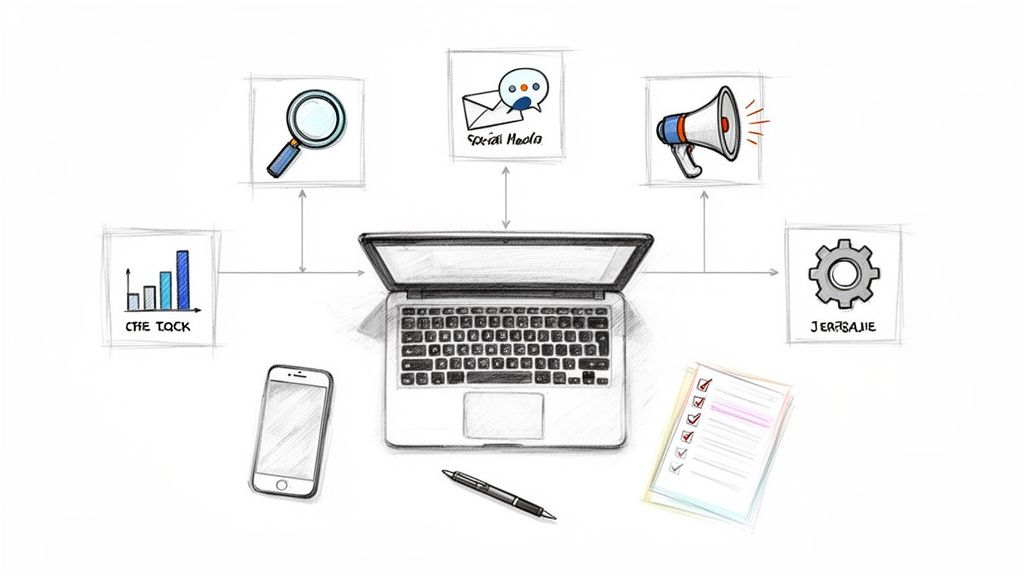
In a crowded market, standing out is no longer optional-it's essential for survival. For small businesses, the challenge is often amplified by limited budgets, small teams, and the constant pressure to find new customers. The right digital marketing strategies, however, can level the playing field, transforming your business from a local secret into a recognized market leader. This guide moves beyond generic advice to deliver 10 of the most impactful small business digital marketing tips, blending quick wins with sustainable, long-term growth plans.
Each tip is designed to be practical and actionable, showing you not just what to do, but precisely how to do it. We'll cover the entire customer journey, from building a powerful website foundation and mastering SEO to implementing analytics and nurturing customer relationships through email. A special focus will be placed on how modern tools, such as an AI website builder like Alpha, can streamline these complex processes, making professional-grade marketing accessible to everyone. To kickstart your comprehensive plan, consider incorporating broader insights from these proven small business growth strategies to complement the specific tactics we outline here.
Whether you're a startup founder launching your first venture or a seasoned entrepreneur looking to scale, these strategies provide a clear and comprehensive roadmap. Our goal is to equip you with the knowledge to attract, engage, and convert your ideal customers, creating a playbook that drives measurable results in 2026 and beyond. Let's get started.
1. Build a Mobile-First Website as Your Digital Foundation
Your website is the central hub of your online presence, and in today's digital landscape, most of your customers will find it on a smartphone. A mobile-first approach means designing your website for the smallest screen first and then scaling up to larger devices like tablets and desktops. This strategy ensures a seamless, fast, and user-friendly experience for the majority of web traffic, which is crucial since Google now prioritizes mobile-friendly sites in its search rankings.

This isn't just a technical detail; it's a core component of effective small business digital marketing tips that directly impacts your bottom line. E-commerce sites built with a mobile-first design can capture up to 52% more sales simply because they make the purchasing process easier for customers on the go. When your site is intuitive and accessible on any device, you reduce friction, build trust, and encourage conversions.
How to Implement a Mobile-First Strategy
Creating a high-performing mobile website doesn't have to be complicated. Modern AI website builders like Alpha are designed with mobile responsiveness at their core, handling the technical aspects automatically.
Actionable Micro-Checklist:
Prioritize Above-the-Fold Content: Place your most important information, like your value proposition and a clear call-to-action (CTA), at the very top of the page so mobile users see it without scrolling.
Design for Touch: Ensure all buttons and interactive elements are large enough for easy tapping. A minimum size of 44x44 pixels is a widely accepted best practice.
Simplify Navigation & Forms: Use a simple "hamburger" menu and minimize the number of fields in your contact or checkout forms to reduce user effort.
Test on Real Devices: Use your own phone and ask others to test your site. Tools like Alpha's built-in preview function also allow you to see how your site looks across various screen sizes before you publish.
By focusing on the mobile experience first, you create a solid foundation for all your other digital marketing efforts. To dive deeper into the technical and strategic aspects, you can learn more about what mobile-first design is and why it's a non-negotiable for modern businesses.
2. Master SEO Optimization to Increase Organic Visibility
Search Engine Optimization (SEO) is the art and science of improving your website's visibility in search engine results for relevant queries. Unlike paid ads, which stop delivering traffic the moment you stop paying, SEO builds a sustainable source of qualified, organic traffic. It levels the playing field, allowing small businesses to compete with larger corporations by earning trust and authority directly with search engines like Google.
This is one of the most powerful small business digital marketing tips because it connects you with customers at the exact moment they are actively looking for your products or services. A local bakery ranking on the first page for "best birthday cakes near me" captures high-intent customers for free, driving foot traffic and sales. Similarly, content-focused sites can generate over 40% of their total traffic purely from organic search by effectively targeting user needs.
How to Implement SEO Optimization
Effective SEO begins with a solid technical foundation and a focus on creating valuable content that answers your audience's questions. AI-powered platforms like Alpha simplify this process by providing built-in SEO tools that guide you through optimizing titles, descriptions, and site structure without needing to be a technical expert. A cornerstone of increasing organic visibility is mastering how to optimize content for SEO across all your digital platforms.
Actionable Micro-Checklist:
Target Long-Tail Keywords: Focus on specific, multi-word phrases (e.g., "handmade leather dog collars for large breeds") that have lower competition and higher conversion intent.
Optimize On-Page Elements: Use Alpha’s SEO settings to ensure every page has a unique, keyword-rich title tag and meta description that encourages clicks.
Build Internal Links: Connect related pages and blog posts on your site using descriptive anchor text. This helps search engines understand your site structure and distributes authority.
Monitor Your Performance: Set up a free Google Search Console account to track which keywords you rank for, identify technical issues, and monitor your site's overall health in Google's index.
3. Implement Lead Capture Forms to Build Your Email List
Your website traffic is valuable, but most visitors will leave and never return. A lead capture form is your tool to convert these anonymous visitors into tangible leads by collecting their contact information, typically an email address. This process builds a direct communication channel you own, allowing you to nurture relationships, promote offers, and drive repeat business through email marketing, which consistently delivers one of the highest returns on investment of all marketing channels.
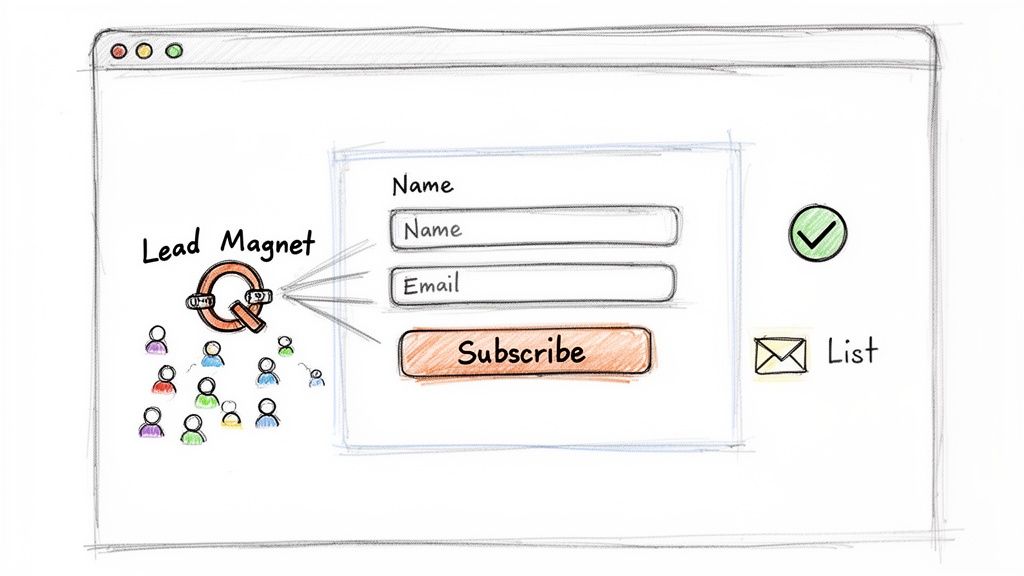
This strategy is one of the most effective small business digital marketing tips because it transforms passive website browsing into an active, consent-based relationship. Offering a valuable lead magnet, like a free guide or a discount, can drive form conversion rates above 40%. Even a simple newsletter signup form, strategically placed, can grow your email list by 20-30% monthly, giving you a powerful asset for sustainable growth.
How to Implement Lead Capture Forms
Adding effective forms to your site is straightforward with the right tools. Platforms like Alpha include built-in, customizable form blocks that you can drag and drop onto any page. These forms can be integrated directly with popular email marketing services like Mailchimp or ConvertKit, automating the entire list-building process.
Actionable Micro-Checklist:
Offer a Compelling Incentive: Give visitors a reason to subscribe. Offer a "20% off your first order" coupon or a "Download our free e-book" lead magnet.
Keep It Simple: Ask for only the essential information, usually just a name and email address. Every additional field you add will decrease your conversion rate.
Strategic Placement: Place forms where they are most visible and relevant. Consider placing them in your website’s footer, at the end of blog posts, or as an exit-intent popup to catch visitors before they leave.
Set Up a Thank You Page: After a user submits the form, redirect them to a confirmation page. This acknowledges their action and provides a great opportunity to present a next step, like following you on social media or browsing a specific product category.
4. Leverage Content Marketing and Distribution to Establish Authority and Drive Traffic
Content marketing is the practice of creating and sharing valuable, relevant, and consistent content to attract and retain a clearly defined audience. When combined with strategic distribution, it becomes a powerful engine for building brand authority, establishing trust, and driving organic traffic to your website without a massive advertising budget. This approach focuses on solving your audience's problems, not just selling your products.
This is one of the most sustainable small business digital marketing tips because it creates assets that work for you long-term. A single, high-quality blog post can attract visitors for years, while a viral social media post can generate tens of thousands of impressions overnight. For instance, many small businesses have gained over 10,000 followers and driven significant website traffic simply by consistently sharing helpful content on the right platforms.
How to Implement a Content Marketing & Distribution Strategy
An effective strategy starts with understanding what your audience needs and where they spend their time online. From there, you can create content that meets those needs and distribute it where it will have the most impact.
Actionable Micro-Checklist:
Create a Content Calendar: Plan your topics in advance, mapping each piece of content to a specific stage of the customer journey, from awareness to decision.
Write for Search Intent: Develop "pillar" pages for broad topics and "cluster" content for more specific sub-topics. This structure helps search engines understand your expertise and rank your site higher.
Choose 2-3 Core Platforms: Don't try to be everywhere. Focus your distribution efforts on the social media channels where your target audience is most active and engaged.
Repurpose Everything: Turn a single blog post into a series of social media updates, a short video, an infographic, and an email newsletter. This maximizes the value of every piece you create.
Engage with Your Community: Content distribution is a two-way street. Respond to comments and encourage sharing to amplify your reach and build relationships.
5. Optimize for Conversions with Strategic CTA Placement and Design
Your website’s call-to-action (CTA) buttons are the gateways to your business goals, whether that’s making a sale, booking a demo, or signing up for a newsletter. Optimizing their placement and design guides visitors toward these actions, turning passive browsers into active customers. This is one of the most powerful small business digital marketing tips because it increases results without needing a single extra visitor.
Small changes can yield significant results. For example, HubSpot famously increased conversions by 21% simply by changing a button color from green to red. This isn't just about aesthetics; it's about using visual cues and compelling language to eliminate hesitation and prompt immediate action. A well-designed CTA system can dramatically improve your conversion rates and directly boost your revenue.
How to Implement Strategic CTAs
Effective CTAs are a blend of psychology, design, and clear communication. With platforms like Alpha, you can easily drag, drop, and customize buttons, making A/B testing simple and accessible for any business owner.
Actionable Micro-Checklist:
Use Contrasting Colors: Ensure your CTA button stands out visually from the page background. It should be the most eye-catching element in its section.
Write Action-Oriented Copy: Instead of generic text like "Learn More," use specific, value-driven phrases like "Start Your Free Trial" or "Get Your Instant Quote."
Create Urgency: Incorporate language that encourages immediate action, such as "Claim Your Discount Today" or "Limited Spots Available," to combat user procrastination.
Strategic Placement: Place CTAs both above the fold for immediate visibility and at the end of key content sections to capture interest after you’ve provided value.
Test and Measure: Use analytics to track which button colors, text, and placements get the most clicks. Alpha’s built-in analytics can help you monitor CTA performance and make data-driven decisions.
By focusing on these details, you create a clear path for your visitors to follow. To get a comprehensive overview of how to craft the perfect prompt, you can learn more about what a call-to-action is and its crucial role in your digital strategy.
6. Build Social Proof and Trust Through Testimonials and Reviews
When potential customers are considering your product or service, they look for signals that they can trust your business. Social proof, in the form of customer testimonials and reviews, provides exactly that. It's the modern-day word-of-mouth, demonstrating that real people have used and benefited from what you offer, which significantly reduces purchase hesitation and builds credibility.
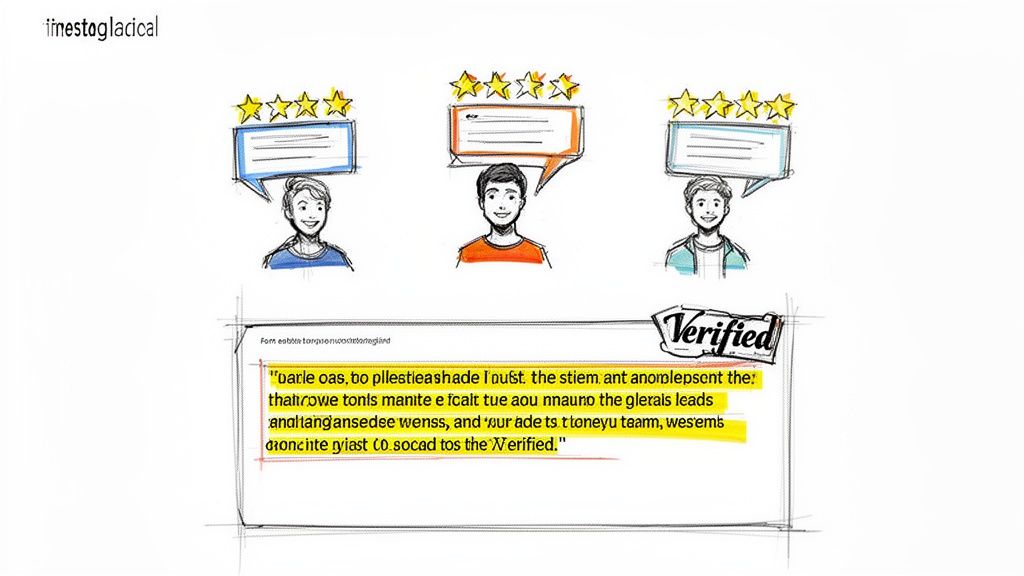
This is one of the most powerful small business digital marketing tips because it directly influences buying decisions. For instance, data shows that dedicated testimonial pages can increase conversions by 34%, and Amazon product pages with high star ratings see a dramatic boost in sales. By showcasing positive feedback, you're not just selling a product; you're selling confidence and peace of mind.
How to Implement a Social Proof Strategy
Actively collecting and displaying feedback should be a core part of your marketing workflow. You can automate requests and use website tools to feature them professionally. Website builders like Alpha often include pre-designed testimonial blocks and templates, making it easy to add this crucial element to your site.
Actionable Micro-Checklist:
Request Feedback Systematically: Send an automated email asking for a review a week after a product is delivered or a service is completed. Ask specific questions to guide detailed responses.
Feature Testimonials Prominently: Place your best reviews on your homepage, key landing pages, and product pages. Include the customer's name, photo, and company for added authenticity.
Create a Dedicated Case Study Page: For more in-depth stories, build a page that showcases detailed customer success stories. This acts as a powerful resource for prospects in the final stages of their decision-making process.
Respond to All Reviews: Engage with both positive and negative reviews on platforms like Google and Yelp. This shows you value customer feedback and are committed to service quality.
7. Create Strategic Landing Pages for Campaigns and Lead Generation
Instead of sending paid traffic or email subscribers to your homepage, a dedicated landing page acts as a focused, high-performance sales pitch. A landing page is a standalone web page created specifically for a single marketing campaign. Its sole purpose is to convert visitors into leads or customers by removing distractions like site navigation and presenting one clear, compelling call-to-action (CTA). This focus is a cornerstone of effective small business digital marketing tips that directly boosts your return on investment.
This strategy is incredibly effective because it matches the user's intent perfectly. A user who clicks an ad for a "free SEO checklist" expects to see a page about that checklist, not your company's "About Us" section. Companies that use dedicated landing pages see conversion rates soar; lead magnet campaigns can convert at 25-40%, while SaaS free trial pages often hit 20-30% conversion when properly optimized. This laser-focus minimizes friction and maximizes results.
How to Implement a Landing Page Strategy
Building a high-converting landing page is simpler than ever. AI website builders like Alpha offer conversion-focused templates, making it easy to launch a professional page quickly without needing to code. Alpha users, for example, have created landing pages for their services that convert at over 18%.
Actionable Micro-Checklist:
One Page, One Goal: Stick to a single, clear call-to-action. If the goal is an ebook download, don't also ask them to follow you on social media.
Write a Compelling Headline: Match the headline to your ad copy and clearly state the value proposition. Address a specific pain point, like "Build Your Website in 3 Hours, Not 3 Weeks."
Remove Distractions: Hide the main website navigation menu to keep the visitor focused on the offer and the conversion action.
Incorporate Trust Signals: Add testimonials, client logos, or security badges "above the fold" to build credibility instantly.
A/B Test Key Elements: Experiment with different headlines, CTA button colors, images, and copy to continuously improve your conversion rate.
8. Implement Analytics and Data-Driven Decision Making
Flying blind with your marketing is a recipe for wasted time and money. Analytics and data-driven decision-making involve tracking, measuring, and analyzing your website's performance to understand visitor behavior. This insight allows you to stop guessing and start making strategic choices based on real-world evidence, a crucial advantage when every marketing dollar counts.
This approach transforms your website from a digital brochure into a dynamic business tool. For example, by analyzing user data, you might discover that 70% of visitors abandon your site on the pricing page. This insight prompts you to test different pricing layouts or value propositions. Similarly, finding out that a specific blog category drives most of your conversions tells you exactly what kind of content to create next. This is one of the most powerful small business digital marketing tips because it directly links your actions to results.
How to Implement a Data-Driven Strategy
Getting started with analytics is simpler than it sounds, especially with modern tools. AI website builders like Alpha often integrate with analytics platforms, making setup a one-click process. The key is to focus on metrics that align with your business objectives.
Actionable Micro-Checklist:
Set Up Analytics Immediately: Install Google Analytics or a similar tool on your website from day one. This ensures you capture historical data to identify long-term trends.
Define Key Performance Indicators (KPIs): Identify what matters most to your business. This could be newsletter sign-ups, contact form submissions, or completed purchases.
Track Specific Conversions: Create custom goals in your analytics platform to track the specific actions you want users to take, such as downloading a PDF or watching a video.
Review Data Regularly: Schedule a weekly or monthly review of your analytics dashboard to spot trends, identify high-performing content, and pinpoint areas for improvement.
Use UTM Parameters: Tag your marketing campaign links with UTM parameters to precisely track which channels (e.g., social media, email) are driving the most traffic and conversions.
By systematically tracking performance, you can continuously refine your strategy and allocate your limited resources to the initiatives that demonstrably grow your business. To get a foundational understanding of this practice, you can explore what is website analytics and how it fuels smarter marketing decisions.
9. Build Email Marketing and Nurture Campaigns for Customer Retention
While acquiring new customers is important, retaining existing ones is far more cost-effective and crucial for long-term growth. Email marketing remains one of the most powerful tools for this, offering a direct line of communication to your audience. By creating automated email sequences, you can nurture relationships, guide leads toward a purchase, and turn one-time buyers into loyal advocates.
This isn't about sending random newsletters; it's a strategic digital marketing tip focused on delivering the right message at the right time. For example, a well-crafted welcome sequence can convert 20-30% of new subscribers into customers, while abandoned cart emails can recover up to 30% of potentially lost sales. These campaigns work automatically in the background, consistently generating revenue and building brand affinity.
How to Implement Email Nurture Campaigns
Getting started with email marketing is easier than ever with platforms like Mailchimp or ConvertKit. The key is to think in terms of automated workflows, or "drips," that are triggered by specific user actions.
Actionable Micro-Checklist:
Create a Welcome Sequence: Set up a 3-5 email series that new subscribers receive over 7-10 days. Use it to introduce your brand story, highlight your core value proposition, and offer an initial incentive.
Segment Your Audience: Group your contacts based on their behavior: new subscribers, first-time customers, repeat buyers, and inactive users. This allows you to send highly relevant and personalized content.
Set Up Behavioral Triggers: Automate emails based on actions. Common triggers include purchase confirmations, abandoned carts, or celebrating a customer anniversary with a special offer.
Personalize and Optimize: Use the subscriber's first name in the subject line to boost open rates. Write compelling preview text that clearly communicates the email's value before asking for a sale.
Monitor Key Metrics: Track your open rates, click-through rates, and conversion rates to understand what resonates with your audience and refine your campaigns over time.
10. Leverage Paid Advertising (PPC) to Accelerate Growth and Test Ideas
While organic strategies like SEO and content marketing are crucial for long-term growth, pay-per-click (PPC) advertising offers immediate visibility and traffic. By paying for ad placements on platforms like Google or Facebook, you can put your business directly in front of a highly targeted audience, making it one of the most powerful small business digital marketing tips for rapid growth and market validation.
This approach isn't just about driving sales; it's a powerful tool for learning. You can quickly test different messaging, offers, and landing page designs to see what resonates with your audience before investing heavily in organic content. For instance, a local service business can profitably acquire customers for $30-$100, while an e-commerce store might see a 2-5x return on ad spend (ROAS), validating their business model in real-time.
How to Implement a PPC Strategy
Success with PPC hinges on targeting the right audience with the right message and sending them to a high-converting landing page. This is where an integrated tool like Alpha becomes invaluable, allowing you to quickly build and deploy dedicated landing pages for each ad campaign without needing any code.
Actionable Micro-Checklist:
Start with High-Intent Keywords: Begin with Google Search Ads, targeting keywords that signal a user is ready to buy (e.g., "emergency plumber near me" instead of just "plumbing tips").
Create Dedicated Landing Pages: Use a tool like Alpha to build a specific landing page for each campaign. The page's headline and content should directly match your ad copy to ensure a seamless user journey.
Track Everything: Install tracking pixels like the Facebook Pixel or set up Google Analytics conversion goals. Focus on your cost per acquisition (CPA), not just clicks or impressions.
Begin with a Small Budget: You don't need a huge budget to start. Begin with $5-$10 per day to gather data, learn what works, and optimize before scaling up your spending.
Implement Retargeting: Set up campaigns to show ads to users who have previously visited your website but didn't convert. These warm leads are often the most cost-effective to win over.
10-Point Comparison: Small Business Digital Marketing Tips
Strategy | Implementation Complexity 🔄 | Resource Requirements ⚡ | Expected Outcomes 📊 | Ideal Use Cases 💡 | Key Advantages ⭐ |
|---|---|---|---|---|---|
Build a Mobile-First Website as Your Digital Foundation | 🔄 Moderate — responsive design, touch UX, device testing | ⚡ Low–Medium — templates, hosting, mobile testing tools | 📊 Higher mobile traffic, improved SEO, lower bounce, better conversions | 💡 Consumer-facing sites, e‑commerce, businesses with mobile-first audiences | ⭐ Strong mobile UX and SEO; faster market entry with automatic optimization |
Master SEO Optimization to Increase Organic Visibility | 🔄 Moderate–High — ongoing content + technical fixes | ⚡ Medium — keyword tools, analytics, content production | 📊 Sustainable traffic growth; lower CAC over time (3–6 months) | 💡 Content sites, local services, anyone needing long-term discovery | ⭐ High-quality organic visibility and credibility when sustained |
Implement Lead Capture Forms to Build Your Email List | 🔄 Low — add/configure forms, integrate with email tools | ⚡ Low — form builder, CRM/email platform, analytics | 📊 Growth of owned audience and lead generation | 💡 Early-stage businesses, e‑commerce, SaaS needing leads | ⭐ Direct lead capture and high ROI channel for nurturing prospects |
Leverage Content Marketing and Distribution to Establish Authority and Drive Traffic | 🔄 High — content creation + distribution planning | ⚡ Medium–High — writers, designers, scheduling tools | 📊 Increased organic traffic, authority, multiple conversion paths over time | 💡 Brands seeking thought leadership, long-term inbound growth | ⭐ Repurposable assets; strong long-term audience building and SEO |
Optimize for Conversions with Strategic CTA Placement and Design | 🔄 Low — design, copy, A/B testing | ⚡ Low — design editor, analytics, testing tools | 📊 Higher conversion rate from existing traffic without extra spend | 💡 Landing pages, product pages, campaign pages | ⭐ Quick wins on conversion uplift; easy to iterate and test |
Build Social Proof and Trust Through Testimonials and Reviews | 🔄 Low–Medium — collect, format, display testimonials | ⚡ Low — collection system, display widgets, moderation | 📊 Significant uplift in trust and conversions (often 20–50%) | 💡 Product pages, service providers, early-stage credibility building | ⭐ Boosts credibility and reduces purchase hesitation with authentic proof |
Create Strategic Landing Pages for Campaigns and Lead Generation | 🔄 Low–Medium — focused design for each campaign | ⚡ Low–Medium — templates, copy, analytics, forms | 📊 Much higher campaign conversion rates; clearer ROI on ads | 💡 Paid campaigns, lead magnets, event signups, product launches | ⭐ Rapid deployment and strong ad-to-page conversion performance |
Implement Analytics and Data-Driven Decision Making | 🔄 Moderate — setup tracking, define goals, interpret data | ⚡ Medium — analytics tools, dashboards, time for analysis | 📊 Clear insights on performance and optimization opportunities | 💡 All businesses aiming to optimize funnels and allocate budget | ⭐ Enables measurable improvements and evidence-based decisions |
Build Email Marketing and Nurture Campaigns for Customer Retention | 🔄 Moderate — list building, segmentation, automation | ⚡ Medium — email platform, content creation, triggers | 📊 High ROI; increased LTV and repeat purchases | 💡 Subscription businesses, e‑commerce, SaaS, retention-focused teams | ⭐ Direct owned channel with strong automation-driven revenue |
Leverage Paid Advertising (PPC) to Accelerate Growth and Test Ideas | 🔄 Moderate — campaign setup, targeting, ongoing optimization | ⚡ High — ad budget, creative production, tracking pixels | 📊 Immediate traffic and fast learning; scalable lead acquisition | 💡 New product launches, demand testing, fast customer acquisition | ⭐ Quick visibility and precise targeting; ideal for rapid experiments |
(repeat) Optimize for Conversions with Strategic CTA Placement and Design | 🔄 Low — design tweaks and testing | ⚡ Low — editor + analytics | 📊 Improves conversion rates without extra traffic | 💡 Pages with existing visitors but low conversion | ⭐ Fast, low-cost uplift via iterative optimization |
(repeat) Build Social Proof and Trust Through Testimonials and Reviews | 🔄 Low–Medium — gather and manage reviews | ⚡ Low — testimonial collection + display tools | 📊 Raises trust and conversion rates; mitigates hesitation | 💡 New brands, high‑trust purchase decisions | ⭐ Authentic credibility that amplifies other channels |
Turn Your Digital Marketing Plan Into Reality
Embarking on a digital marketing journey can feel like navigating a vast, complex landscape. This guide has broken down that landscape into ten manageable, high-impact strategies, moving from establishing your foundational website to accelerating growth with paid advertising. We've explored how a mobile-first design is no longer optional, why mastering both general and local SEO is your key to organic visibility, and how strategic content marketing builds authority and trust. Each tip, from lead capture forms and conversion-optimized CTAs to building social proof with reviews, is a critical piece of a larger puzzle.
The path to success isn't about implementing all ten of these small business digital marketing tips overnight. It's about strategic, incremental progress. The goal is to move from theory to action, transforming this comprehensive list from a set of ideas into a tangible, results-driven plan that fuels your business growth. The common thread connecting every strategy is a powerful, optimized, and conversion-focused website that serves as your central digital hub.
From Overwhelmed to Empowered: Your Actionable Roadmap
The most common hurdle for small business owners is not a lack of ambition, but a feeling of being overwhelmed. The solution is to focus on sequential, methodical implementation. Start by evaluating your current digital presence against the tips we've covered.
Your Immediate Next Steps:
Audit Your Foundation (Tips 1, 2, 5, 6): How does your website perform on mobile? Is it optimized for your core keywords? Are your calls-to-action clear and compelling? Do you prominently display customer reviews and testimonials to build immediate trust? A strong foundation makes every other marketing effort more effective.
Build Your Audience (Tips 3, 4, 9): Once your website is solid, focus on attracting and retaining an audience. Implement a simple lead capture form, start a blog to share your expertise, and set up a basic email nurture sequence. These actions turn passive visitors into an engaged community and a valuable list of potential customers.
Analyze and Accelerate (Tips 7, 8, 10): With your foundation and audience-building systems in place, it's time to scale. Use dedicated landing pages for specific campaigns, dive into your analytics to understand what’s working, and strategically invest in paid ads to reach new segments and test offers quickly.
This phased approach prevents burnout and ensures each new strategy is built upon a solid preceding layer.
The Power of a Unified Strategy
Individually, each of these tips can yield positive results. However, their true power is unlocked when they work together in a cohesive system. Your SEO efforts drive organic traffic to a blog post (Content Marketing), where a compelling CTA (Conversion Optimization) directs visitors to a strategic landing page (Lead Generation). On that page, they fill out a form (Lead Capture) and are added to your email list, where a nurture campaign (Email Marketing) builds a relationship over time.
This interconnectedness creates a flywheel effect, where momentum from one area amplifies the results in another. Mastering these small business digital marketing tips isn't just about checking boxes; it’s about creating an integrated engine for sustainable growth. By leveraging smart tools and focusing on these core pillars, you can move beyond day-to-day tactics and build a robust marketing machine that consistently delivers customers and drives revenue. The journey begins with a single, confident step forward.
Ready to build the strong digital foundation your marketing strategy deserves? Alpha provides an AI-powered platform that simplifies everything from creating a mobile-responsive design to implementing built-in SEO tools and conversion-focused templates, making it easier than ever to apply these expert tips. Start building a professional website that grows with your business today at Alpha.
EXAMPLES
Build beautiful websites like these in minutes
Use Alpha to create, publish, and manage a fully functional website with ease.