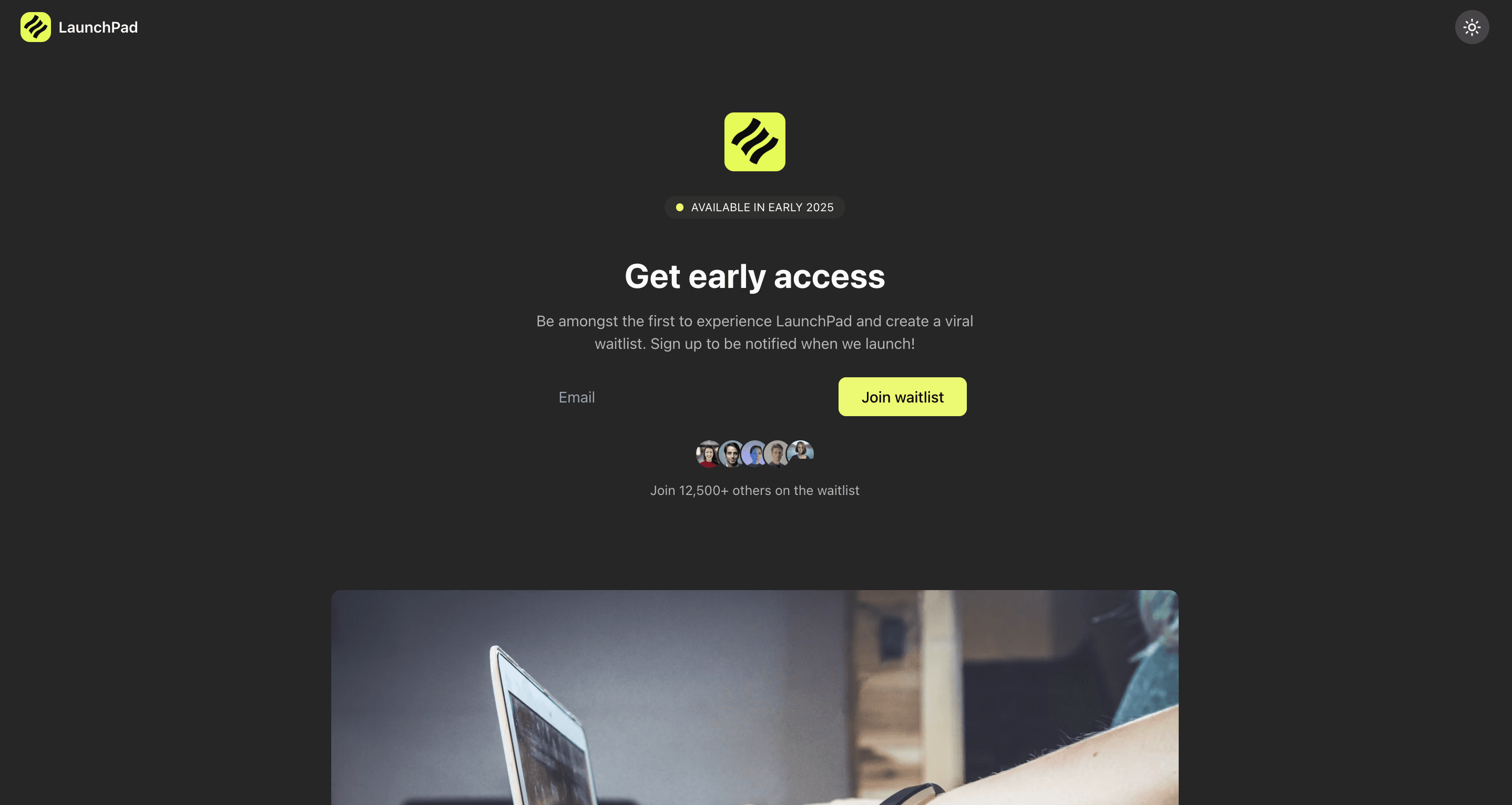
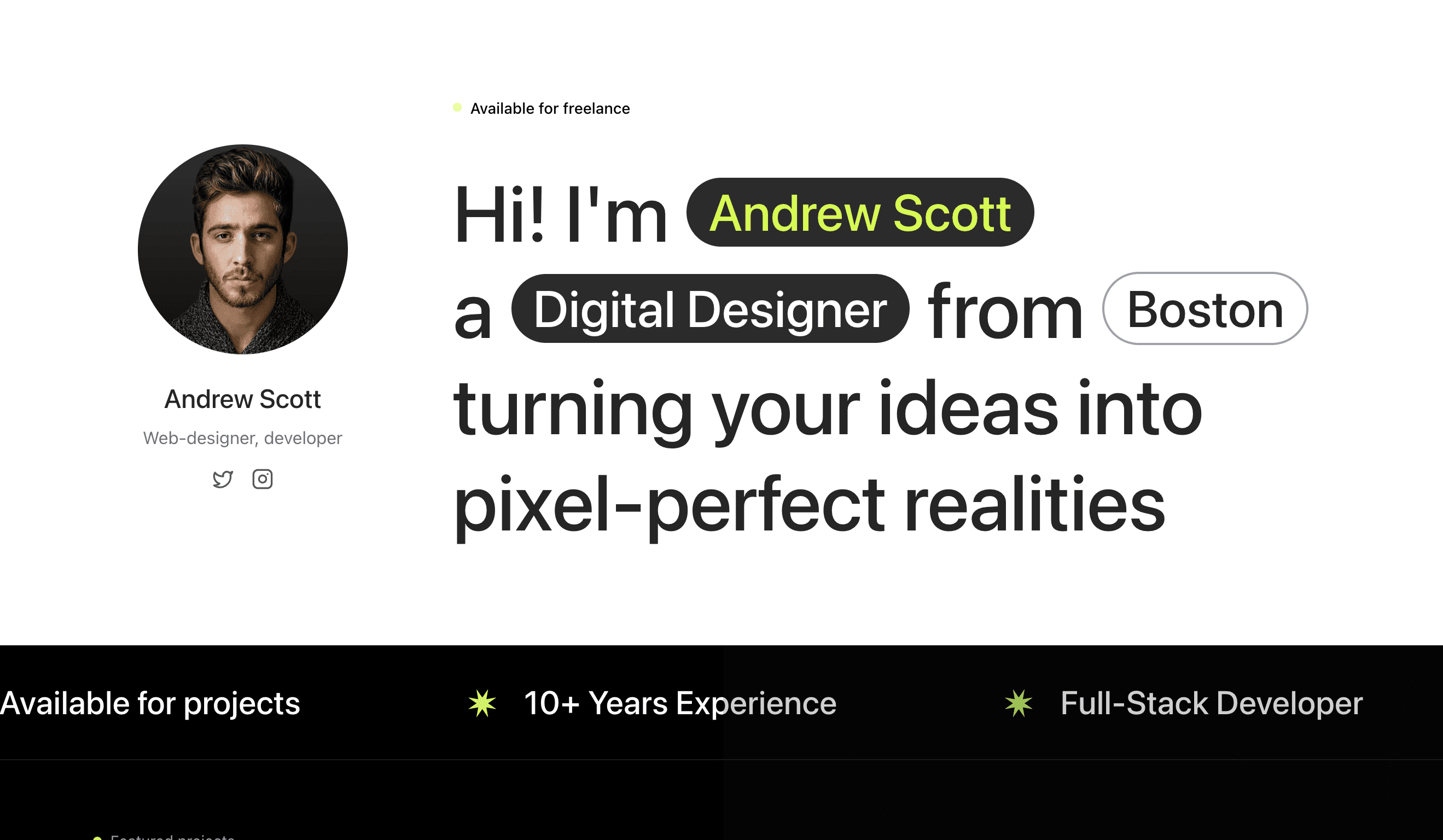


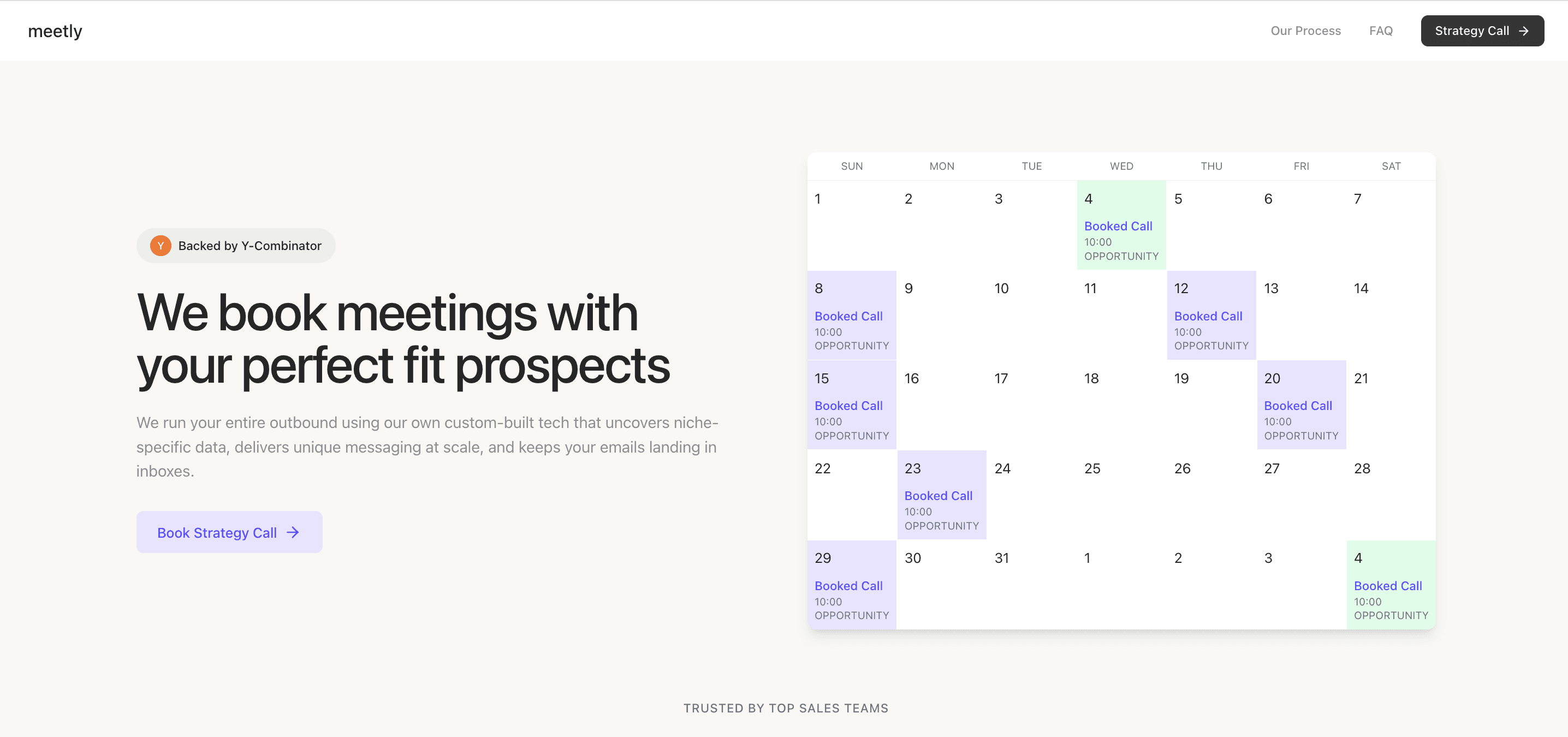
How to Create Website Mockups People Actually Love
Learn how to create website mockups that bridge the gap between idea and reality. Our guide covers tools, principles, and developer handoff.
EXAMPLES
Build beautiful websites like these in minutes
Use Alpha to create, publish, and manage a fully functional website with ease.
When we talk about search intent, we're really talking about the why behind a search. It’s not about the specific words someone types into Google, but what they’re actually trying to accomplish. Are they looking for an answer, a specific website, or are they ready to buy something?
Why Every Search Query Tells a Story
Imagine someone walking into a physical store. A good salesperson wouldn't just point to an aisle based on one word the customer says. They'd ask questions to understand what the person truly needs. "How can I help you?" is the start of a conversation, and that's exactly what Google is trying to do with every search.
This shift in focus is huge. Modern search engine optimization has evolved beyond a simple keyword-matching game. Today, it’s all about figuring out what a searcher really wants and giving it to them.
At its heart, search intent is the reason someone performs a search. It’s the user’s ultimate objective, and successfully matching your content to that objective is one of the most critical ranking factors today.
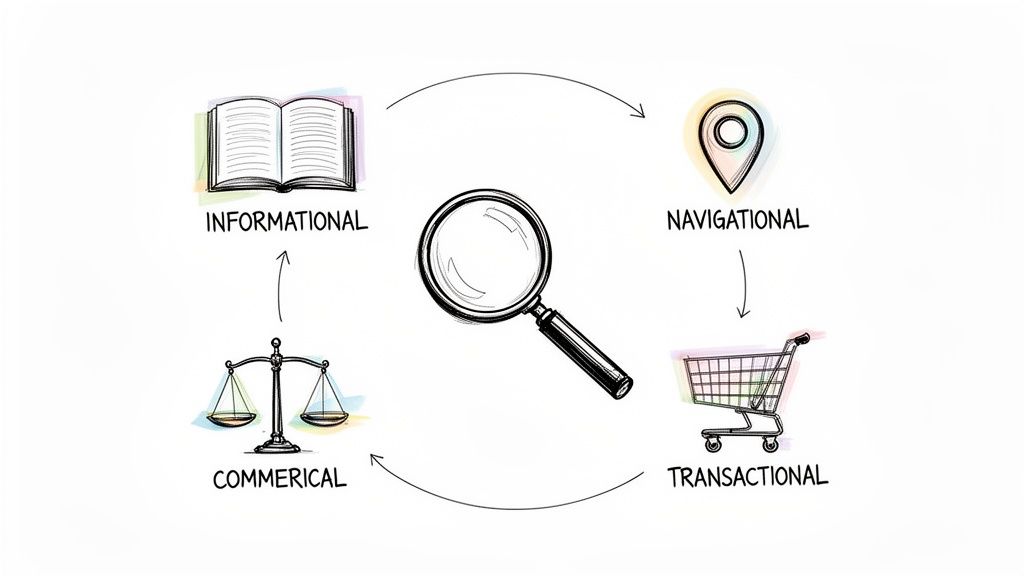
To get this right, we need to understand the different kinds of "why." We can break down almost every search into one of four main categories. Each one represents a different stage of a user's journey and tells us what kind of content they expect to see.
The Four Main Types of Search Intent
Let's break down these four primary types. Recognizing them is the first step to creating content that actually ranks.
Informational: The user is looking for information. They want to learn something, get an answer to a question, or understand a topic better. Think queries like “what is a Roth IRA” or “how to bake sourdough bread.”
Navigational: The user already knows where they want to go. They’re just using the search engine as a quick way to get there. Searches for “YouTube” or “Alpha AI login” are perfect examples of this.
Commercial: The user is thinking about making a purchase soon, but they’re still in the research and comparison phase. They're weighing their options with searches like “best AI website builders” or “Alpha vs Wix.”
Transactional: The user is ready to pull the trigger. They want to buy, sign up, or download right now. Their keywords are direct and action-oriented, such as “buy Alpha subscription” or “running shoes for sale.”
To make this even clearer, here's a quick cheat sheet that breaks down each intent type.
The Four Main Types of Search Intent at a Glance
Intent Type | User's Goal | Example Keywords |
|---|---|---|
Informational | To find information or an answer. | "how to...", "what is...", "benefits of..." |
Navigational | To go to a specific website or page. | "Facebook login", "YouTube", "Alpha AI" |
Commercial | To investigate products/services before buying. | "best...", "review", "vs", "comparison" |
Transactional | To complete a purchase or action. | "buy", "deal", "coupon", "for sale" |
Getting a handle on these different intents is what separates good content from great content. It’s the foundation for building a strategy that doesn’t just chase keywords but actually serves the needs of your audience.
The Four Core Types of Search Intent
To really get a handle on search intent, we need to look past a simple definition and dig into the core reasons people turn to Google in the first place. Think of it this way: every single search query fits into one of four main categories. Each one tells us something different about what the user wants and, in turn, what kind of content we need to create.
This model helps visualize the primary motivations driving a search, connecting the user's "why" to a specific type of intent.
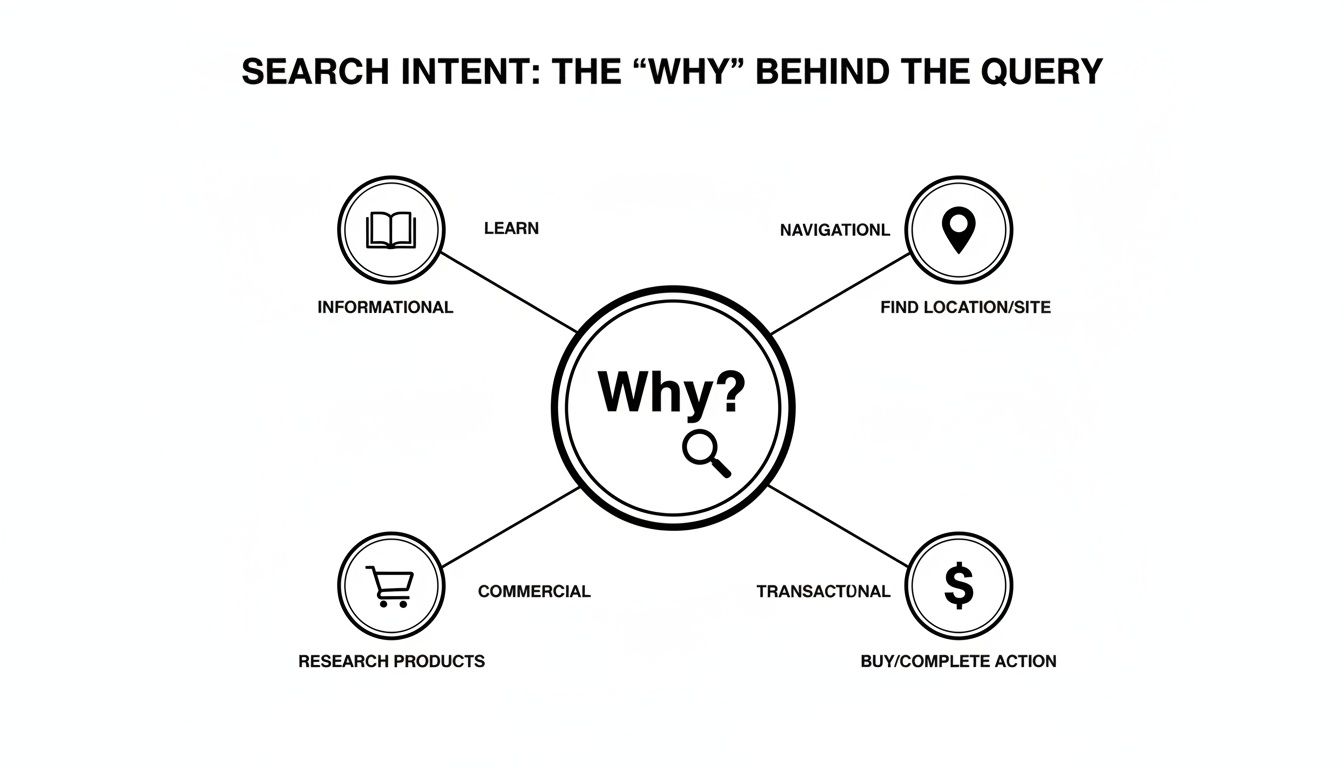
As you can see, each intent—Informational, Navigational, Commercial, and Transactional—points to a unique user goal. Understanding these is the key to creating content that Google loves to rank.
Informational Intent: The Need to Know
By far the most common reason people search is to learn something. These users are in discovery mode, looking for answers, definitions, or how-to guides. They aren't thinking about buying anything just yet; they simply want information.
Queries with informational intent often start with phrases like:
"how to..."
"what is..."
"guide to..."
"tutorial"
Someone searching "how to start a blog" wants a step-by-step guide, not a sales page for a hosting service. Check the SERP, and you’ll see the top spots are dominated by in-depth articles and tutorials. This is where you build trust and show you're an expert by providing real value, no strings attached.
Navigational Intent: The Need to Go
Sometimes, a user knows exactly where they're going and just uses Google as a shortcut. Think of it like a GPS for the internet. These are navigational queries, and they're almost always branded.
Simple examples include "Alpha AI login" or "YouTube." The searcher doesn’t want a list of video sites; they want to get to YouTube as fast as possible. If it's your brand, you absolutely have to own the #1 spot for these terms. Anything less is just a bad user experience that sends traffic somewhere else.
Commercial Intent: The Need to Compare
This is that all-important middle stage between learning and buying. Users with commercial intent are doing their homework before they pull out their wallets. They're weighing their options, digging through reviews, and looking for the best fit.
According to one deep dive into search queries, this kind of commercial investigation accounts for a hefty 17.68% of all searches.
You’ll see keyword modifiers that give this intent away, like:
"best"
"review"
"vs"
"comparison"
"alternative"
A search for "best website builders" is a clear signal the user is in evaluation mode. They expect to find round-up posts, detailed reviews, and handy comparison tables. Your job is to create content that helps them make a smart, informed decision.
Transactional Intent: The Need to Act
Finally, we have transactional intent. These users have done their research and are ready to make a move. They want to buy, sign up, or download something right now. Their queries are direct and leave no doubt about their goal.
Look for keywords like "buy," "deal," "coupon," or a specific product name like "buy Alpha subscription." The content that wins here is all about reducing friction. You need to send them straight to a product page or a clean landing page where they can finish their task in as few clicks as possible.
When you add it all up, a huge chunk of searches—30.55% transactional and 22.29% navigational—are geared toward taking action. You can see the full research about these intent breakdowns from STAT Search Analytics to get a deeper sense of the numbers.
How to Identify Search Intent Like an Expert
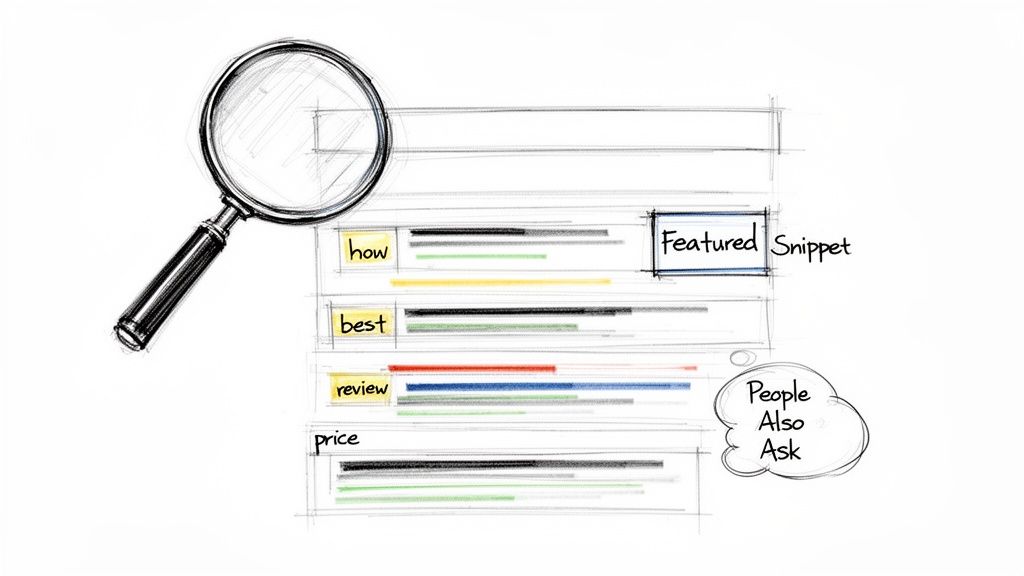
Knowing the theory is one thing, but putting it into practice is what separates the pros from the amateurs. Figuring out what a user really wants isn’t just a guessing game. It's a skill, a repeatable process of investigation that you can master.
The secret is learning to read the clues left behind by both searchers and the search engines themselves. Think of it like detective work. There are two core methods we use: analyzing the query itself and, more importantly, digging into the search engine results page (SERP). Let's walk through how to use both to get this right every time.
Uncovering Clues in the Keyword Itself
Often, the words people tack onto their main search term give their game away. These keyword modifiers are like little signposts pointing directly to their intent.
Certain words are dead giveaways for a specific kind of search:
Informational Modifiers: When you see words like "how," "what," "guide," or "tutorial," you know someone is in learning mode. They want information.
Commercial Modifiers: Terms like "best," "review," "vs," and "top" tell you the searcher is weighing their options. They're in the research phase, getting ready to make a choice.
Transactional Modifiers: Action words such as "buy," "price," "deal," and "coupon" are a clear signal that someone has their wallet out and is ready to pull the trigger.
This is a great starting point, but don't rely on it exclusively. Some keywords have no modifiers, and others can be ambiguous. That's why the next step is absolutely essential for true accuracy.
Decoding the SERP for Ultimate Clarity
If you want the most reliable answer, go straight to the source: the search results page. Google’s entire business is built on giving users exactly what they want. So, the pages it ranks at the top are its best shot at satisfying the searcher's needs.
By studying the SERP, you’re basically looking at the answer key. Perform the search yourself and ask a few simple questions about what Google shows you.
The SERP is a direct reflection of what Google’s algorithm believes will best satisfy a user’s query. The types of pages and features that dominate the results are your clearest roadmap to understanding intent.
What to Look For in the SERP
To truly master this, a comprehensive roadmap to search intent mapping can be an invaluable guide. When you analyze the SERP, keep your eyes peeled for these three key areas:
Dominant Content Types: What kind of pages are ranking? If you see a wall of blog posts and how-to guides, that's a massive clue for informational intent. If it's all product pages from e-commerce stores, you're looking at transactional intent. A mix of listicles, reviews, and comparison articles points squarely to commercial intent.
Ranking URLs: The structure of the URLs can tell you a lot. A URL with
/blog/is almost certainly informational content. On the other hand, something with/product/or/category/signals a commercial or transactional purpose.SERP Features: Google's special result features are huge hints. A Featured Snippet or a "People Also Ask" box screams informational intent. But if you see Shopping ads or product carousels, that's a clear sign of commercial and transactional intent.
By combining a quick keyword analysis with a deep dive into the SERP, you can stop guessing and start building a crystal-clear picture of what your audience is actually looking for.
Matching Your Content to User Intent
That lightbulb moment when you finally pinpoint a user's intent is great, but it’s really just the starting line. The real work—and where most SEO strategies either sink or swim—is in creating the exact piece of content that satisfies that intent. It’s not enough to know why someone is searching; you have to give them the answer they need in the format they expect.
Think of it like this: if a customer walks into a store and asks to see a specific camera, you wouldn't hand them a brochure for a different brand. The same logic applies to search. The format of your content isn't just a suggestion; it's a critical part of the user's journey.
Choosing the Right Content Format
Different intents require completely different types of content. If you get this match wrong, you’re practically begging for a high bounce rate, which tells Google your page just wasn't helpful.
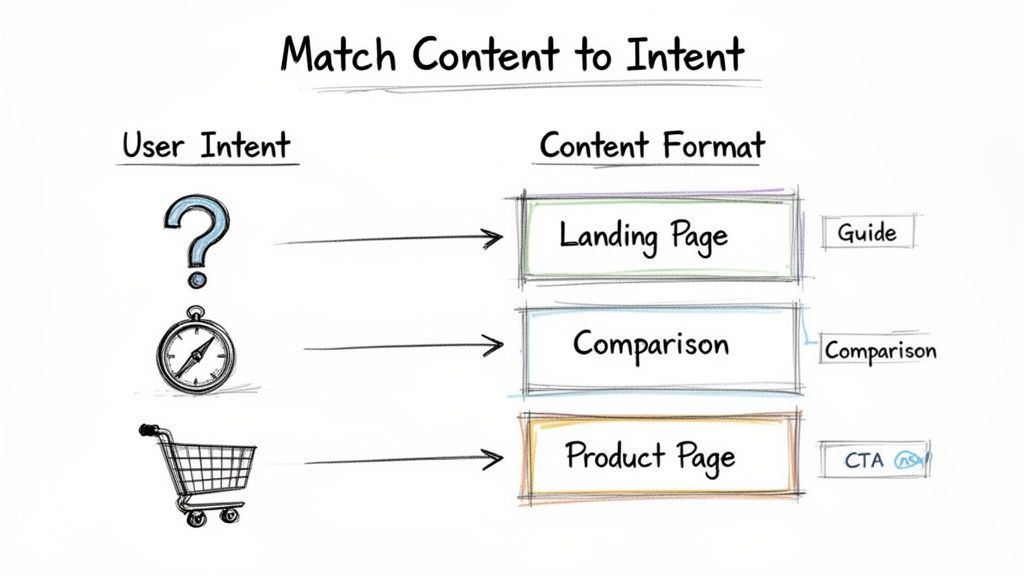
Here’s a simple way to think about matching formats to intent:
Informational Intent: These searchers are hungry for knowledge. They're looking for comprehensive guides, how-to articles, tutorials, and detailed blog posts that leave no stone unturned.
Commercial Intent: People here are in comparison mode. They need to see their options laid out clearly. Think comparison pages, in-depth reviews, "best of" listicles, and tables that break down features and pricing.
Transactional Intent: This user is ready to act. You need to make it as easy as possible with clean product pages, focused service pages, and landing pages with an impossible-to-miss call-to-action (CTA).
Getting this alignment wrong can be disastrous. Mismatched pages often see bounce rates over 70%. On the flip side, getting it right pays off big time—properly aligned content can keep users on the page 3-4 times longer, which is a massive signal of quality to Google.
Nailing the Content Angle and On-Page SEO
Beyond just the format, you have to consider the content angle. Who is this person? Are they a complete beginner who needs a simple, step-by-step explanation, or an expert looking for nuanced, technical details?
A query like "how to start a blog" is clearly for a novice. But something like "custom CSS for WordPress theme" is for someone much further along. You have to tailor your tone, language, and depth to match that user's expertise.
Once you’ve locked in your format and angle, it's time to use your on-page SEO to signal that you have the right answer.
Your on-page SEO—especially your title tag, headers, and introduction—should act as a clear signpost, telling the user immediately, "You're in the right place."
Here’s how to make sure your on-page elements are doing their job:
Title Tags and Meta Descriptions: These need to perfectly mirror the searcher's goal. For a query like "best running shoes for flat feet," your title should be a direct promise, like "The 10 Best Running Shoes for Flat Feet in 2024 (Reviewed)."
Headers (H1, H2, H3): Use your headers to build a logical flow and answer the user's primary question and any follow-up questions they might have.
Call-to-Action (CTA): Your CTA has to align with the intent. An informational article might ask users to subscribe for more tips. A transactional page needs a clear, action-oriented button like "Buy Now" or "Get Started."
When you connect your content format, angle, and on-page signals directly to the user's goal, you close the loop. This is the foundation of SEO copywriting that converts readers into customers, turning your page from just another result into the definitive answer they were looking for.
Why Search Intent Is a Modern SEO Pillar
Back in the early days of SEO, ranking felt like a simple numbers game of keyword density and backlinks. But if you’re still playing by that old rulebook, you’re already behind. The entire game has shifted from just matching keywords to deeply understanding—and satisfying—the why behind a search.
This isn’t just some minor update; it's the new foundation for any SEO strategy that actually works long-term.
The driving force behind this change is Google itself. Thanks to sophisticated AI updates, the search engine now gets language with a nuance that's almost human. It's not just spotting words on a page anymore; it’s piecing together context, relationships, and the ultimate goal of every query.
The Rise of Smarter Search Engines
Google’s mission has always been to give people the most relevant and helpful results. As search gets smarter with AI, the broader field of search marketing intelligence is becoming essential for marketers who want a full picture of user behavior. This focus on user happiness is exactly why search intent has become the core of modern SEO.
Think of the search engine as your user's advocate. If your content doesn't deliver what the searcher was looking for, Google knows it—fast. User engagement signals are basically a direct report card on how well your page did its job.
Key signals Google watches include:
Dwell Time: How long someone stays on your page before heading back to the search results. A longer stay usually means you've given them what they wanted.
Pogo-sticking: This is when a user clicks your link, immediately hits the back button, and picks another result. It’s a huge red flag that your page missed the mark.
Click-Through Rate (CTR): While not a direct ranking factor, a high CTR suggests your title and meta description are making a compelling promise to searchers.
The Real Cost of Ignoring Intent
Getting search intent wrong isn't just a missed opportunity; it’s a fast track to the bottom of the rankings. Ever since major algorithm updates started focusing on natural language, the penalty for an intent mismatch is steep. In fact, after Google’s 2019 BERT update, pages that didn't align with intent saw their rankings drop by an average of 20-30%.
Think of it this way: your content is a promise to the searcher. If your title promises a "how-to guide" but the page delivers a hard sales pitch, you've broken that promise. Google's job is to stop promoting content that lets its users down.
Ultimately, understanding what search intent is all about goes beyond a simple ranking tactic. It’s about building real authority and trust with your audience. When you put the "why" first, you stop creating content that just ranks for a little while and start building something that delivers real, lasting value.
Your Search Intent Action Plan
Knowing the theory behind search intent is one thing. Actually turning that knowledge into a repeatable process that gets results? That's a whole different ballgame. It's time to build a real plan that puts intent at the core of everything you do.
The big shift here is moving from "what are people searching for?" to the much more powerful question, "why are they searching for it?" When you nail that "why," you stop just chasing keywords and start creating content that genuinely solves problems for your audience. That's where the real, sustainable growth comes from.
A Practical Four-Step Roadmap
You don't need some overly complicated system to start using search intent. It really just comes down to a straightforward, repeatable roadmap you can apply to any piece of content, new or old.
Here are the four steps I follow to make sure every page I create is perfectly tuned to what the user actually wants.
1. Audit Your Existing Content
First things first, look at what you’ve already built. Go through your top pages and ask yourself a blunt question: does the content I have here really match what someone is looking for when they type in its main keyword?
You’ll often find some quick wins. Maybe an informational blog post is accidentally ranking for a commercial term, or a product page is showing up for a "how-to" query. These are goldmines for optimization.
2. Analyze Keywords and SERPs for New Content
Before you even think about writing, you have to play detective. Start with the keyword itself—what modifiers are people using? Words like "best," "vs," or "how to" are massive clues.
Then, dive headfirst into the SERP for that keyword. What's already ranking on page one? Are they blog posts? Product pages? Comparison tables? Pay close attention to the SERP features Google is showing, too. If you see a ton of "People Also Ask" boxes or shopping ads, that tells you a lot about what Google thinks searchers want.
3. Map Intent to Content Types
This step is about creating a clear blueprint. For every keyword you decide to target, assign it one of the main intent types. Once you know the intent, you can map it directly to a specific content format. This makes sure you're building the right kind of asset from the very beginning.
Informational → This calls for an in-depth blog post, a how-to guide, or a step-by-step tutorial.
Commercial → Think comparison pages, detailed product reviews, or a classic "best of" list.
Transactional → This is where your product or service pages live. A free trial landing page also fits perfectly here.
Navigational → These are your core pages, like the homepage, a login portal, or your about us page.
4. Create and Optimize with Intent in Mind
With your blueprint ready, it's time to build. Create content that gets straight to the point and answers the user's core question. Your title tag, H1, and introduction should all act as big, friendly signposts confirming to the visitor, "Yep, you're in the right place."
From the angle you take to the call-to-action at the very end, every single element on the page needs to serve that initial intent. This concept is fundamental when you're learning how to create a content strategy that actually works.
When you make this four-step process a habit, you create a powerful feedback loop. You'll find yourself creating content that doesn't just rank higher—it truly connects with your audience, building trust and getting them to take action.
EXAMPLES
Build beautiful websites like these in minutes
Use Alpha to create, publish, and manage a fully functional website with ease.