





How to Create Website Mockups People Actually Love
Learn how to create website mockups that bridge the gap between idea and reality. Our guide covers tools, principles, and developer handoff.

EXAMPLES
Build beautiful websites like these in minutes
Use Alpha to create, publish, and manage a fully functional website with ease.
Ever wonder how some websites seem to magically appear at the top of Google and convince you to buy something? That’s not magic; it’s SEO copywriting.
Think of it as a specialized skill: part art, part science. It’s about crafting content that speaks two languages fluently. First, it speaks the language of search engines, telling Google exactly what your page is about so you rank high. Second, it speaks the language of your audience, persuading them to click, subscribe, or purchase.
This is the bridge between getting eyeballs on your site and actually making a sale.
Blending Art and Science for Search and Sales
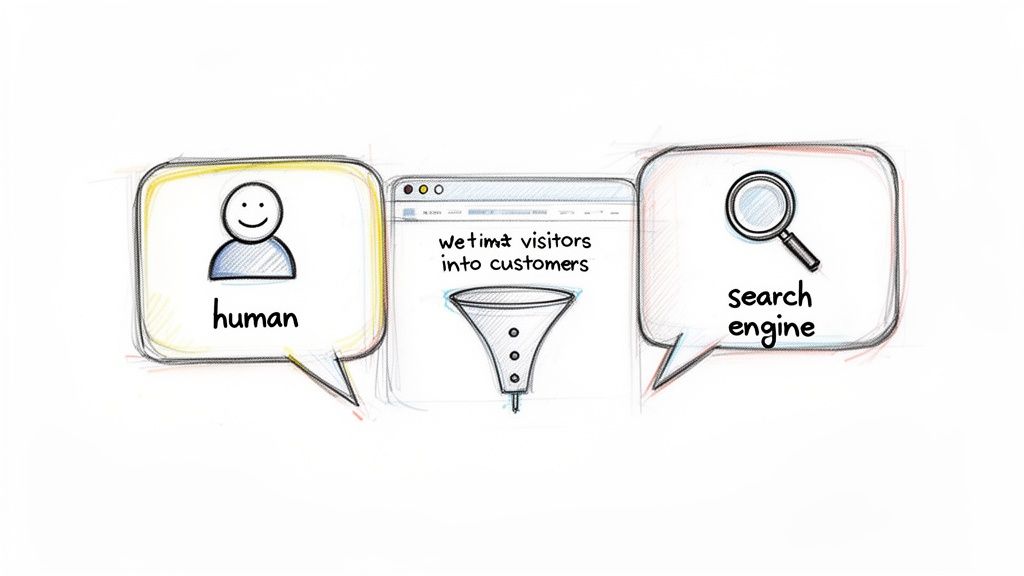
It’s a common mistake to treat search engine optimization (SEO) and copywriting as two separate jobs. Many see SEO as the technical, behind-the-scenes work—all about keywords, site speed, and algorithms. Copywriting, then, is the creative part—the clever headlines, the compelling stories, and the brand's unique voice.
But here’s the thing: they don't work well in isolation. SEO copywriting is the powerful fusion of both. It’s built on the understanding that traffic without conversions is just a vanity metric, and brilliant copy that no one ever finds is a complete waste of effort. To turn clicks into actual customers, you need both.
How SEO Copywriting Unites Different Goals
So, how does this all fit together? Let's break down the individual roles to see where SEO copywriting really shines. SEO is all about getting seen, copywriting is all about persuasion, and SEO copywriting is about doing both at the same time.
Here’s a simple table to see the difference at a glance:
Discipline | Primary Goal | Key Focus Areas |
|---|---|---|
SEO | Increase visibility on search engines | Keyword research, technical optimization, backlinks |
Copywriting | Persuade readers to take action | Emotional triggers, brand voice, calls-to-action |
SEO Copywriting | Attract and convert the right audience | Blending keywords with persuasive prose, satisfying user intent, on-page optimization, and driving conversions |
This powerful combination is exactly why the demand for this skill has skyrocketed. The global SEO copywriting market is on track to hit $12.1 billion by 2033, with a projected annual growth rate of 14.90% between 2025 and 2033. Businesses are realizing just how critical it is for everything from blog posts to product descriptions.
The Big Idea: Effective SEO copywriting ensures your content doesn't just get found; it gets results. It's about answering a searcher's query so compellingly that they become a customer.
Ultimately, learning this skill shifts your mindset from just "creating content" to building a strategic business asset. While you need to know the basics of optimization, the real focus is always on the person reading your words. If you're new to the technical side, our guide on what is search engine optimization is a great place to build your foundation.
The Core Pillars of Effective SEO Copywriting
To really get what SEO copywriting is all about, you have to break it down into its core components. It’s a lot like building a house. You can't just throw up some walls and hope for the best; you need a solid foundation, a sturdy frame, a practical layout, and a design that makes people want to come inside.
In the same way, great SEO copy stands on four essential pillars. Each one works with the others to pull in search engines and win over actual human readers. If you neglect one, the whole structure gets wobbly. An beautifully written article without keyword research is invisible, and a keyword-stuffed page that’s a nightmare to navigate will never make a sale. Nailing these four areas is how you create content that works.
Pillar 1: Keyword Research and Search Intent
Before you even think about writing, you have to know what your audience is searching for. This is the absolute foundation of everything else. Keyword research is simply the process of finding the exact words and phrases people are typing into Google when they need something you can provide.
But it’s not just about chasing popular terms. You have to dig a layer deeper to understand search intent—the why behind the search. Is the person looking for information? Are they comparing their options? Or are they ready to pull out their credit card right now?
Matching your content to that intent is non-negotiable. Someone searching "how to start a blog" is looking for a guide, not a hard sell for a website builder. Get this right, and you'll attract people who find your content genuinely helpful. If you want to dive deeper, we have a complete guide on how to add keywords to a website.
Pillar 2: High-Quality Content Creation
Okay, so you know what people are looking for. Now you have to deliver the goods. The second pillar is all about creating outstanding content that actually solves their problem or answers their question. We're not just talking about good grammar here; we're talking about delivering real, tangible value. The goal is to make your content the single best, most complete answer out there for that specific query.
This means your writing needs to be:
Comprehensive: Don't just scratch the surface. Cover the topic from all angles and anticipate the follow-up questions your reader will have.
Clear and Engaging: Use short paragraphs, straightforward language, and a tone that keeps people reading. No one wants to read a textbook.
Trustworthy: Build credibility by backing up your points with data, real-world examples, or expert insights.
This commitment to quality sends a powerful signal to both your readers and the search engines that your site is a reliable source of information.
Pillar 3: Strategic On-Page SEO
Think of on-page SEO as the structural frame of your house. It’s all the technical stuff you do on the page itself to show search engines exactly what your content is about. You’re essentially putting up signposts for Google's crawlers so they can easily understand, categorize, and rank your page.
Key Takeaway: On-page SEO isn't about gaming the system. It's about giving search engines a clear roadmap to your content so they can confidently show it to the right people.
This pillar covers optimizing elements like:
Title Tags and Meta Descriptions: This is your page's billboard in the search results. Make it count.
Headings (H1, H2, H3): These break up your content into a logical structure that’s easy for both people and bots to scan.
Internal Linking: This is how you connect related pages on your website, creating a web of context and authority.
Pillar 4: A Flawless User Experience
The final pillar is user experience (UX). This is the interior design of your house—how it feels to be inside. If a visitor lands on your page and is hit with slow loading times, confusing menus, or a giant wall of text, they’re gone. That quick exit, or "bounce," tells Google your page wasn't a good match for their search, which can hurt your rankings over time.
A great user experience makes people want to stick around. It encourages them to read, click, and maybe even buy something. This is a huge deal, especially when you consider that organic search drives 53.3% of all website traffic. You can read more about it in these SEO copywriting market insights. By making your content easy to read and fully functional on mobile devices, you give your masterpiece the best possible chance to do its job.
Your Step-by-Step SEO Copywriting Framework
Alright, let's move from theory to action. This is where the magic really happens. A solid SEO copywriting framework isn't about following a rigid checklist; it's a flexible, repeatable process that takes you from a blank page to a powerful piece of content that actually works. Think of it as your roadmap for hitting all the right notes for both Google and your future customers.
To make this real, let's walk through an example. We'll pretend we're creating a service page for a local business: "eco-friendly house cleaning in Brooklyn."
Stage 1: Start with Keyword Research
Before you even think about writing a headline, you need to get inside your customer's head. What words are they typing into Google? This all starts with finding your primary keyword, which is the main phrase you want this page to own. For our example, that's clearly "eco-friendly house cleaning Brooklyn."
But don't just stop there. That's beginner stuff. The real pros dig deeper to find all the related terms and questions people are asking.
LSI Keywords: These are just related, context-setting terms. Think "non-toxic cleaning services," "green maid service," or "organic home cleaning." They show Google you're covering the topic comprehensively.
Question Keywords: This is where the gold is. You find out exactly what's on your customer's mind. Things like "how much does green cleaning cost" or "what products do eco-friendly cleaners use."
Finding these terms is like getting a treasure map of your audience's needs. It gives you everything you need to build a page that's genuinely helpful, not just stuffed with keywords.
Stage 2: Outline for Clarity and SEO
Now that you have your list of keywords, it's time to build the skeleton of your page. A good outline is your best friend—it ensures your content flows logically for a human reader while also making it easy for search engine crawlers to understand what's important.
Your outline is where you'll map out your headings and subheadings (your H1, H2s, H3s, etc.). This is your chance to strategically place your keywords where they'll have the most impact without sounding clunky or forced.
Pro Tip: Here’s a great litmus test. Read only your subheadings out loud. Do they tell a coherent story? If you can get the gist of the entire page just by scanning the headings, you've nailed the structure.
For our Brooklyn cleaning service, a simple outline might look something like this:
H1: The Best Eco-Friendly House Cleaning in Brooklyn
H2: Our Non-Toxic Cleaning Services for a Healthier Home
H2: What's Included in Our Green Cleaning Packages?
H2: Why Choose Our Organic Home Cleaning?
H2: Frequently Asked Questions About Eco-Friendly Cleaning
This structure creates a clear path for the reader and sends strong signals to Google about the page's main topics.
The whole process, from the research we just did to getting the final piece in front of a user, follows a logical flow.
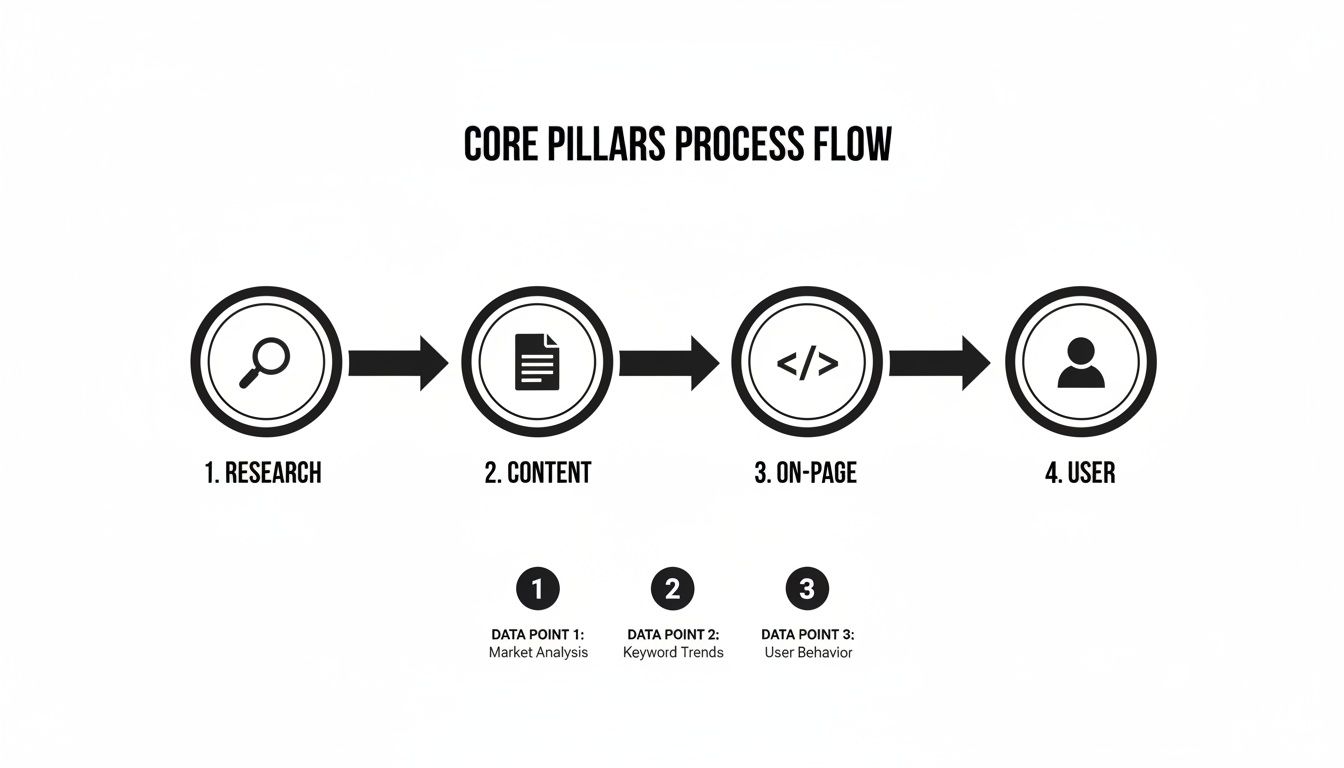
As you can see, each step builds on the last. Solid research leads to great content, which is then optimized and ultimately designed to connect with the user.
Stage 3: Write Compelling and Optimized Copy
Finally, it's time to write. Your main goal here is to weave your keywords into the copy so naturally that nobody would ever guess you did it on purpose.
Start with an intro that grabs your reader right away. Hit their main pain point head-on. For our cleaning service, you might open with a line acknowledging how hard it is to find cleaners who use products that are safe for kids and pets.
From there, just flesh out each section of your outline. Focus on delivering real value and answering all those questions you uncovered during your research phase.
And don't forget the grand finale: every piece of SEO copy needs a clear and compelling call-to-action (CTA). Tell people exactly what you want them to do next. Is it "Get a Free Quote," "Book Your Cleaning Now," or "See Our Pricing"? A powerful CTA is what turns a curious reader into a paying customer.
How AI Is Reshaping the Rules of SEO Copywriting
Artificial intelligence has completely turned content creation upside down, but probably not in the way you think. The explosion of AI tools hasn't made real, human-driven SEO copywriting obsolete—in fact, it's made it more valuable than ever.
Think of AI as a powerful co-pilot, not a replacement for the writer. It's brilliant at the grunt work: brainstorming topics, hammering out a structure, and doing the initial keyword research. This frees you up to focus on the things that AI, frankly, just can't do.
The New Divide: Human vs. Machine
AI can spit out text, but it can't build trust. It has no genuine empathy to connect with a customer’s real-world problems and lacks the strategic insight to craft a unique brand voice that actually resonates with people. It’s a fantastic tool for getting things done faster, but it’s a terrible substitute for genuine human connection and persuasion.
As AI keeps evolving, understanding the impact of Large Language Models is becoming mission-critical. These are the engines powering the tools we use every day, and knowing what they can—and can't—do is the key to using them wisely.
The content world is quickly splitting into two camps:
AI-Generated Noise: This is the fast, cheap, and often generic stuff that’s clogging up search results with forgettable, surface-level information.
Human-Crafted Value: This is strategic, empathetic, and persuasive copy that builds authority, solves actual problems, and ultimately drives sales.
In this new environment, your ability to write with clarity, personality, and persuasive flair is the ultimate competitive advantage. It's what separates winning content from the endless stream of AI-generated noise.
Why Human Copywriting Is the New Superpower
The flood of low-quality AI content is forcing both search engines and human readers to reward authenticity. Some analysts are even predicting that by 2026, copywriting will become the 'new superpower' in SEO, precisely because AI is clearing out so much of the low-effort informational junk.
The game is shifting from just getting traffic to actually being persuasive. The top-ranking, human-crafted pages are already reaping the rewards, earning 27.6% of all clicks. You can discover more insights about this trend on Search Engine Land.
This means your job is to use AI to handle the tedious tasks so you can pour your creative energy into what really matters. Let AI organize your research while you find the perfect story to make a point. Let it structure an outline while you craft a headline that stops the scroll and a call-to-action that seals the deal. That’s how you win.
Putting Your SEO Copywriting Into Action
All the brilliant SEO copywriting in the world won't do you any good if it's stuck on a website that's not built to perform. I like to think of it this way: your website is the stage, and your copy is the main act. A wobbly, poorly lit stage will tank even the most incredible performance. Your site is the technical foundation that lets your content do its job—attracting, engaging, and converting visitors.
This is where having the right tools in your corner makes all the difference. Modern platforms like Alpha give you an SEO-ready foundation right out of the gate, clearing away the technical hurdles that trip up so many entrepreneurs. You get layouts designed for conversions and a structure that search engines can easily understand, letting you focus on your message instead of the mechanics.

Bridging Content and Conversions
Getting your perfectly crafted SEO copy live on your site shouldn't feel like you need a degree in computer science. An AI-powered builder lets you publish optimized content quickly, turning your website into a genuine growth engine. This is especially true when it comes to mobile optimization, which is no longer a "nice-to-have" for ranking—it's a must.
Instead of fighting with code or clunky editors, you can pour that energy into writing compelling stories that connect with your audience. The right platform handles the technical SEO heavy lifting behind the scenes, making sure all your hard work actually gets seen. That synergy, the sweet spot between powerful copy and a solid technical base, is where the magic happens.
The goal is to make publishing optimized content as simple as possible. When the platform supports your SEO efforts, you can move faster, test ideas, and see returns on your copywriting investment sooner.
Maximizing Your Efforts with the Right Tools
The impact here is real and measurable. For instance, when you combine strong SEO copywriting with a pre-optimized site built by an AI-powered tool, you can see a visitor conversion rate of around 2.4%. To put that in perspective, it's nearly double the 1.3% average for paid PPC ads. It's a clear sign that great organic content on a high-performing site delivers a much better return.
To take it even further, exploring the best AI SEO tools can give your strategy an immediate boost. These tools are fantastic for digging deeper into keyword research, seeing what your competitors are up to, and refining your content with data-backed insights. When you combine great writing with a smart platform and the right tools, you’re not just writing content—you’re building an unstoppable growth machine.
Common SEO Copywriting Questions Answered
When you're first getting your hands dirty with SEO copywriting, a lot of questions pop up. As an entrepreneur, you don't have time for fluff—you need straight answers so you can start putting these ideas to work. Let's clear up some of the most common points of confusion.
We'll tackle the big questions first and then drill down into the nitty-gritty details you can use on your site right away.
How Is SEO Copywriting Different from Regular Copywriting?
The biggest difference comes down to who you're writing for. Traditional copywriting has one audience: a person. Its entire job is to connect with that person, make them feel something, and nudge them toward an action, like buying your product.
SEO copywriting has to do all that, but for two audiences at once: people and search engines. It means you’re still writing compelling, persuasive copy, but you're also strategically weaving in keywords and structuring the content so Google can easily understand what your page is about. Great SEO copy finds that perfect balance where it’s discoverable by machines but still feels like it was written for a human.
What Does Keyword Density Mean Anymore?
Not much, honestly. Back in the day, SEOs were obsessed with keyword density—the exact percentage of times a keyword showed up on a page. Today, that’s an outdated and frankly, risky, strategy. Google's algorithms are now sophisticated enough to understand topics, context, and synonyms.
The Modern Approach: Forget about hitting a specific keyword percentage. Instead, focus on creating the single best, most thorough resource on the topic. When you do that, you'll naturally use your main keyword and a whole host of related terms. A genuinely helpful article will always beat one that’s been artificially stuffed with keywords.
Your real goal is to satisfy the user's reason for searching. Nail that, and the keywords will take care of themselves.
Can I Still Maintain My Brand Voice?
You absolutely should. In a sea of generic, AI-generated content, your unique brand voice is your most powerful asset. It’s what makes you memorable and builds a real connection with your audience.
The trick is to learn how to integrate keywords into your natural writing style, not the other way around. SEO should amplify your brand, not overwrite it. Never sacrifice your authentic tone just to cram in another keyword. People connect with personality, and the longer they stay on your page because they enjoy your writing, the better a signal that sends to Google.
How Long Should My Content Be?
There’s no single magic number, but the general trend is that longer, more in-depth content tends to rank better for competitive search terms. Many studies point to top-ranking pages often having over 1,500 words.
But here's the golden rule: your content should be as long as it needs to be to completely answer the user's question, and not a word longer.
For a simple question: A quick, 500-word post might be perfect.
For a complex "how-to" guide: A 3,000-word deep-dive might be what it takes to cover every angle.
Always prioritize value over volume. Your mission is to create the most helpful resource out there on that specific topic.
How Soon Will I See Results?
This is the tough one. SEO is a marathon, not a sprint. While you might see some minor ranking shifts in a few weeks, don't expect transformative results overnight.
The good news? The payoff is huge. Content marketing powered by smart SEO copywriting generates 3 times more leads per dollar spent than old-school advertising. Still, patience is a virtue—it's common for 62% of companies to see a real jump in organic traffic after about 6 to 12 months. You can discover more insights about these marketing findings to see the long-term impact.
Things like how competitive your industry is and your website's current authority play a big role in the timeline. To give your content the best possible start, make sure you're also crafting killer title tags and meta descriptions. Our guide on how to write meta descriptions for SEO has you covered.
Ready to put your powerful SEO copy on a website built to convert? Alpha uses AI to create stunning, SEO-optimized websites in hours, not weeks. Turn your content into a true growth engine. Get started with Alpha today.
EXAMPLES
Build beautiful websites like these in minutes
Use Alpha to create, publish, and manage a fully functional website with ease.