


How to Create Website Mockups People Actually Love
Learn how to create website mockups that bridge the gap between idea and reality. Our guide covers tools, principles, and developer handoff.
Build beautiful websites like these in minutes
Use Alpha to create, publish, and manage a fully functional website with ease.
A proper content strategy is your blueprint for turning random content ideas into a predictable growth engine. It’s about more than just writing—it's about defining your audience, setting clear business goals, auditing what you already have, digging into SEO research, building a practical editorial calendar, and, finally, creating a solid system for distribution and measurement.
Why Your Content Needs a Real Strategy
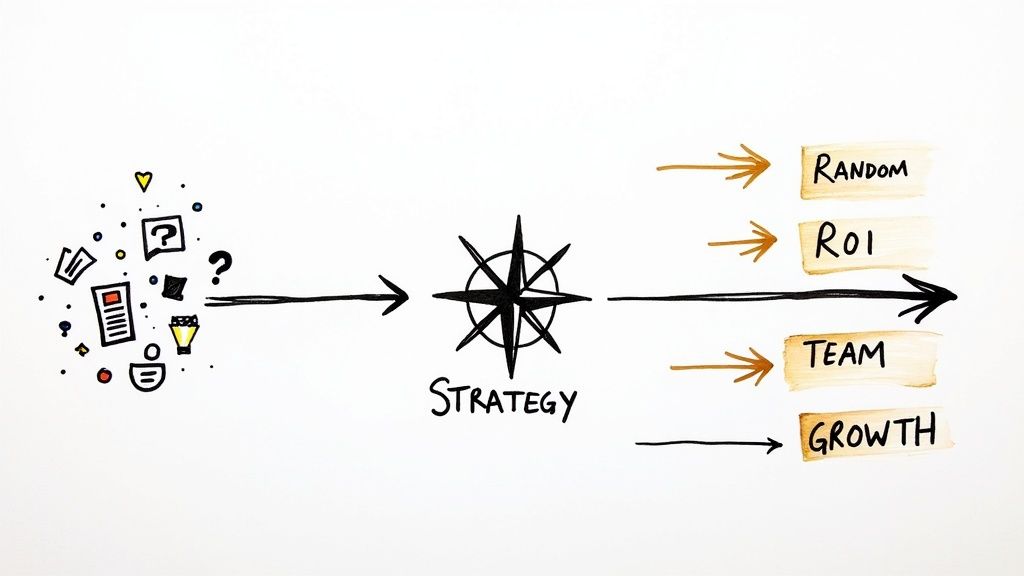
We've all heard "content is king," but honestly, that's old news. Creating content without a plan is like driving in a new city without a map—you're moving, sure, but you probably won't end up anywhere useful.
Those random acts of content—the blog post you rushed out last Tuesday, the impulsive social media update—might get a quick spike in likes, but they don't build real, sustainable momentum. That's a reactive, inefficient way to work, and it's impossible to scale. A documented content strategy is what turns that chaos into a reliable machine for growth. It’s the difference between hoping for results and engineering them.
From Random Acts to Measurable ROI
When you know how to build an effective content strategy, you’re actually creating a system that gets your entire team on the same page. Your writers, designers, and social media managers all understand the "why" behind every single piece of content. This kind of alignment stops people from wasting time and ensures every asset you create has a clear business purpose.
A solid plan also makes it much easier to justify your marketing spend. Instead of pointing to fuzzy metrics like "engagement," you can directly connect content performance to actual business goals, like leads generated or sales closed.
A documented strategy is a roadmap. It guides you from where you are to where you want to be by answering the big questions: what topics should we own, what formats will resonate, and which channels will give us the best return?
This structured approach is what allows you to produce high-quality work over and over again, which is how you build real authority in your space. It’s not just about what you create; it’s about how that creation fits into your larger business story. To really get a handle on the value here, it helps to see how content marketing drives results for different kinds of businesses, which is covered well in this breakdown on the importance of content marketing for agencies.
Ultimately, a strategy gives every piece of content a job. This guide will walk you through the core pillars of a plan that works:
Audience and Goals: First, we'll nail down who you’re talking to and what you need to achieve.
Content and SEO Framework: Then, we’ll audit your existing assets and map keywords to what your audience is actually searching for.
Execution Plan: Next, you'll build practical workflows and an editorial calendar you can stick to.
Distribution and Measurement: Finally, we’ll make sure your content reaches the right people and show you how to track what truly matters.
Know Your Audience, Know Your Goals
Every great content strategy starts with two fundamental questions: Who are you talking to, and what do you want to achieve? If you can’t answer those with absolute clarity, you’re just creating content in a vacuum and hoping for the best. It’s time to ditch the guesswork and build a foundation on solid data and real purpose.
This first step is everything. It will shape every single decision you make down the line, from the topics you cover to the channels you post on. When you truly get who your audience is, making content they actually want to consume becomes second nature.
Go Deeper Than Demographics
Basic info like age and location is a starting point, but it barely scratches the surface. To create content that genuinely connects, you need to understand the psychographics—the why behind their actions.
Dig into their:
Pain Points: What are the frustrating, persistent problems they're trying to solve?
Motivations: What are their biggest dreams, goals, and ambitions?
Consumption Habits: Where do they spend their time online? Do they binge-watch YouTube tutorials, listen to podcasts on their commute, or read long-form articles?
Buying Triggers: What information makes them feel confident enough to pull out their credit card?
The best way I’ve found to pull all this together is by creating user personas. These aren’t just dry profiles; they're detailed, semi-fictional characters based on your research that feel like real people. Give them a name, a job, and a story.
Here’s a fantastic user persona template that helps visualize these key traits.
A visual layout like this forces you to think about the human being behind the data points. You stop thinking about abstract concepts and start creating for a person with real needs.
Tie Your Content to Measurable Business Goals
Okay, you know who you're talking to. Now, what do you want them to do? Vague goals like “get more traffic” aren’t a strategy; they’re a wish list. Your goals need to be specific, measurable, and directly linked to growing your business.
For example, instead of "more traffic," a much stronger goal is: "Increase marketing qualified leads (MQLs) from our blog by 20% over the next six months."
See the difference? This target gives every piece of content a clear job. You can now filter your ideas by asking, "Will this post help us attract and convert the right kind of leads?" If the answer is no, it doesn’t belong in your strategy.
Think of your business goals as a filter for all your content ideas. They ensure every article, video, or post is a deliberate move toward a tangible result—not just another piece of content to fill a slot on your calendar.
Getting this right is more critical than ever. The global content marketing market is expected to balloon from $413.2 billion in 2022 to an incredible $2 trillion by 2032. That explosion in spending means competition is fierce. The businesses that will win are the ones with a clear, goal-driven strategy. You can dig into what's driving these trends in this detailed market analysis on Bloggingwizard.com.
Connecting what your audience needs with what your business needs to achieve—that’s the very heart of a winning content strategy. Do this work upfront, and you’ll be building a reliable engine for growth, not just making noise.
Weaving Your Content and SEO Framework Together
Alright, you’ve figured out who you’re talking to and what you want to achieve. Now for the fun part: building the actual engine of your content strategy. This is where you connect what your audience is desperately searching for with what Google needs to see to rank you. It's about being both incredibly helpful and easy to find—that’s the magic formula.
This whole process kicks off by looking at what you already have. I've seen it time and time again: businesses, even brand-new startups, are sitting on a small goldmine of forgotten blog posts or underperforming pages. A content audit isn't about judging past work; it's about finding quick, strategic wins.
The graphic below really nails the foundational flow. You start with a deep understanding of your audience and your goals, and everything else—your core content pillars—grows from there.
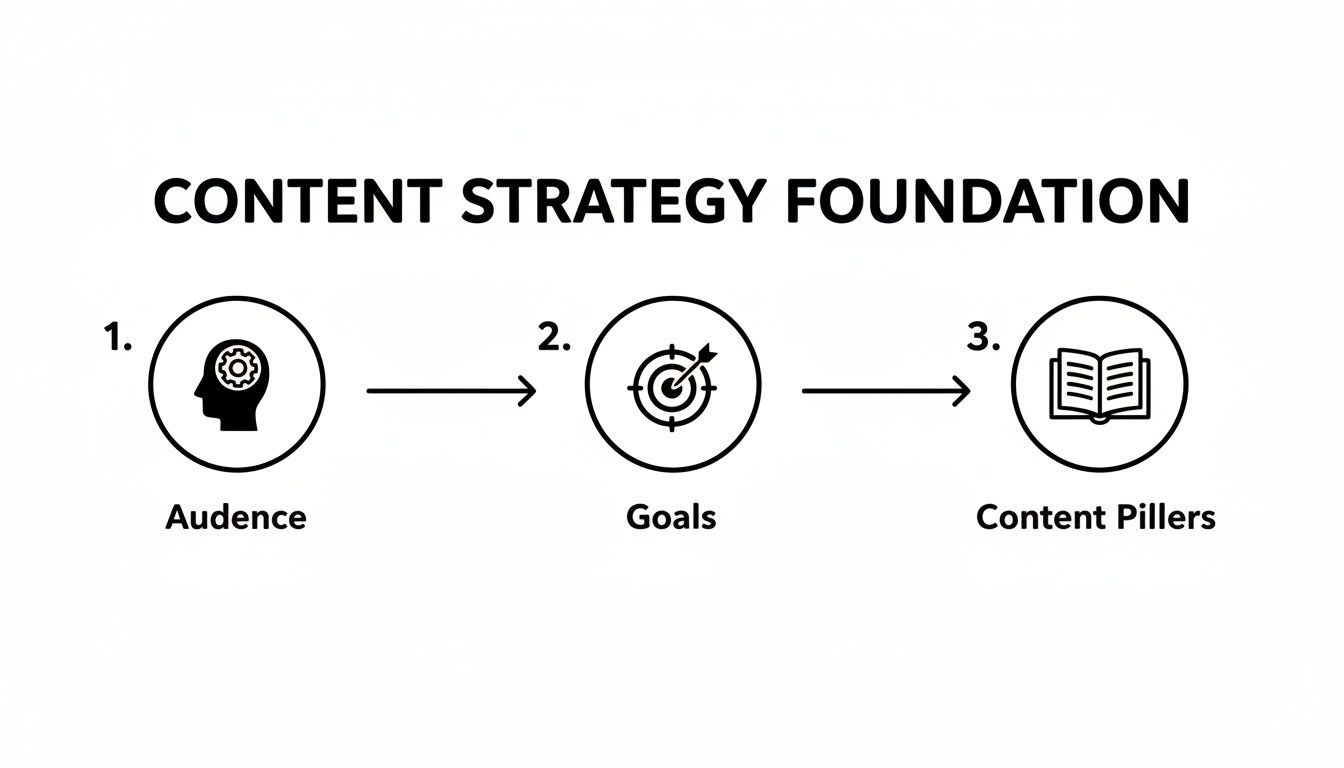
This isn't just a pretty diagram. It's a reminder that great content is never created in a vacuum. It has to be anchored to real audience needs and clear business objectives from the very beginning.
How to Run a Quick and Painless Content Audit
The term "content audit" can sound like a six-month-long headache, but it doesn't have to be. Your goal is simply to get a fast, honest snapshot of your existing content. What's working? What's collecting dust?
Start by listing out your main content assets—blog posts, key service pages, case studies, you name it. For every piece, you'll play a little game of keep, toss, or tune-up:
Keep: Is the content still relevant, accurate, and getting decent traffic? Perfect. Don't touch it.
Update: Is the topic still golden but the information a little stale? This is your low-hanging fruit. Refreshing an old post with new stats and better SEO can bring in results way faster than starting from scratch.
Merge: Got three different posts that all touch on the same basic idea? Combine them. Create one monster "ultimate guide" that becomes a powerhouse asset for search engines.
Delete: Is a piece totally irrelevant, poorly written, and getting zero traffic? Sometimes, the best thing you can do for your site's health is to prune the dead branches.
This simple exercise will almost always uncover some hidden gems. That one blog post from two years ago? It might just need a fresh intro and a few new examples to start climbing the ranks again.
Building Authority with the Topic Cluster Model
Once you've cleaned house, you can start building for the future using a structure I swear by: the topic cluster model. Instead of just firing off random blog posts whenever inspiration strikes, this model brings order to the chaos by organizing everything around your core themes.
It’s a simple but brilliant concept. You pick a broad, essential topic and create a massive, in-depth guide on it. This becomes your pillar page.
From there, you create several shorter, more focused articles—your cluster content. Each one dives deep into a specific sub-topic related to your pillar. The crucial part? Every cluster article links back to the main pillar page. This creates a powerful network of internal links that screams to Google, "Hey, we're an authority on this subject!"
This isn't just about chasing keywords anymore. When you build topic clusters, you're building genuine topical authority. That makes it easier for all your related content to rank for a whole constellation of search terms.
For startups and small businesses, this model is a game-changer. It channels your limited resources into creating a content library that’s organized, a joy for users to navigate, and built to dominate search results.
Moving Beyond Keywords to User Intent
The last piece of the puzzle is keyword research, but with a critical shift in mindset. You have to focus on user intent. It’s not enough to know what people are typing into Google; you need to understand the why behind the search.
Generally, search intent falls into four buckets:
Informational: The user has a question ("how to write a business plan").
Navigational: The user wants to find a specific site ("Alpha website login").
Transactional: The user is ready to pull out their wallet ("buy project management software").
Commercial Investigation: The user is in comparison mode ("Alpha vs. Squarespace").
Let’s say you run a SaaS company. A keyword like "what is agile methodology" is purely informational. A user searching for that wants a detailed explanation, not a sales pitch. But a search for "best agile software for small teams" is clearly commercial—they're deep in the buying cycle. Matching your content type to the user's intent is non-negotiable.
You can get started on this without dropping a dime on fancy tools. Use Google’s own "People Also Ask" and "Related Searches" to see the exact questions your audience is asking. I'm also a big fan of AnswerThePublic for visualizing the web of questions around any topic.
Let's see how this works in a simple table. Imagine we're a SaaS company selling project management software.
Topic Cluster Content Plan Example
Pillar Topic | Cluster Content Idea | Target Keyword | Keyword Intent |
|---|---|---|---|
Project Management for Startups | How to Choose PM Software for Your Team | "best project management software for startups" | Commercial Investigation |
Project Management for Startups | A Beginner's Guide to Kanban Boards | "what is a kanban board" | Informational |
Project Management for Startups | 5 Common Project Management Mistakes to Avoid | "project management mistakes" | Informational |
Project Management for Startups | [Our Software] vs. Asana vs. Trello | "[our software] vs asana" | Commercial Investigation |
This table shows how different cluster pieces, all supporting the main "Project Management for Startups" pillar, can target various intents to capture users at every stage of their journey.
By carefully choosing your terms, you can more effectively add keywords to a website in a way that truly resonates. This ensures you’re not just getting traffic—you’re getting the right traffic that will actually turn into customers.
Putting Your Content Plan into Action
A brilliant content strategy is a great start, but it's just a document until you actually do something with it. The real magic happens when you turn those well-researched plans into actual content that gets in front of your audience. This is where we build the bridge from strategy to execution.
Forget about static plans that gather digital dust. The goal here is to build a content production engine—a system of repeatable workflows that makes creating and sharing content a predictable, manageable process, not a frantic scramble.
Crafting a Functional Editorial Calendar
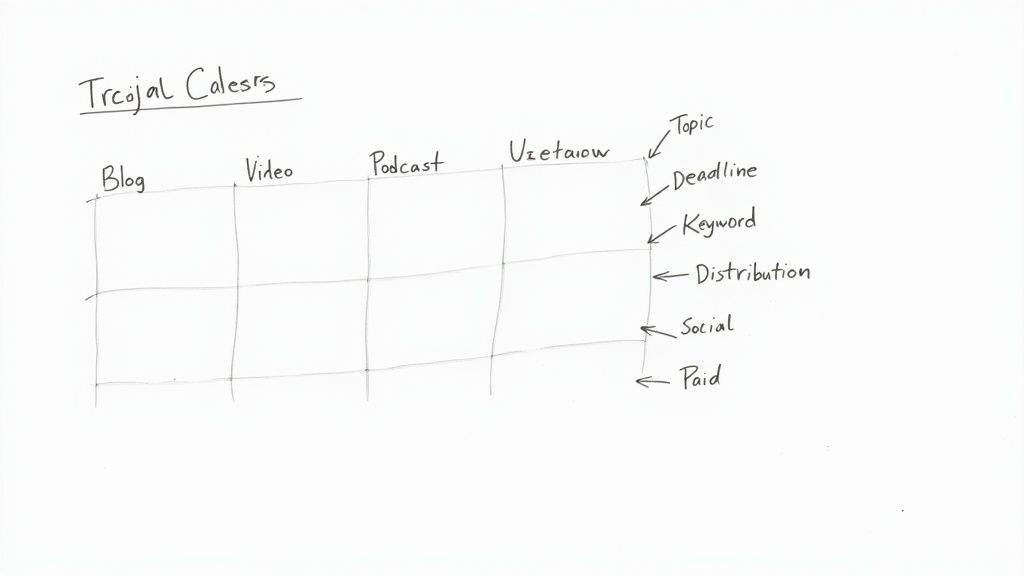
Your editorial calendar is the beating heart of your content operation. It’s more than just a list of due dates; it's the single source of truth for what’s being published, why, and who’s making it happen. My advice? Ditch the overly complicated spreadsheets nobody wants to update. A good calendar is simple, accessible, and tracks only what matters.
At a minimum, make sure your calendar includes these key fields:
Topic/Headline: What's the piece about?
Content Format: Is it a blog post, video, case study, or podcast?
Target Keyword: What’s the primary SEO keyword we’re targeting?
Owner: Who is responsible for getting this done?
Deadline: When does the draft need to be ready for review?
Publish Date: When does this go live?
Status: Keep it simple (e.g., Idea, In Progress, In Review, Published).
Once your strategy is set, you need to operationalize it. A good ultimate content marketing strategy template can be a lifesaver for structuring your calendar and workflows. This is what separates sporadic content efforts from a systematic approach to growth.
Choosing the Right Content Format
The medium is just as important as the message. You can have a game-changing idea, but if you package it in the wrong format, it will fall completely flat. A complex, data-heavy analysis probably works best as a detailed blog post or an infographic, while a customer success story hits hardest as a video testimonial.
Don't fall into the trap of thinking everything has to be a blog post. By diversifying your formats, you can connect with different segments of your audience who have different consumption habits.
Consider adding formats like these to your mix:
Short-Form Video: Perfect for TikTok and Instagram Reels to grab attention fast.
Long-Form Video: Ideal for in-depth YouTube tutorials or webinar recordings.
Podcasts: A fantastic way to reach people during their commute or workout.
Case Studies: Powerful bottom-of-the-funnel content that proves your value.
The best format is one that serves the story you’re telling and aligns with how your target audience actually consumes information. Don't be afraid to experiment, measure what works, and then double down on it.
A Repeatable Multi-Channel Distribution Process
Hitting "publish" isn't the finish line—it's the starting gun. Without a clear plan for distribution, even the most amazing piece of content will just sit there, unheard. A smart distribution strategy is what gets your work in front of the right people, on the right channels, at the right time.
I like to think about distribution channels in three buckets:
Owned Media: These are the channels you control completely, like your blog, email newsletter, and company social media profiles. This is your home turf.
Earned Media: This is the word-of-mouth exposure you get from others. Think guest posts, mentions from influencers, or features in industry publications. It builds credibility and expands your reach.
Paid Media: This is where you pay to play. Social media ads, search engine marketing, and sponsored content are all ways to guarantee reach and target specific demographics with precision.
So, what does this look like in practice? Here’s a simple, robust distribution checklist you could use for every new blog post:
Channel | Action |
|---|---|
Email Newsletter | Send a dedicated email to your subscriber list with a compelling hook. |
Social Media | Schedule 3-5 unique posts across LinkedIn, X, and Facebook. |
Community Forums | Share the link in relevant Reddit or Slack communities where it adds value. |
Employee Advocacy | Ask your team to share the post with their professional networks. |
Paid Promotion | Boost the top-performing social post to a lookalike audience. |
This kind of structured approach will amplify your content’s impact far beyond what you'd get from just hitting publish and hoping for the best.
As you share your content, remember that the little details matter. Check out our guide on how to write meta descriptions for SEO to make sure your content is as clickable as possible when it shows up in search. By systemizing both creation and distribution, you build a reliable machine for turning your strategy into real, measurable results.
Measuring Performance and Optimizing for Growth
So, you've created and published your content. Great. But if you’re not measuring its performance, you're essentially shouting into the void. You're making noise, sure, but you have no idea if anyone is listening or—more importantly—if they care.
This is where your strategy comes full circle. It's the final, crucial loop where you prove that all your hard work is actually moving the needle for your business. A solid measurement plan takes you beyond fuzzy vanity metrics like page views and social media likes. Instead, it gets you focused on Key Performance Indicators (KPIs) that connect directly to your business goals. This is how you show real, tangible ROI.
Moving Beyond Vanity Metrics to Real KPIs
As a small business or startup, every blog post, video, and social update has to earn its keep. This means tracking numbers that draw a straight line to revenue and growth. The real goal isn't just to see how many people saw your content, but to understand what they did afterward.
These are the KPIs that actually matter:
Conversion Rate: What percentage of people who read a blog post then sign up for your newsletter, request a demo, or buy something? This is the ultimate test of your content's power.
Lead Quality: Are the leads coming from your content actually a good fit for your business? Tracking Marketing Qualified Leads (MQLs) and Sales Qualified Leads (SQLs) tells you if you're attracting the right crowd.
Content-Influenced Revenue: Can you trace a new customer's journey back to a piece of content they engaged with? This metric directly connects your content to your bottom line.
Measuring success is the heartbeat of any content strategy, and the data backs this up. According to HubSpot's 2025 data, over 41% of marketers now gauge their content's success by its direct impact on sales, with web traffic being a close second. It’s a clear signal that content is being held accountable for growing the customer base.
Setting Up Your Measurement Dashboard
For this, Google Analytics is your best friend, especially for websites built on platforms like Alpha. But don't just glance at the default dashboard. You need to set up specific goals and custom reports that mirror what you’re trying to achieve as a business.
For example, you can create a "Goal" in Google Analytics to track every single time a user fills out a contact form. Just like that, an abstract action becomes a concrete conversion number you can track. Our guide on how to add Google Analytics to your site gives you a step-by-step walkthrough to get this essential tool up and running.
Here’s a glimpse of what a customized Google Analytics dashboard can look like, zeroing in on user engagement and traffic sources.
This kind of view shows you, at a glance, where your best users are coming from. That insight is gold, helping you decide which distribution channels deserve more time and money.
The most powerful insight you can gain is understanding which content topics and formats are driving the most valuable actions. This data is your roadmap for what to create next.
Creating a Data-Driven Optimization Loop
Measurement isn't something you do once and forget about. It's a continuous cycle. The real magic happens when you get into a regular rhythm—weekly, bi-weekly, or monthly—to analyze what's happening and feed those insights right back into your strategy.
Here’s what that process looks like in practice:
Analyze the Data: Dig into your KPIs. Which blog posts brought in the most demo requests? Which social channels drove the most newsletter sign-ups?
Identify Patterns: Start looking for trends. Do listicles consistently outperform your how-to guides? Does your audience engage more with video content on weekends?
Form a Hypothesis: Based on what you see, make an educated guess. For example: "We believe creating more case-study-style posts will increase MQLs because our last one converted at twice the average rate."
Test and Refine: Now, put that hypothesis to the test. Create the new content, promote it, and measure its performance against your baseline. Did it work?
This data-driven loop is what turns your content from a collection of one-off pieces into a predictable, scalable growth engine. It makes sure your strategy is a living, breathing plan that gets smarter and more effective over time.
Got Questions? Let's Talk Strategy.
Okay, so you've got the blueprint. But putting a content strategy into motion is where the real work begins. It’s totally normal to hit a few bumps along the road—whether you're wrestling with a tiny budget, a packed schedule, or content that just isn't landing right.
Let's dive into some of the most common questions I hear from entrepreneurs and get you some practical, no-fluff answers. Think of this as the part of the workshop where we roll up our sleeves and figure out how to make this stuff work in the real world.
"How Often Should We Actually Be Publishing?"
This is the big one, the classic "quality versus quantity" tug-of-war. And the honest-to-goodness answer is: it depends. There’s no secret number that guarantees success. The best publishing frequency is the one you can stick to without letting the quality slide.
Seriously, one fantastic, deeply researched article is worth more than three half-baked posts you rushed out the door just to meet a quota. Consistency trumps frequency every time. Your audience will learn to look forward to your content if they know when to expect it, whether that’s once a week or twice a month.
To find your sweet spot, think about:
Your Resources: Be brutally honest about your team's time and budget. Burnout is the number one killer of great content strategies.
Your Audience's Appetite: Are you in a fast-paced industry where people crave daily updates? Or a more considered niche where a single, comprehensive guide each month is exactly what they need?
Your Goals: If you're going for broke on brand awareness, a higher frequency might make sense. But if your goal is generating high-quality leads, a slower, more deliberate pace focused on pillar content is probably the smarter play.
My advice? Start with something you know you can handle, like one solid blog post a week. Get that process down to a science. Once you've mastered it, you can think about scaling up.
"What If Our Budget is Practically Non-Existent?"
A small budget isn't a dead end. In fact, it can be a blessing in disguise because it forces you to be resourceful and smart. You don’t need a huge ad spend to make a dent; your most powerful assets are your own expertise and your time.
Here’s how to punch above your weight with limited funds:
Go All-In on SEO: Organic search is the great equalizer. One killer piece of evergreen content that ranks for the right keywords can be a traffic-driving machine for years with zero ongoing cost. It's the best investment you can make.
Repurpose Everything: Don't let your content be a one-hit-wonder. That amazing blog post you wrote? It can be sliced and diced into a dozen social media posts, a short video script, an email newsletter, and an infographic. Squeeze every last drop of value out of what you create.
Embrace User-Generated Content (UGC): Get your customers in on the action! Testimonials, reviews, and social media shoutouts are pure gold. They're authentic, trustworthy, and best of all, they cost you nothing.
A tight budget isn’t a weakness; it’s a filter. It forces you to focus on what truly matters. Owning a small niche with incredible content is far better than being a tiny, unheard voice in a massive, expensive crowd.
"Help! My Content Isn't Performing."
Ugh, that feeling. You pour your heart and soul into a piece of content, hit publish, and… crickets. It’s frustrating, but don't just throw your hands up or scrap the whole thing. It's time to put on your detective hat.
First, you have to define what "not performing" actually means. Is it getting low traffic? Are people bouncing right away? Or are you getting visitors but no conversions? Each of these problems has a very different cause.
Problem: Low Traffic. This is a discoverability issue. Your first stop should be re-optimizing your on-page SEO. Is the target keyword prominent in your title, URL, and H1? Is your meta description actually enticing someone to click? After that, look at your distribution—did you promote it on the right channels where your audience actually hangs out?
Problem: Low Engagement. If you're getting clicks but people aren't sticking around, the problem lies with the content itself. Does your intro grab them, or is it a snoozefest? Is the formatting a giant wall of text that’s hard to read? Most importantly, does the content deliver on the promise of its headline?
Problem: No Conversions. Getting traffic and engagement but no leads or sales? Your call-to-action (CTA) is the likely suspect. Is it clear and compelling? Is it a natural next step for someone reading that piece of content? Or is it a jarring, out-of-place sales pitch?
Never be afraid to go back and improve older posts. Your content strategy isn't set in stone; it's a living thing that you should constantly be tweaking and refining.
Ready to stop guessing and start building? With Alpha, you can launch a stunning, SEO-optimized website in hours, not weeks. Our AI-powered platform is designed for entrepreneurs who need results, providing you with the perfect foundation to execute your new content strategy. Turn your vision into a high-performing website today at https://www.alpha.page.
Build beautiful websites like these in minutes
Use Alpha to create, publish, and manage a fully functional website with ease.