How to Create Website Mockups People Actually Love
Learn how to create website mockups that bridge the gap between idea and reality. Our guide covers tools, principles, and developer handoff.
Build beautiful websites like these in minutes
Use Alpha to create, publish, and manage a fully functional website with ease.

Think of a high-quality real estate website template as your secret weapon. It’s the fastest, most affordable way to get a truly professional online presence without the months-long headache and sky-high costs of a custom build. A great template gives you the framework for success right out of the box.
Why a Template Is Your Digital Secret Weapon
Let's be real for a second. Building a real estate website from scratch is a massive project. It drains your budget, eats up your time, and forces you to make a million tiny decisions that have nothing to do with what you’re best at—selling homes.
This is exactly why so many smart agents and brokers are ditching the custom-build route. Instead, they're grabbing top-tier templates that offer sophisticated design and powerful features without the custom-build nightmare. The old idea that "template" equals "cookie-cutter" is dead. Today’s platforms give you so much room for customization that your brand will absolutely shine through.
The point isn't just to have a website. It's to own a business asset that works for you around the clock. A well-chosen template gets you there faster and more efficiently than any other path.
The Modern Template Advantage
Modern real estate templates are so much more than just a pretty face. They are complete business platforms built specifically for the chaos and demands of our industry. Don't think of a template as a finished house; think of it as a professionally designed blueprint you get to furnish and make entirely your own.
Here's what you're really getting:
Speed to Market: You can launch a beautiful, fully functional website in days, not months. That means you can start pulling in leads and building your online authority this week.
Cost-Effectiveness: A template costs a tiny fraction of a custom-built site. That frees up cash for things that actually move the needle, like professional photography or a targeted local ad campaign.
Built-in Real Estate Tools: The best templates already have seamless IDX integration, optimized lead capture forms, and stunning property gallery layouts baked right in. No need to reinvent the wheel.
This guide will be your roadmap. We’re going to walk through how to pick the perfect foundation, customize it to scream your brand, and launch a site that works tirelessly to bring in new clients and close more deals. It's your edge in a very crowded market.
Choosing the Right Foundation for Your Business
Picking the right template real estate website is a lot more than just finding pretty colors and a nice font. Think of it as laying the foundation for your digital office—it has to be solid, functional, and ready to grow with you. While great visuals pull clients in, it’s the features humming away in the background that actually convert those visitors into leads and, eventually, closed deals.
Too many agents get bogged down in the surface-level stuff, but the real power is in a template's core functionality. A weak foundation will sabotage all your marketing efforts, no matter how amazing your listings are. You need a platform that works as hard as you do.
This simple flowchart breaks down the choice between a custom build and a template. For most agents, the path is clear.
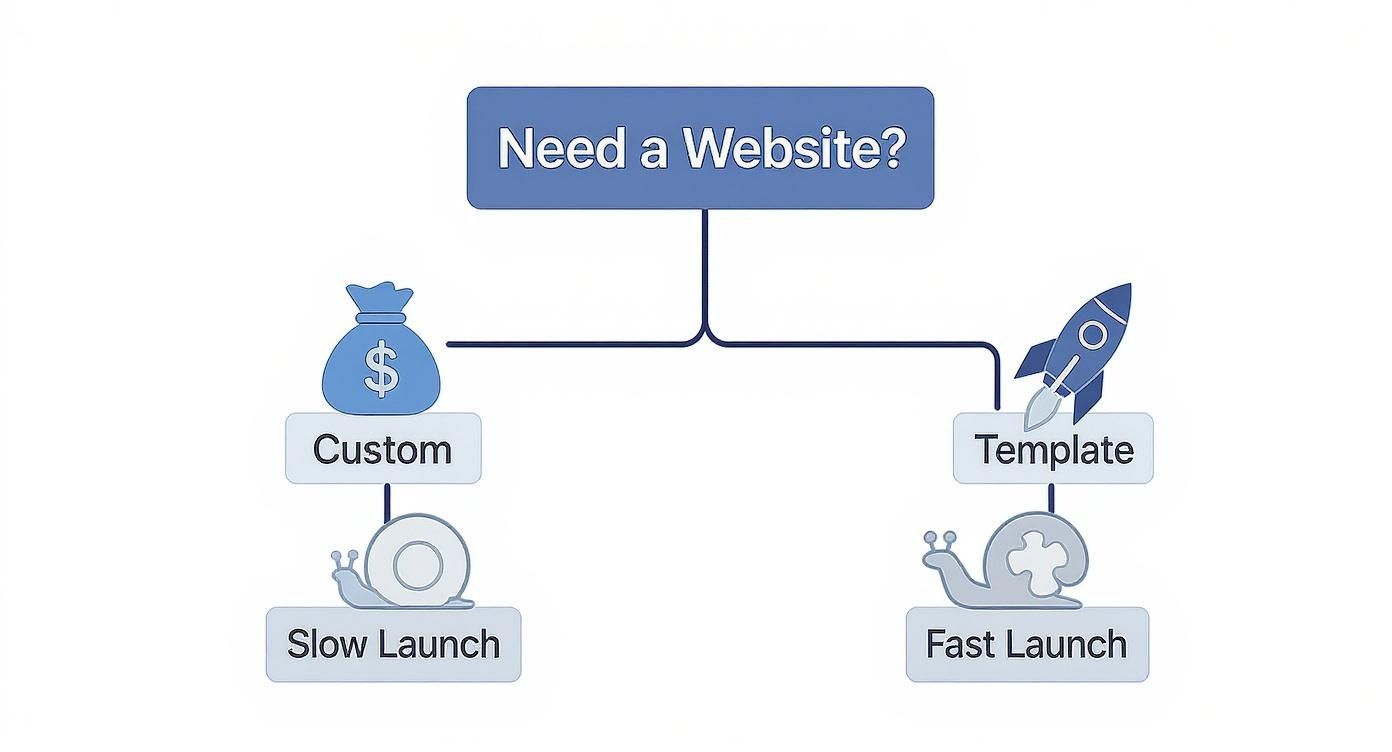
As you can see, a template gets your business online fast, saving you a ton of time and money that are better spent on marketing.
Must-Have Features in a Real Estate Website Template
Use this checklist to compare different template real estate platforms and prioritize the functionality that will actually grow your business.
Feature | Why It's Critical for Agents | What to Look For |
|---|---|---|
IDX/MLS Integration | This is the engine of your site. It pulls in all the listings that buyers are looking for. | Fast-loading, reliable connection. Customizable search filters (e.g., school district, price, beds/baths). High-quality listing photos and clear layouts. |
Built-in CRM | A contact management system keeps you organized, letting you track leads, schedule follow-ups, and nurture relationships without missing a beat. | Automated lead assignment, email drip campaign capabilities, and notes for each contact. Seamless integration with website forms. |
Lead Capture Forms | Your site's primary job is to generate leads. Without smart, strategically placed forms, you’re just a digital brochure. | Pop-ups for market reports, "Schedule a Showing" buttons on listings, and mortgage calculator lead magnets. Forms should be short and easy to fill out. |
Mobile-First Design | Over 50% of home buyers search on a mobile device first. If your site is clunky on a phone, you're losing more than half your potential clients. | Test the demo on your phone. Can you easily tap to call? Are forms simple to complete? Do images load quickly without excessive pinching and zooming? |
Local SEO Tools | You're competing with Zillow and local brokerages. Your website needs to be optimized to show up for "homes for sale in [your city]." | Editable page titles and meta descriptions, schema markup for real estate listings, and easy-to-create community pages. |
Choosing the right template is the first step, but it's also crucial to make your real estate website look more professional to build trust with visitors from the moment they land on your page. These features are the building blocks of a credible, high-performing site.
The Non-Negotiables of a Great Template
Before you commit, you absolutely have to look under the hood. A top-tier real estate template isn't just a collection of pages; it’s a purpose-built machine for generating business.
Here’s what I tell every agent to prioritize:
Seamless IDX/MLS Integration: This is the heart of your website. Your listings have to load fast, look amazing, and be dead simple for users to search. A slow or confusing IDX is a dealbreaker that will send potential clients running straight to the big portals.
Strategic Lead Capture Forms: A generic "Contact Us" page isn't going to cut it. You need a template with thoughtfully placed calls-to-action, like "Schedule a Showing," "Request More Info," or pop-ups that offer a free home valuation.
Mobile-First Design: It’s not enough for a site to just "work" on a phone. It needs to be explicitly designed for that small-screen experience. Pull up the demo on your own phone—is it actually easy to scroll through listings, fill out a form, and tap a number to call you? If it’s frustrating, you’re losing leads. Period.
Planning for Future Growth
The business you have today might look very different a year from now. A great template grows right alongside you. Ask yourself: Can you easily add new agent profiles if you start a team? Does the structure let you build out detailed community guides or a blog to become the go-to local expert?
Thinking about scalability from the start saves you from having to completely rebuild your site when your business really takes off. For small business owners in any industry, this initial choice is critical. You can learn more about what makes a great starting point with these helpful website templates for small business.
A template isn't a limitation; it's a launchpad. Choose one that gives you the tools to build not just for the business you have today, but for the one you're building tomorrow.
The real estate market is exploding, projected to grow from $4.34 trillion to over $7 trillion by 2034. That massive growth means more competition, making a powerful digital presence more critical than ever to stake your claim. This is why getting your online tools right from day one is non-negotiable.
Turning a Template Into Your Brand's Digital Home
A great real estate template gives you the blueprint, but it's your brand that makes it a home. This is where the magic happens—where you take a professionally designed framework and breathe your unique identity into it. It’s about transforming a functional tool into a memorable brand experience that instantly builds trust with buyers and sellers.
This goes way beyond just slapping your logo on the homepage. True branding is a careful mix of visuals and voice. The real goal is to create a website that feels authentically you and speaks directly to the clients you want to work with. When you get this right, your site doesn't just look good; it connects.

Nail Down Your Visual Identity
Your visuals are the first impression. Before a visitor reads a single word, they’re already forming an opinion based on your colors, fonts, and photos. A cohesive visual strategy makes you look polished and professional, signaling to clients that you’re an agent who pays attention to the details.
Here’s where to start:
Color Palette: Stick to two or three main brand colors. In real estate, you often see trustworthy blues, earthy greens, or sophisticated grays. The key is to pair them with a single, bold accent color for your buttons and calls-to-action to make them pop.
Typography: Pick two fonts that work well together—one for headings, one for body text. A clean, easy-to-read sans-serif like Lato or Montserrat is fantastic for paragraphs. For headlines, a classic serif font can add a touch of timeless authority.
High-Quality Photography: This is non-negotiable, and it's not just for listings. Get a professional headshot that makes you look approachable and confident. You should also feature high-resolution photos of the neighborhoods you serve; this showcases your local expertise and puts the community front and center.
Your brand isn't what you say it is—it's what your clients feel when they interact with you. A consistent visual identity is the foundation of that feeling, creating a sense of reliability and recognition across your website, social media, and marketing materials.
Find Your Authentic Brand Voice
Once your visuals set the stage, your words need to tell the story. The copy on your website is your opportunity to build a real, human connection with potential clients, especially on pages like your "About" section. This is where you go beyond the sales pitch and show them who you really are.
An effective brand voice is both professional and personal. It has to clearly answer the question: "Why should I work with you over any other agent?" Maybe it’s your encyclopedic knowledge of the local market, your reputation as a sharp negotiator, or your genuine passion for guiding first-time buyers.
To get started, focus your energy here:
Your "About" Page: Don’t just recite your resume. Tell the story of why you chose real estate and what truly motivates you to help people with one of the biggest decisions of their lives.
Agent Bio: Let your personality shine through. Talk about your connection to the area, mention a hobby, or share what you love most about your community. People do business with people they like and trust.
Writing copy that feels natural and compelling can be tough, but it's a skill that pays off in a big way. If you want to dive deeper, there are some great strategies on how to write website copy that converts visitors into actual leads. At the end of the day, authentic storytelling is what elevates a generic template into a powerful business asset that works for you 24/7.
Dominating Local Search with Your New Website
A beautiful website is a great start, but it's not much use if local buyers and sellers can't find it. You've got the technical foundation with a high-quality template real estate website; now it's time to build a smart local search engine optimization (SEO) strategy on top of it. This isn't about chasing generic, nationwide traffic. It’s about becoming the go-to digital authority in the specific neighborhoods you know and serve.
Success in real estate SEO all comes down to relevance. Put yourself in your ideal client's shoes. What are they actually typing into Google? It's almost never just "homes for sale." It’s far more likely to be something like "three-bedroom homes in Maple Creek school district" or "condos for sale near downtown Northwood." Your entire content strategy should be built around answering these incredibly specific questions.

When you take this targeted approach, the people finding your site aren't just browsing—they're motivated clients looking for exactly what you offer. If you're new to this, our guide on what is search engine optimization offers a great primer on the core concepts.
Mastering On-Page SEO for Local Impact
On-page SEO simply means optimizing the individual pages of your site. Think of it as putting up clear signposts for both Google and your human visitors. The good news is that a platform like Alpha gives you total control over these critical elements, no coding required.
Here are a few high-impact optimizations you can make right away:
Title Tags: This is the clickable headline that shows up in search results. It needs your target keyword and location. So, instead of a generic "About Us" page title, try "Maple Creek Real Estate Agent | Jane Doe."
Meta Descriptions: This is the little snippet of text under the title tag. While it doesn't directly affect your ranking, a great description makes people want to click. This is your chance to share your unique value proposition.
Image Alt Text: Don't overlook your images! Describe every photo on your site with location-focused text. For a picture of a neighborhood park, alt text like "Community park and playground in Northwood" is much better than "park.jpg."
Think of each page of your website as a dedicated digital billboard. Every element—from the main heading to the tiniest image description—is an opportunity to tell Google exactly what you're about and which clients you serve.
Building Authority with Community Pages
Want a strategy that will put you ahead of 90% of other agents? Start creating dedicated "Community Pages." These are deep-dive pages on your website for every single neighborhood, town, or subdivision you specialize in. This is where your local expertise can really shine and deliver massive value to potential clients.
A great community page is so much more than a list of available properties. It should be the ultimate resource, packed with information like:
Local Market Data: Share current trends, average sale prices, and days on market.
School Information: Give details on local schools, their ratings, and even zoning maps.
Lifestyle & Amenities: Highlight the best restaurants, parks, shops, and community events that make the area special.
Video Tours: A quick video of you driving through the neighborhood can be incredibly powerful and builds an instant connection.
This strategy positions you as the go-to neighborhood expert, not just another agent. These pages naturally attract those super-specific, long-tail keyword searches and build trust long before you ever speak to a potential client.
This local focus is more critical than ever as the market finds its footing. In 2025, the global real estate market is in a clear recovery phase after a two-year correction. With transaction volumes expected to rebound to $739 billion—a 19% year-over-year increase—standing out in your local area is non-negotiable. To truly make your new website a local powerhouse, you need to know which keywords to target. Exploring the top SEO keywords for real estate is a fantastic place to start.
By combining a powerful website template with a smart, localized content strategy, you’re not just building a website; you’re building a lead-generation machine that works for you 24/7.
Launching and Promoting Your Real Estate Website
https://www.youtube.com/embed/ZC37jl0lRF8
You’ve put in the work—the design is polished, the content is sharp, and your new template-based real estate website is ready for the world. This is the moment you've been building toward, but before you go live, a quick final once-over is crucial for a smooth, professional launch.
A small glitch can sour a visitor's first impression, so taking a few extra minutes now is time well spent. This isn't about some deep technical audit. It's about looking at your site from a user's perspective. Click through everything, test every button, and—most importantly—fill out your own contact forms to make sure those valuable leads are actually hitting your inbox. Trust me, there’s nothing worse than realizing a week after launch that your lead pipeline was broken from the start.
Your Simple Pre-Launch Checklist
Run through these final checks to make sure everything is perfect for launch day:
Form Functionality: Go to every single lead capture form and submit a test entry. Does the notification land in the right email? If you set up an auto-responder, does it fire correctly?
Link Integrity: Click on every single link, from your main navigation down to the social media icons in the footer. Broken links scream unprofessionalism.
Mobile Review: Pull out your smartphone and do one last walkthrough. How do the listing photos look? Is the text easy to read without pinching and zooming? Can you easily navigate with your thumb?
Proofread Everything: Give every headline, paragraph, and call-to-action button one last read. It's amazing what a fresh set of eyes can catch.
Once you’ve ticked these boxes, you can launch with confidence. You know the site works, looks great, and is ready to start generating business.
Your Immediate Promotion Strategy
A beautiful website without an audience is just a digital billboard in the desert. The good news is your initial promotion strategy doesn't need to be complicated, just consistent. On day one, your focus should be on the people who already know, like, and trust you: your existing network.
Don't just quietly launch your website; announce it. Treat it like a digital grand opening. You want to build some buzz and make it an event your network wants to check out and share.
Start by writing a simple, enthusiastic email to your sphere of influence—past clients, friends, family, and professional contacts. Let them know about your new online home and highlight how it can be a great resource for them. At the same time, make sure your new website URL is updated everywhere it needs to be: your Zillow profile, all your social media bios, and especially your email signature.
This initial push gets eyeballs on your site immediately and sends positive signals to search engines that your new domain is active and relevant. From there, the game shifts to creating ongoing value that keeps people coming back. Think about starting a blog with local market updates or filming short video tours of new listings. This is how you begin to carve out your piece of a global real estate market valued at a staggering $393.3 trillion. If you want to dive deeper into that number, you can get more insights on the global real estate market here.
Got Questions? Let's Clear a Few Things Up
Diving into website templates for your real estate business probably brings a few questions to mind. That’s a good thing—it means you're thinking like a business owner. Let's tackle the most common ones I hear from agents so you can make your next move with confidence.
These aren't just tech questions; they're about building a real asset for your brand. Getting the right answers means your new site will be a lead-generating machine, not just another line item on your marketing budget.
Will a Template Website Actually Rank on Google?
Yes, absolutely. The old myth that template sites are bad for SEO is a leftover from a decade ago. Today’s top platforms are built from the ground up with search engine best practices baked right in. We're talking clean code, lightning-fast load times, and mobile-first designs—all the stuff Google loves.
Your ranking ultimately comes down to your content strategy and how well you dial in your local SEO. The template is just the high-performance engine; you still have to drive it by creating great content and building your local authority.
A modern, well-built template doesn't hold you back from page one. It gives you a massive head start by handling the technical SEO, freeing you up to focus on the hyperlocal content that actually gets you noticed by Google and clients.
How Much of a "Tech Whiz" Do I Need to Be?
Honestly, not much at all. That’s the whole point. The best real estate website platforms are designed for agents, not developers. They come with intuitive drag-and-drop editors and super simple dashboards.
If you can write an email or post on Facebook, you have all the technical skills you need. It’s built so you can easily:
Add a new listing in minutes.
Write and publish a blog post about local market stats.
Create new community pages to show off your neighborhood expertise.
Swap out team photos or update your bio.
And for those rare moments you get stuck, any good provider will have a top-notch support team ready to help you out.
Is My Website Going to Look Like Every Other Agent's?
Only if you want it to! A template is the starting point, not the final product. Think of it as the canvas, not the finished painting.
While you start with a proven framework, the end result is all you. It’s the combination of your logo, your brand colors, your professional photos, your unique property images, and your personally written copy that makes it one-of-a-kind.
No one else has your voice or your expertise. That’s what will make your site stand out, not the underlying code. The framework just gets you there faster.
Ready to build a website that captures your brand and converts visitors into lifelong clients? Alpha uses AI to help you launch a stunning, professional real estate website in a fraction of the time. See how easy it is to create your digital home base and get started today.
Build beautiful websites like these in minutes
Use Alpha to create, publish, and manage a fully functional website with ease.