




How to Create Website Mockups People Actually Love
Learn how to create website mockups that bridge the gap between idea and reality. Our guide covers tools, principles, and developer handoff.

EXAMPLES
Build beautiful websites like these in minutes
Use Alpha to create, publish, and manage a fully functional website with ease.
Navigating search engine optimization can feel like a daunting challenge for small business owners. Between managing daily operations, serving customers, and planning for growth, dedicating time to decipher complex digital marketing algorithms often falls to the bottom of the list. Yet, establishing a strong online presence is non-negotiable for competing and thriving. This is precisely where a clear, prioritized roadmap transforms from a "nice-to-have" into a business-critical tool.
This comprehensive small business SEO checklist is engineered to eliminate the guesswork. We've distilled the process into 10 actionable, high-impact steps specifically designed for entrepreneurs and teams with limited resources. You won't find vague theories here, only practical instructions you can implement immediately, even on user-friendly platforms like the Alpha website builder. We will guide you through the essentials of building a powerful search presence that drives real results.
From foundational keyword research and on-page optimization to crucial local SEO tactics and technical site health, each item is a building block for sustainable organic growth. This checklist covers the full spectrum of what matters most:
Foundational SEO: Keyword Strategy, On-Page Elements, and Technical Health.
Authority Building: Content Strategy, Backlinks, and E-E-A-T Signals.
Local & Mobile: Google Business Profile and Mobile-First Optimization.
Measurement & Maintenance: Analytics Tracking and Ongoing Link Building.
By following these structured steps, you'll learn how to attract more qualified customers, increase your visibility in search results, and build a digital foundation that supports your business for years to come. Let's get started.
1. Conduct Keyword Research & Gap Analysis
Keyword research is the cornerstone of any successful SEO strategy. It’s the process of identifying the words and phrases your potential customers use to find businesses like yours on search engines. This foundational step ensures you create content and optimize your website for terms that attract relevant, high-intent traffic, making it a critical first item on any small business SEO checklist.
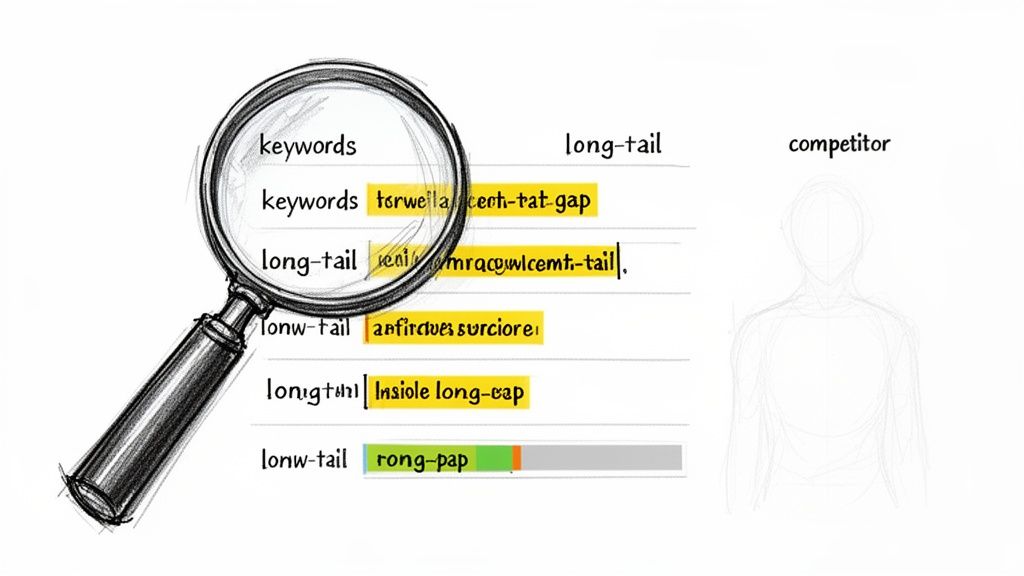
The goal is to find a sweet spot: keywords with significant search volume but manageable competition. A local plumber, for instance, might target "emergency plumbing services in Boston" instead of the hyper-competitive term "plumber." Similarly, a boutique bakery could focus on "custom gluten-free wedding cakes near me" to attract a specific, motivated audience.
How to Get Started
Begin by brainstorming core topics related to your services. Use free tools like Google Keyword Planner to expand this list and gather data on search volume and competition. For a deeper dive, consider paid tools like Ahrefs or SEMrush, which offer advanced features like keyword difficulty scores and competitor analysis.
A crucial part of this process is the keyword gap analysis. This involves identifying valuable keywords your competitors rank for, but you do not. Uncovering these gaps presents a clear roadmap for new content and optimization opportunities. For those looking to go deeper, understanding how to dissect your rivals' strategies is key. Beyond basic research, Mastering Keyword Analysis Competitor Strategy can provide a significant advantage.
Actionable Tips for Success
Focus on Long-Tail Keywords: Target phrases with three or more words. They typically have lower competition and higher conversion rates because the user's intent is more specific.
Prioritize Commercial Intent: Look for keywords that signal a user is ready to buy, such as "for sale," "quote," or "service."
Map Keywords to Pages: Create a spreadsheet that assigns a primary keyword and several secondary keywords to each important page on your site. This prevents "keyword cannibalization," where multiple pages compete for the same term.
Check User Intent: Before targeting a keyword, search for it on Google. Analyze the top-ranking results to understand what kind of content Google believes satisfies that query (e.g., blog posts, product pages, videos).
2. Optimize On-Page SEO Elements
On-page SEO involves optimizing individual web pages to rank higher and earn more relevant traffic in search engines. This includes strategic placement of keywords and improvements to elements like title tags, meta descriptions, and headers. Fine-tuning these factors is a fundamental part of any small business SEO checklist because it directly tells search engines what your content is about, making it easier for them to match your pages with relevant user queries.

The goal is to make each page as clear and valuable as possible for both search engines and human visitors. For example, an e-commerce store should optimize product pages with descriptive URLs and title tags that include the product name and primary keyword. Similarly, a service business can optimize its location pages by ensuring the city and service are prominent in the H1 tag and meta description to attract local customers.
How to Get Started
Begin by conducting a page-by-page audit of your most important content. Using a tool like the Yoast SEO plugin for WordPress or an all-in-one platform like Moz can simplify this process by providing a clear checklist for each page. Focus on the core elements first: the title tag, meta description, and the main H1 heading.
Ensure each page has a unique and compelling title tag that includes its primary keyword, preferably near the beginning. The meta description should act as a short ad, enticing users to click from the search results page. Structure your content logically with a single H1 tag for the main topic, followed by H2s and H3s for subheadings, which helps both readability and search engine crawling.
Actionable Tips for Success
Write Compelling Meta Descriptions: Don't just stuff keywords. Create a value proposition that answers the user's need and encourages a click-through.
Create SEO-Friendly URLs: Keep URLs short, descriptive, and readable. Include your primary keyword where it feels natural (e.g.,
yourdomain.com/emergency-plumbing-services).Optimize Images: Use descriptive file names and add alt text containing relevant keywords. This helps with image search rankings and improves accessibility.
Use Internal Linking: Strategically link to other relevant pages on your site. This helps distribute page authority and guides users to more valuable content.
Implement Schema Markup: Add structured data like FAQ or Local Business schema to help search engines understand your content better and potentially earn rich snippets in search results.
3. Build High-Quality Backlinks & Link Profile
Backlinks, or links from other websites to yours, act as powerful "votes of confidence" in the eyes of search engines. Acquiring these links from reputable, relevant sources is a cornerstone of any effective SEO strategy, as they remain one of Google's most significant ranking factors. This critical step in a small business SEO checklist signals to search engines that your site is a credible and authoritative source of information.
The focus must always be on quality over quantity. A single backlink from a highly respected industry publication like TechCrunch is far more valuable than dozens of links from low-quality, irrelevant directories. For a local bakery, a feature in a popular city food blog or a link from the local chamber of commerce serves as a powerful local signal. The goal is to build a natural and authoritative link profile over time.
How to Get Started
Begin by creating "link-worthy" assets, such as original research, comprehensive guides, or free tools that provide immense value to your audience. These assets become natural magnets for backlinks. Next, identify websites in your niche that might be interested in your content. Tools like Ahrefs and SEMrush are invaluable for analyzing your competitors' backlink profiles to find opportunities you can replicate.
An equally important, yet often overlooked, component is your internal linking strategy. This involves linking between relevant pages on your own website. Proper internal linking helps search engines understand your site structure, distributes link equity (ranking power) throughout your pages, and improves user experience by guiding visitors to related content.
Actionable Tips for Success
Create Linkable Assets: Develop original research, in-depth case studies, ultimate guides, or free digital tools that people will naturally want to reference and link to.
Pursue Guest Posting: Write articles for reputable blogs in your industry. This allows you to share your expertise and include a contextual link back to your website.
Utilize Broken Link Building: Find broken outbound links on other websites and suggest your relevant content as a replacement. It’s a win-win for both parties.
Get Listed in Quality Directories: Secure listings in relevant, high-quality business directories and industry associations to build foundational, relevant links.
Monitor Your Profile: Regularly use a tool to check your backlink profile for toxic or spammy links. Use Google's Disavow Tool to tell Google to ignore these harmful links and protect your site's authority.
4. Create SEO-Optimized Content Strategy
An SEO-optimized content strategy is your documented roadmap for creating and distributing valuable content. It moves you beyond random blog posts to a purposeful plan that aligns your publishing efforts with your target keywords and business goals. This strategic approach is a non-negotiable part of any modern small business SEO checklist, ensuring every piece of content works to attract, engage, and convert your ideal audience.
The objective is to become a trusted authority in your niche by consistently answering your audience's questions. For example, a marketing agency might create a comprehensive "pillar page" on "small business SEO" and support it with "cluster" articles on topics like "local SEO tips" and "keyword research for beginners." Similarly, a law firm could build authority by publishing detailed practice area guides supported by in-depth FAQ content.
How to Get Started
Begin by identifying your core business topics. These will become your content pillars. For each pillar, brainstorm related subtopics that address specific user questions or pain points. Use free tools like AnswerThePublic to discover what your audience is searching for around these topics. Organize these ideas into a content calendar, planning at least 3-6 months in advance to maintain consistency.
This structured plan is what separates successful SEO from guesswork. It ensures you cover all stages of the buyer's journey, from initial awareness to the final decision. For those ready to build a comprehensive plan from the ground up, our guide on how to create a content strategy provides a detailed, step-by-step framework.
Actionable Tips for Success
Build Topic Clusters: Organize your content around a central pillar page linked to several in-depth cluster posts. This structure signals topical authority to search engines.
Target the Buyer's Journey: Create content for different user stages: informational posts for awareness, comparison guides for consideration, and case studies for decision-making.
Maintain a Consistent Schedule: Aim to publish new, high-quality content at least 2-4 times per month to keep your audience engaged and show search engines your site is active.
Refresh and Update Old Content: Regularly identify your top-performing older posts and update them with new information, stats, and images to maintain their ranking power.
Include Clear Calls-to-Action (CTAs): Every piece of content should guide the user to the next step, whether it's downloading a guide, scheduling a consultation, or making a purchase.
5. Optimize for Local SEO & Google Business Profile
For small businesses with physical locations or service areas, local SEO isn't just an option; it's a lifeline. This practice focuses on increasing your visibility in local search results, Google Maps, and the coveted "local pack." Mastering this is a non-negotiable step in any small business SEO checklist because it connects you directly with nearby customers actively seeking your products or services.
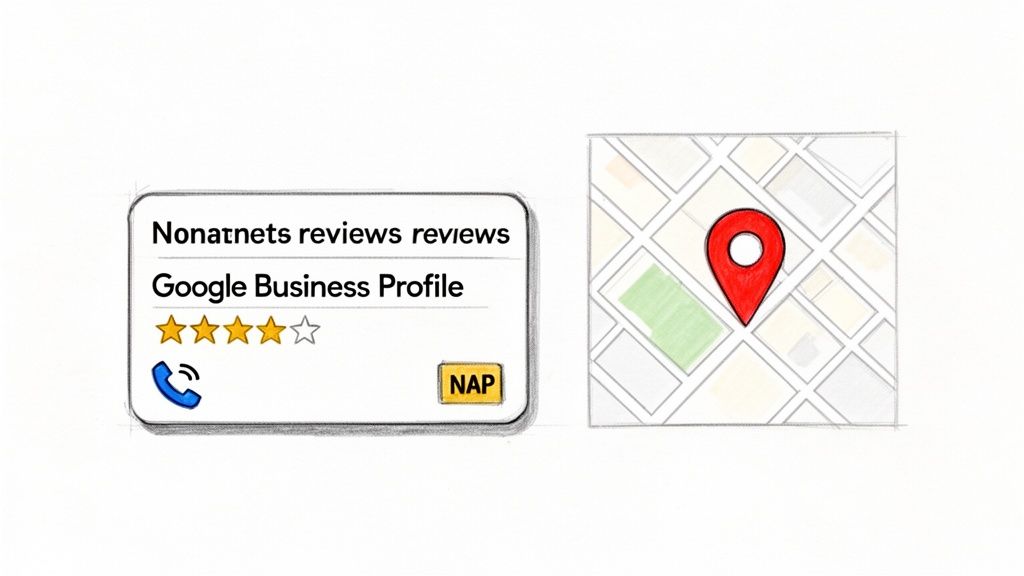
The goal is to dominate searches like "dentist near me" or "emergency plumbing in Dallas." When a potential customer searches for these terms, a well-optimized business appears prominently, complete with reviews, hours, and directions. This visibility builds immediate trust and drives foot traffic, making it a powerful tool for converting local searchers into paying customers.
How to Get Started
Your first and most critical step is to claim and fully optimize your Google Business Profile (GBP). This free tool from Google is your digital storefront on the search results page. Treat it with the same care as your physical location. Ensure every section is complete, from your business hours and service areas to a detailed, keyword-rich description of what you offer.
Beyond GBP, focus on building local citations. These are mentions of your business's name, address, and phone number (NAP) on other websites like Yelp, Angie's List, and industry-specific directories. Consistency is paramount; your NAP information must be identical across every platform to avoid confusing search engines and potential customers.
Actionable Tips for Success
Complete Your Profile: Fill out 100% of your Google Business Profile. This includes adding high-quality photos, selecting all relevant categories, and utilizing features like Q&A and Google Posts.
Encourage and Manage Reviews: Actively ask satisfied customers for reviews. Respond professionally to all feedback, both positive and negative, to show you are engaged and value customer input.
Build Localized Pages: If you serve multiple neighborhoods or cities, create dedicated pages on your website for each location. This helps you rank for specific geographic queries like "haircut in downtown Austin."
Ensure NAP Consistency: Use a tool like Moz Local or BrightLocal to audit your existing citations and ensure your name, address, and phone number are consistent everywhere online.
6. Improve Technical SEO & Site Speed
Technical SEO refers to the behind-the-scenes optimizations that help search engines crawl and index your website more effectively. This critical part of any small business SEO checklist addresses factors like site speed, mobile-friendliness, and site architecture. A technically sound website provides a better user experience, which Google rewards with higher rankings.

Neglecting this area can undo all your content and keyword efforts. For example, a local e-commerce store could improve its Largest Contentful Paint (LCP) from 4 seconds to under 2.5 seconds, leading to a noticeable boost in search rankings and a decrease in bounce rates. Similarly, a service business that fixes mobile usability issues ensures it doesn't alienate the majority of users who browse on their phones.
How to Get Started
Begin by running your site through Google's PageSpeed Insights. This free tool will provide a performance score and a detailed report on issues affecting your Core Web Vitals (LCP, FID, CLS). It will highlight specific problems like large images, render-blocking resources, or slow server response times.
Next, check your site's mobile-friendliness with Google's Mobile-Friendly Test. Ensure you have an XML sitemap submitted in Google Search Console and that your robots.txt file isn't accidentally blocking important pages. For those ready to dig deeper, exploring how to improve website loading speed provides a comprehensive guide to making impactful changes.
Actionable Tips for Success
Compress Your Images: Use tools like TinyPNG or image editing software to reduce file sizes without sacrificing visual quality.
Enable Browser Caching: Configure your server to store static files (like logos and CSS) in a user's browser, so they don't have to be re-downloaded on every visit.
Minimize CSS and JavaScript: Remove unnecessary code, spaces, and comments from your files to reduce their size and speed up parsing.
Choose a Quality Host: A slow or unreliable hosting provider will bottleneck your site speed, no matter how well-optimized your site is.
Implement Structured Data: Use schema markup to help search engines understand your content better, which can lead to rich snippets in search results.
7. Build Topic Authority & E-E-A-T Signals
Building authority is about proving to Google and your audience that you are a true expert in your field. This is encapsulated by Google's E-E-A-T guidelines, which stand for Experience, Expertise, Authoritativeness, and Trustworthiness. For a small business, demonstrating these signals is crucial for earning higher rankings, especially in industries that impact a person's health or finances (known as YMYL, or "Your Money or Your Life").
The core idea is to move beyond simply creating content and instead become a definitive resource. For example, a financial advisor who publishes an extensive library of in-depth guides on retirement planning demonstrates deep expertise. Similarly, a law firm that regularly shares detailed case studies and legal analyses builds both authority and trust with potential clients. These actions are a vital part of any modern small business SEO checklist.
How to Get Started
Begin by identifying your core areas of expertise. Plan a content strategy around these "topic clusters," creating one comprehensive "pillar" page for a broad topic and multiple "cluster" articles that dive into specific sub-topics. This structure signals to search engines that you have deep knowledge in that domain.
Showcasing the people behind your business is also essential. Create detailed author bios for your content creators that highlight their credentials, experience, and qualifications. To truly build E-E-A-T and project a strong online presence, understanding how to leverage professional reputation management services is essential. These efforts collectively enhance your brand's credibility in the eyes of both users and search algorithms.
Actionable Tips for Success
Create In-Depth Guides: Publish long-form content (2,000+ words) that comprehensively covers a topic, leaving no questions unanswered.
Showcase Credentials: Display author bios with photos, qualifications, and links to social profiles. Add trust badges, security certifications, and industry awards to your site.
Publish Case Studies: Demonstrate your real-world experience and results by sharing detailed case studies and customer testimonials.
Pursue Media Mentions: Earn links and mentions from reputable publications in your industry to build external validation of your authority.
8. Implement SEO Monitoring & Analytics Tracking
Executing the steps in this small business SEO checklist is crucial, but without tracking, you're flying blind. SEO monitoring and analytics tracking is the process of setting up systems to measure your performance, identify issues, and guide your optimization efforts. It transforms SEO from a guessing game into a data-driven strategy, allowing you to prove return on investment and make smarter decisions.
The goal is to understand what works and what doesn't. A local service provider might discover new ranking opportunities for high-intent queries in Google Search Console, while an e-commerce store can use Google Analytics 4 (GA4) to track exactly how much revenue their organic traffic generates. This data is the feedback loop that fuels continuous improvement and sustainable growth.
How to Get Started
The first step is setting up foundational tools. Begin by creating a Google Search Console account and verifying ownership of your website. This free tool from Google provides invaluable insights into your site's health, performance in search results, and any technical errors that need addressing.
Next, implement Google Analytics 4. GA4 is essential for understanding user behavior, tracking conversions, and identifying your top-performing content. Setting it up correctly is vital for collecting accurate data. For those using a modern site builder, learning how to add Google Analytics to your site is a straightforward but non-negotiable task. Once connected, create specific goals or conversions that align with your business objectives, like form submissions or phone calls.
Actionable Tips for Success
Establish a Baseline: Before making changes, record your current metrics (organic traffic, keyword rankings, conversion rate) to measure progress accurately.
Monitor Search Console Weekly: Check for indexing errors, manual actions, and spikes or drops in impressions and clicks. This is your early warning system.
Track Keyword Rankings: Use a tool (or manual checks for a small list) to monitor your position for target keywords monthly. This helps gauge the impact of your on-page and off-page efforts.
Create a Simple Dashboard: Build a monthly SEO report that pulls key metrics from GA4 and Search Console. Focus on organic traffic, top landing pages, conversions from organic, and keyword performance.
Analyze Conversion Drivers: Dig into your analytics to see which blog posts, service pages, or landing pages are driving the most conversions, and then create more content like them.
9. Optimize for Mobile-First Experience
Optimizing for a mobile-first experience is no longer a suggestion; it’s a requirement. Google now primarily uses the mobile version of a website for indexing and ranking, a policy known as mobile-first indexing. With over 60% of all online searches happening on mobile devices, a poor mobile experience can severely damage your SEO performance and alienate a huge segment of your audience, making this a non-negotiable item on your small business SEO checklist.
This means your website must be designed for the smallest screen first, ensuring it is responsive, fast, and easy to navigate with a thumb. For instance, a local restaurant must ensure its mobile site allows for one-tap reservations and clear menu viewing. Similarly, an e-commerce business needs a streamlined mobile checkout process to prevent cart abandonment, and a service provider must have forms that are simple to complete on a small screen.
How to Get Started
The first step is to analyze your current mobile performance. Use Google's free Mobile-Friendly Test to get an instant report on your site's compliance. This tool will highlight specific issues that need addressing.
Next, review your site's Mobile Usability report in Google Search Console. This report provides ongoing monitoring and alerts you to errors like "Text too small to read" or "Clickable elements too close together." Addressing these errors directly improves both user experience and your site's standing with Google.
Actionable Tips for Success
Implement Responsive Design: Ensure your website's layout automatically adjusts to fit any screen size, from smartphones to desktops. Most modern website builders like Alpha handle this automatically.
Prioritize Mobile Speed: Compress images, leverage browser caching, and minimize code to ensure your pages load quickly, even on slower 3G or 4G connections.
Simplify Navigation: Use a clear and concise mobile menu (like a "hamburger" menu) and ensure key information is easily accessible without excessive pinching or zooming.
Optimize for Touch: Make sure buttons and links are large enough (at least 48x48 pixels) and have adequate spacing to be easily tappable.
Keep Forms Simple: Break down long forms into multiple steps and use mobile-friendly input types (e.g., number pads for phone numbers) to make submissions effortless.
10. Execute Link Reclamation & Broken Link Building
Link building can feel intimidating, but link reclamation and broken link building are two of the most efficient ways to earn high-quality backlinks. These strategies focus on capturing low-hanging fruit: links you've already earned or can easily acquire. This makes them a perfect addition to a small business SEO checklist because they deliver significant value with less outreach effort than traditional cold campaigns.
Link reclamation is the process of finding "unlinked mentions" of your brand, products, or content and simply asking the publisher to add a link. Broken link building involves finding dead links on other websites, creating a suitable replacement resource on your own site, and suggesting they update their broken link to point to your new, live page.
How to Get Started
For link reclamation, set up alerts using tools like Google Alerts or Mention to track your brand name. When you find an article that mentions you without a link, reach out to the author or editor with a polite request. For broken link building, use tools like Ahrefs' Broken Link Checker to scan relevant, high-authority sites in your niche for dead outbound links.
A great example is a local bakery that finds a food blogger's article listing "best croissants in the city" that mentions their shop by name but doesn't link to their website. A quick, friendly email is often all it takes to convert that mention into a valuable backlink. Similarly, a tech blog can find a competitor's outdated "best software tools" list riddled with broken links and offer their own up-to-date guide as a superior replacement.
Actionable Tips for Success
Monitor Brand Mentions: Use free (Google Alerts) or paid tools (Mention, Ahrefs) to automate the discovery of unlinked brand mentions.
Personalize Your Outreach: Always address the author or editor by name. Explain exactly where the mention is and why adding a link would benefit their readers.
Provide a Replacement Resource: For broken link building, ensure your suggested content is a high-quality, relevant replacement for the dead link.
Make It Easy: In your outreach email, provide the exact URL you'd like them to use and even suggest the anchor text to make the update as simple as possible.
10-Point Small Business SEO Checklist Comparison
Strategy | 🔄 Implementation Complexity | Resources Required | ⚡ Time-to-Impact | 📊 Expected Outcomes ⭐ | 💡 Quick Tip |
|---|---|---|---|---|---|
Conduct Keyword Research & Gap Analysis | Medium — needs tool learning and analysis | Keyword tools (GKP, Ahrefs, SEMrush), analyst time | 4–12 weeks | Targeted keyword list, improved content focus, find ranking opportunities | Prioritize long-tail + map keywords to pages |
Optimize On-Page SEO Elements | Low–Medium — content edits and basic markup | Content editor, CMS access, minor developer help for schema | Weeks | Better rankings, higher CTR, featured snippet chances | Use unique titles, one H1 per page, add schema |
Build High-Quality Backlinks & Link Profile | High — outreach, relationship building | Outreach resources, PR/content assets, backlink tools | 3–12+ months | Increased domain authority, referral traffic, stronger rankings | Create link‑worthy assets; focus on relevance over volume |
Create SEO-Optimized Content Strategy | Medium–High — planning and execution | Content team, editorial tools, analytics | 3–6+ months | Consistent organic growth, topic authority, higher ROI | Build pillar + cluster content and a 3–6 month calendar |
Optimize for Local SEO & Google Business Profile | Low–Medium — profile & citation work | GBP, citation tools, review management | Weeks–months | Local visibility, map-pack placements, higher local conversions | Claim/verify GBP, keep NAP consistent, solicit reviews |
Improve Technical SEO & Site Speed | High — technical fixes and monitoring | Developers, hosting/CDN, speed & crawl tools | Weeks–months | Better crawlability, faster pages, improved Core Web Vitals | Compress images, enable CDN, monitor Core Web Vitals |
Build Topic Authority & E-E-A-T Signals | High — content + credentials + PR | Subject experts, long-form content, PR/outreach | 6–18+ months | Stronger rankings for competitive terms, trust signals | Show author credentials; publish comprehensive guides |
Implement SEO Monitoring & Analytics Tracking | Medium — setup and reporting | GSC, GA4, rank trackers, dashboard tooling, analyst | Weeks to start collecting data | Data-driven decisions, issue detection, ROI measurement | Set goals, create dashboards, monitor weekly |
Optimize for Mobile-First Experience | Medium–High — design + dev testing | Developers, designers, device testing tools | Weeks–months | Improved mobile rankings, lower bounce, better conversions | Test on real devices; optimize touch targets and load time |
Execute Link Reclamation & Broken Link Building | Medium — research + outreach | Ahrefs/SEMrush, mention tools, outreach templates | Weeks–months | High-value contextual links, efficient link growth | Monitor mentions, personalize outreach, offer replacement content |
From Checklist to Competitive Edge: Your Path Forward
Navigating the world of search engine optimization can feel like an overwhelming task, but with a structured approach, it transforms from a daunting challenge into a powerful growth engine. The comprehensive small business SEO checklist we've explored is more than just a list of tasks; it’s a strategic roadmap designed to build a durable, high-performing online presence. By methodically working through technical audits, on-page optimizations, content strategy, and local SEO, you are not just ticking boxes. You are laying the foundational bricks for sustainable visibility and long-term success.
The journey begins with understanding what your audience is searching for through meticulous keyword research and gap analysis. From there, you translate that insight into action by optimizing on-page elements like titles and meta descriptions, and by crafting a content strategy that establishes your E-E-A-T (Experience, Expertise, Authoritativeness, and Trustworthiness). Each step, from improving site speed to optimizing your Google Business Profile, works in concert to signal to search engines that your business is a relevant and reliable answer to user queries.
Turning the Checklist into an Ongoing Strategy
The true power of this checklist is realized when it evolves from a one-time project into a continuous operational habit. SEO is not a "set it and forget it" discipline. It’s a dynamic process that requires consistent effort and adaptation.
Key Takeaways to Internalize:
Consistency Over Intensity: Small, regular actions-like publishing one optimized blog post per week or conducting monthly backlink checks-compound over time to produce significant results. It’s more effective than a massive, one-off effort every six months.
Data-Driven Decisions: Your SEO analytics are your compass. Regularly reviewing data in Google Analytics and Google Search Console is non-negotiable. This is how you identify what’s working, spot new opportunities, and diagnose issues before they escalate.
Patience is a Virtue: SEO is a marathon, not a sprint. It can take several months to see meaningful traction from your efforts, especially for a new website. Trust the process, stick to your small business SEO checklist, and focus on executing the fundamentals flawlessly.
Your Actionable Next Steps
To prevent this momentum from fading, it's crucial to translate knowledge into immediate action. Here’s how you can start today:
Prioritize Your Top 3 Wins: Review the 10-point checklist and identify the three items that will have the biggest impact on your business right now. For many, this will be optimizing their Google Business Profile, fixing critical on-page SEO issues, and starting keyword research for their next piece of content.
Block Time on Your Calendar: Dedicate a specific, recurring time slot each week to SEO. Treat this appointment as you would a critical client meeting. Use this time to work on your prioritized tasks, whether it’s link reclamation, content creation, or analyzing performance data.
Choose the Right Tools: The right platform can dramatically simplify execution. For small business owners who need to be efficient, an all-in-one site builder with integrated SEO features is a game-changer. It automates technical complexities, allowing you to focus on high-value activities like creating great content and serving your customers.
Ultimately, mastering the principles in this guide gives you a distinct competitive edge. While your competitors may be guessing or relying on outdated tactics, you will be operating from a strategic, data-informed plan. Every optimized image, every high-quality backlink, and every piece of authoritative content you create is an investment in your business's future, building an asset that generates traffic and leads for years to come.
Ready to build a powerful website without getting bogged down by the technical details of our small business SEO checklist? Alpha provides a streamlined, AI-powered platform with built-in optimization tools, ensuring your site is fast, mobile-friendly, and SEO-ready from day one. Start building your competitive edge today at Alpha.
EXAMPLES
Build beautiful websites like these in minutes
Use Alpha to create, publish, and manage a fully functional website with ease.