

How to Create Website Mockups People Actually Love
Learn how to create website mockups that bridge the gap between idea and reality. Our guide covers tools, principles, and developer handoff.
Build beautiful websites like these in minutes
Use Alpha to create, publish, and manage a fully functional website with ease.
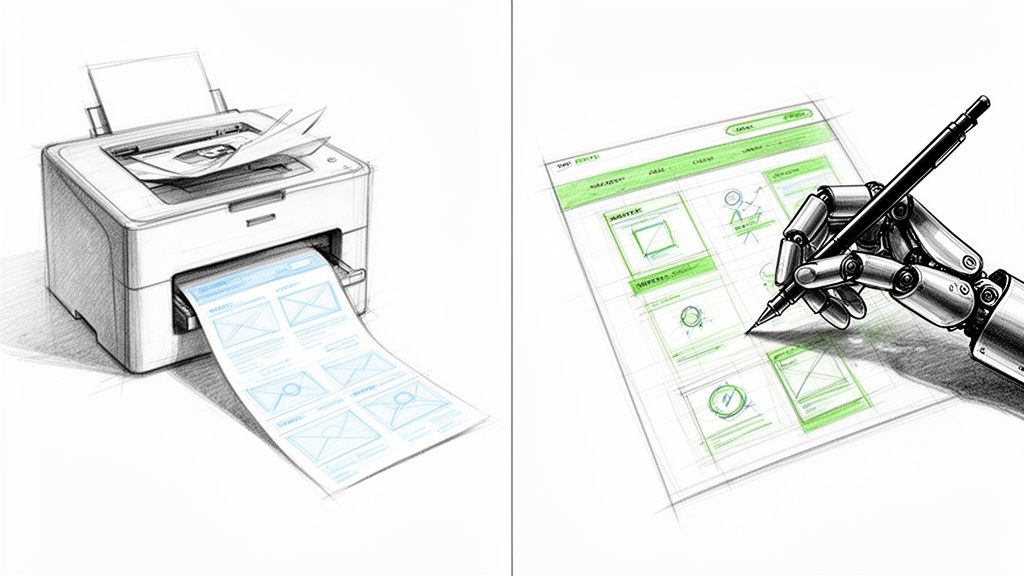
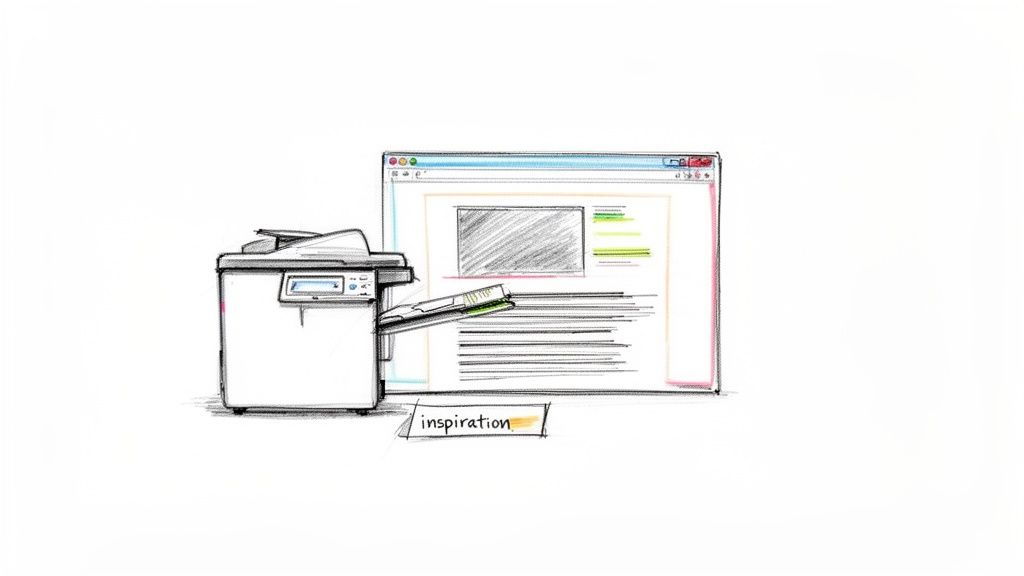
Think of a website cloning tool as a digital photocopier for websites. At a glance, that's the simplest way to get your head around it. These tools are built to make a copy of a live website's front-end design, promising a shortcut to a professional-looking site without having to build it from the ground up. It's this promise of speed and ease that makes them so popular.
What Are Website Cloning Tools and Why Are They Popular
At its heart, a website cloning tool tries to replicate the visual and structural pieces of a website. It’s a bit like taking a high-resolution photograph of a beautifully designed house. You capture the layout, the color palette, and the overall style, but you don't get the actual blueprints, plumbing, or electrical wiring. That distinction is incredibly important.
The main draw is the desire to get a proven, effective design without the huge price tag or steep learning curve of professional web development. For entrepreneurs and small businesses, this can seem like a godsend. Why spend weeks agonizing over a design when you can just find a site you admire and replicate its look and feel?
The Two Sides of Website Replication
It’s crucial to understand the two very different paths that often get lumped together under the "cloning" banner. They couldn't be more different.
Direct Code Scraping: This is the dangerous route. Tools using this method literally download a website's public HTML, CSS, and image files to create a static, pixel-for-pixel copy. It's a direct copy-and-paste job of someone else's hard work and intellectual property. Services like the copycat247 website cloning service operate in this space.
AI-Powered Design Inspiration: This is the modern, ethical alternative. Instead of ripping off code, AI analyzes a website's layout, structure, and style. It then generates a brand-new, fully editable website inspired by that design, using its own clean, original code.
This is the difference between tracing a masterpiece and learning the techniques to paint your own. One gives you a flat copy with no soul; the other gives you a new creation born from inspiration. The demand for faster, smarter web design tools is exploding. The global website builder market is expected to hit USD 4,406.6 million by 2033, which shows just how many people are moving away from traditional, code-heavy development.
The goal should never be to create a carbon copy of a competitor's site. Instead, the smart approach is to use successful designs as a launchpad for your own unique brand identity, blending inspiration with originality.
Comparing Website Replication Methods
To make the distinction crystal clear, let's look at how these two approaches stack up. One is a risky shortcut, while the other is a strategic starting point.
Approach | How It Works | Key Risks | Best For |
|---|---|---|---|
Traditional Cloning | Directly scrapes and copies the public HTML, CSS, and JavaScript files from a target website to create a static replica. | High risk of copyright infringement, plagiarism, security vulnerabilities from messy code, and severe SEO penalties. | No one, really. The legal and technical risks far outweigh any short-term benefits. |
AI-Driven Inspiration | An AI analyzes the visual layout, components, and style of a URL. It then generates a brand-new, fully editable design with clean, original code. | Minimal to none. The output is a unique asset inspired by the original, not a direct copy of its proprietary code. | Developers, agencies, and businesses looking for a fast, ethical way to kickstart a new design based on proven layouts. |
The takeaway here is that while both methods aim to replicate a look, only one does it responsibly and provides a solid foundation you can actually build a business on.
Why Speed and Simplicity Matter
In business, time is money. The old-school web design process can be painfully slow and expensive, often holding back a new product launch or marketing campaign. The appeal of cloning tools is that they promise to slash that timeline. This relentless need for efficiency has made finding the fastest way to build a website a top priority for entrepreneurs everywhere.
Ultimately, wanting a great-looking website without the usual headaches is completely valid. But the method you choose will determine whether you're building a sustainable asset for your business or a ticking time bomb. In the rest of this guide, we’ll dive into why choosing ethical, AI-driven alternatives is the only responsible way forward for your business's security, integrity, and long-term success.
How Traditional Website Cloning Tools Work
So, how do these old-school website cloners actually pull it off? Think of them as super-fast, automated scrapbookers. Their one job is to visit a website and grab everything they can see on the surface, a process commonly known as site scraping.
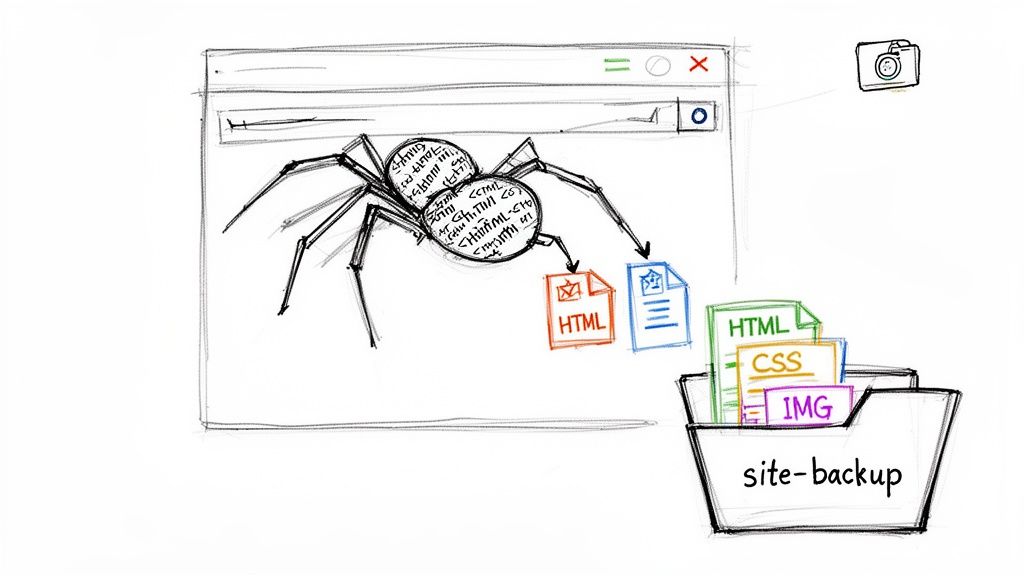
This method essentially creates an offline copy by downloading all the front-end files. It’s like hitting "Save Page As" in your browser, but instead of just one page, it tries to do it for every single page it can find on the entire site.
The Scraping and Downloading Process
The whole thing kicks off when the tool, acting like a web crawler, lands on the homepage you’ve targeted. It immediately starts reading the site's source code and downloading the key building blocks that create the visual experience.
This usually includes a few core types of assets:
HTML (HyperText Markup Language): This is the skeleton—the raw structure and text content of every page.
CSS (Cascading Style Sheets): These are the style rules that control the look and feel—the colors, fonts, and layout.
JavaScript (JS): These are the scripts that handle interactive features like pop-ups, animations, or image sliders.
Images and Media: All the visual assets, from JPGs and PNGs to embedded videos, get downloaded, too.
From the homepage, the tool follows every internal link it finds, repeating this download-and-save process for each new page. It continues this until it has a complete map of the site's structure, leaving you with a folder full of files that mirrors the public-facing website.
A Visual Shell Without a Brain
But here's the catch, and it's a big one. This process only captures the front-end. What you're left with is a hollow, non-functional shell of the original site.
It's like looking at a movie set. From the street, you see a perfect city block, but walk behind the building facades and there's nothing but empty space and scaffolding. The copy has no "brain"—no back-end server, no database, and no content management system (CMS).
A scraped website is a snapshot frozen in time. It captures the appearance but misses the dynamic engine that makes a modern website work. It’s a photograph of a car, not the car itself.
This limitation causes immediate and serious problems. The scraped site is completely static. Want to update a blog post or change a product price? You can't just log in and edit it. You'd have to dig into the raw code files, a monumental task for anyone who isn't a seasoned developer.
Why Functionality Breaks Down
Because these cloning tools only copy the surface-level code, anything that needs a server or database to work will be completely broken. This is where the illusion of a perfect replica falls apart.
Common features that simply stop working in a cloned site include:
Contact Forms: The form fields will be there, but submitting one does nothing. The data has nowhere to go.
User Logins: You'll see the login page, but since there's no user database to connect to, it’s completely useless.
Shopping Carts: You can often add a product to the cart, but the checkout process will fail because it can't communicate with a payment processor or inventory system.
Database-Driven Content: Blog posts, product catalogs, or user-generated reviews are ripped from the database and hard-coded into the HTML, making them impossible to update.
In the end, what these traditional tools produce is a fragile, brittle copy. It might look the part at first glance, but it’s a fundamentally broken asset that can’t support the needs of a real business.
The Legal and Ethical Minefield of Direct Cloning
It's tempting to see website cloning tools as a brilliant shortcut, a way to get a professional-looking site up and running in no time. But the reality is, you're not taking a shortcut—you're walking straight into a legal and ethical minefield. The risks here aren't just theoretical; they can have severe, business-ending consequences. The second you clone a website, you're wading into the deep, murky waters of intellectual property law.
Think about all the pieces that make a website work: the unique layout, the custom graphics, the carefully written text, and even the code that runs it all. Every single one of those elements is considered protected intellectual property. This protection is automatic, too. The creator doesn't have to file a single piece of paperwork for their copyright to hold up in court.
Here's an analogy: cloning a website is like photocopying a bestselling novel, slapping a new cover on it, and passing it off as your own. Nobody would see that as acceptable, yet the digital version of this happens all the time, usually because people just don't understand the potential fallout.
Copyright Infringement: The Biggest Legal Hammer
The most immediate and dangerous risk you face is copyright infringement. When a tool scrapes and copies a website, it’s making an unauthorized duplicate of copyrighted material. This isn't some legal gray area; it's a direct violation of international IP laws.
The owner of the original website has every right to come after you legally. The penalties aren't just a slap on the wrist, either. They can be devastating for any business, especially a new one.
Cease and Desist Letters: The first thing you'll likely receive is a formal demand from their lawyers, telling you to take the copied site down immediately.
DMCA Takedown Notices: The copyright holder can also file a notice with your web host. Your host is legally required to pull your site offline to protect themselves from liability. Suddenly, your business vanishes from the web.
Lawsuits and Hefty Fines: If it gets serious, you could be sued. We're talking about paying for statutory damages, their lost profits, and all the legal fees, which can quickly spiral into tens or even hundreds of thousands of dollars.
To really get a sense of how serious this is, it's worth understanding what qualifies as an intellectual property violation and the full scope of the risks involved. The legal system is built to protect creators, and judges don't take kindly to blatant copying.
Taking inspiration from another design is standard practice in our industry. Directly lifting the code and content is theft. Knowing the difference is absolutely critical to building a business that lasts.
The Ethical Problem and Your Brand's Reputation
Beyond the courtrooms and legal letters, there's a huge ethical problem that can do long-lasting damage to your brand. When you present a copied design as your own, you're being dishonest. You're building your business on a shaky foundation of someone else's work, and that erodes trust from day one.
Your website is often the very first handshake with a potential customer. If that first impression is built on a lie, what does it say about the integrity of your products or services? Sooner or later, someone will notice—a customer, a competitor, or the original designer.
When your business gets exposed as a copycat, the fallout can be brutal:
Risk Category | What It Means for You |
|---|---|
Trust Erosion | Customers will doubt your authenticity. They'll wonder what else isn't original and may flock to a competitor they feel they can trust. |
Industry Reputation | You could get blacklisted. Good luck forming partnerships, attracting talented employees, or being taken seriously in your field. |
Brand Identity | A copied design means you have no unique identity. You'll always be a "me-too" knockoff, never a leader in your own right. |
At the end of the day, direct cloning is just bad business. It trades long-term credibility for a short-term gain. Real brand strength is born from originality and having a clear voice, not from borrowing someone else's. The goal isn't to blend in—it's to stand out.
Uncovering the SEO and Security Nightmares
Beyond the courtroom, the problems with website cloning tools bleed into some serious technical territory. The immediate fallout hits your online visibility and the safety of your digital assets. These aren't just minor setbacks; they can completely derail your business before it even gets off the ground.
The first major issue is a head-on collision with the fundamental rules of search engine optimization (SEO). Search engines like Google are obsessed with one thing: providing unique, valuable content. When you use a direct cloning tool, you’re creating duplicate content—an exact or near-exact copy of another site's code, text, and structure.
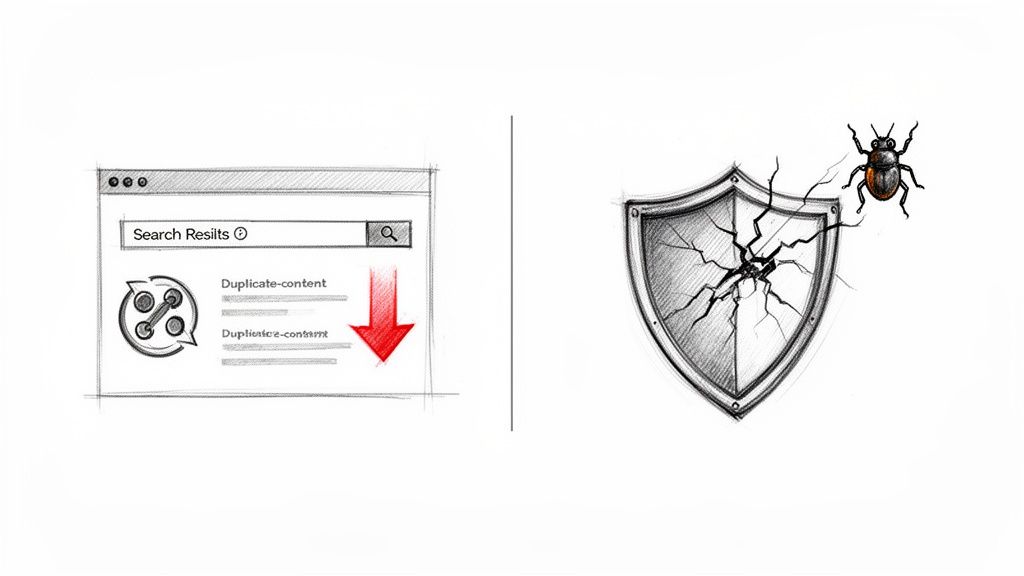
This is a massive red flag for search algorithms. Google’s whole job is to avoid showing users ten different versions of the same page. As a result, it will severely penalize sites for duplicate content. Your pages might get pushed way down in the rankings or, worse, de-indexed entirely, making you invisible. For a new business, that's a death sentence. To get a better handle on these core principles, check out our guide on what is search engine optimization.
The Hidden Dangers in Scraped Code
Even if you somehow dodge an immediate SEO penalty, the code you've just scraped is often a technical disaster waiting to happen. You’re working with code that's likely outdated, messy, and definitely not optimized for performance.
Poor Performance: Scraped code often comes bloated with unneeded scripts and oversized images, which means slow load times. Since site speed is a huge ranking factor, this will drag your site down.
Broken Links and Scripts: The cloning process is rarely perfect. It often messes up internal links and script paths, leading to a broken user experience that frustrates visitors and screams "low quality" to search engines.
Lack of Schema Markup: Modern websites use structured data (schema) to help search engines understand their content. A cloned site will either have the original site’s schema—totally confusing Google—or none at all, missing out on valuable search features like rich snippets.
A cloned website is built on a borrowed, unstable foundation. You inherit all of its existing technical debt without any of the tools or knowledge needed to fix it, guaranteeing a poor user experience and even poorer search performance.
A Permanent Security Vulnerability
While the SEO issues are damaging, the security risks that come with website cloning tools are genuinely alarming. When you download a bundle of files scraped from someone else’s website, you have no idea what’s hiding inside. Think of it like finding a random USB stick on the sidewalk and plugging it straight into your work computer.
Those downloaded files can easily contain malicious code. Hackers often inject malware or backdoors into vulnerable websites, and a cloning tool will happily copy that infected code right along with the clean stuff. This gives attackers an open invitation to your server, your data, and your customers' private information.
Here’s a breakdown of the most common threats you’re inviting in:
Threat Type | How It Works | The Consequence for You |
|---|---|---|
Malware | Malicious software is tucked away in the scraped JS or HTML files, executing when someone visits your site. | Your site could be used for phishing, get blacklisted by Google, or infect your visitors' computers—destroying your reputation overnight. |
Backdoors | A hidden entry point is coded into the site, giving a hacker persistent, unauthorized access to your server. | Attackers can steal data, deface your website, or use your server to launch attacks on other people. |
No Security Updates | A static clone isn't connected to a CMS like WordPress or a secure platform. It gets zero updates or security patches. | Any vulnerability discovered in the original site's code becomes a permanent, unfixable hole in your cloned version. |
That last point is absolutely critical. Legitimate web platforms are constantly being updated to patch new security holes. A static, cloned site is frozen in time, becoming an easier and easier target for automated attacks as the weeks and months go by. By choosing a direct clone, you're opting out of the entire ecosystem of modern web security and leaving your digital front door wide open.
The Modern Alternative: AI-Powered Design Inspiration
We've walked through the serious legal, ethical, and technical minefield that is traditional website cloning. It's pretty clear that directly scraping code is a dead-end street. But the desire for a sharp, professional website without the massive price tag or endless timeline is completely valid. The method is what matters.
This is where a much smarter, more responsible alternative comes in: AI-powered design inspiration.
Think of modern AI website builders less like a shady code thief and more like a highly skilled designer who studies another website for its best ideas. The AI analyzes the layout, the structure, and all the little style elements to understand its "design DNA"—what makes it work so well visually.
This approach gives you the aesthetic you love without any of the baggage. It’s the intelligent evolution of web design: you get the look you want, but it's built the right way, from the ground up, just for you.
From Copying Code to Generating Originality
The real magic is in what you get at the end. A classic cloning tool spits out a fragile, stolen copy. An AI-powered platform, on the other hand, delivers a brand-new, unique website built with clean, optimized, and fully editable code.
It's like the difference between photocopying a famous painting and commissioning a master artist to create a new piece in a similar style. One is a cheap knock-off; the other is a genuine work of art.
The process is simple on the surface but incredibly sophisticated under the hood:
Inspiration Analysis: You give it the URL of a website you admire. The AI scans the page not to lift its code, but to understand its visual hierarchy, how the components are arranged, the color palette, and the typography.
Blueprint Creation: Using this analysis, the AI drafts a structural blueprint or wireframe for a brand-new site.
Original Code Generation: From there, it generates completely new HTML, CSS, and JavaScript to bring that blueprint to life. The final product is a fully functional, mobile-responsive website that is 100% original.
This method elegantly sidesteps all the nightmares of direct cloning. Since the code is brand new, you don't have to worry about copyright infringement, duplicate content penalties from Google, or hidden malware lurking in the scraped files.
The Business Case for AI-Driven Design
Businesses need to move faster than ever, and the demand for smarter web development is exploding. This isn't just a niche trend; the web development market is on track to hit USD 134.17 billion by 2031. Small and medium-sized businesses are really driving this shift, grabbing onto tools that cut down initial costs and free up resources to focus on actual growth. You can see more data on this trend and its impact on web development market growth.
An AI website builder doesn't just replicate a look; it reinterprets a design strategy. It takes the successful elements of an existing site and uses them to construct a new, secure, and unique digital asset for your brand.
This modern approach helps you leapfrog from simple imitation to genuine innovation. You can dive deeper into how this works by checking out our guide on using AI to build a website.
Why This Is the Superior Path Forward
When you get down to it, choosing AI-powered design inspiration over old-school website cloners gives you clear, tangible benefits that actually protect and grow your business. You get the best of both worlds: the speed of starting with a proven layout and the security of owning a unique, well-built website.
Feature | Traditional Cloning Tool | AI-Powered Design Tool |
|---|---|---|
Code Ownership | Stolen, messy, and outdated code. | New, clean, and original code. |
Legal Risk | High risk of copyright infringement. | No legal risk; it's an original creation. |
SEO Impact | Severe penalties for duplicate content. | SEO-friendly from the start. |
Security | High risk of hidden malware and no updates. | Secure, up-to-date platform. |
Editability | Static and nearly impossible to update. | Fully editable through a user-friendly interface. |
In the end, the goal isn't just to launch a website—it's to build a sustainable online presence. AI-driven tools provide the foundation for that, making sure your site is not only beautiful but also safe, scalable, and truly yours.
An Ethical Workflow for Building an Inspired Website
Switching from sketchy website cloning tools to a responsible, AI-driven process is about more than just dodging legal headaches. It’s about building a stronger, more authentic brand. This approach lets you draw inspiration from the best designs on the web and use that spark to launch your own unique creation. This isn't imitation; it's innovation.
You’re not stealing code. Instead, you're learning from a layout that works and then building something entirely new and better. This ensures your final website is secure, original, and perfectly aligned with your business goals right from the start.
The Four Steps to Inspired Design
Building a website this way is a straightforward, four-step process. It's designed to be quick and effective while keeping you firmly on the right side of legal and ethical lines. The key is to use a reference as a starting point, not a restrictive blueprint.
Gather Broad Inspiration: Don't just pick one site. Start by identifying elements you admire across several different websites. Make a note of specific layouts, color combinations, and interactive features that really connect with your brand's vision. This keeps you from getting fixated on a single design and naturally pushes you toward a more original result.
Use a Reference URL as a Starting Point: Take your main inspiration's URL and plug it into an AI website builder like Alpha. The AI will analyze its structure and aesthetic to generate a foundational layout. This gives you a solid wireframe and style direction without copying a single line of someone else's code.
Immediately Customize with Your Assets: This step is absolutely critical. Swap out all the placeholder content with your own text, images, and brand materials. This is where the design stops being "inspired by" and starts being "owned by" you. Your unique voice and visual identity are what make the site truly yours.
Refine and Differentiate: Now, it's time to make the design your own. Tweak the color scheme, change the fonts, and move entire sections around to better fit your content and conversion goals. The aim is to create a final website that is so distinct it stands on its own, completely separate from the original inspiration.
This simple, three-part flow shows how AI tools analyze, generate, and then hand over the design for full customization.
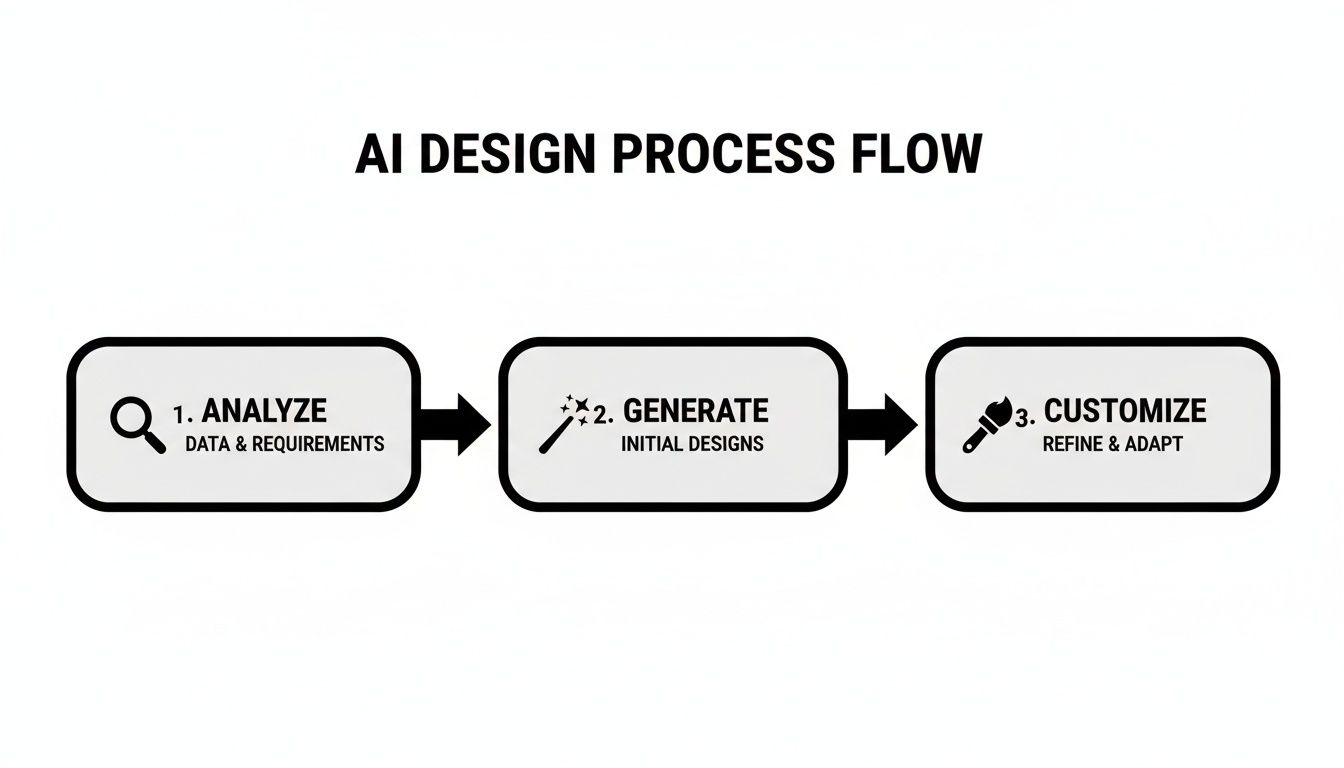
As you can see, the AI generation is just the middle step—it's bookended by your strategic analysis upfront and the deep customization that follows.
The Power of an AI-Driven Process
This workflow is all about achieving both efficiency and originality. While the top 10 web hosting providers still command a huge market share, the real growth is happening on AI-powered platforms. It's no surprise that 30% of business owners now expect AI to help write their website's copy.
Platforms like Alpha are at the forefront of this shift. Forget clunky cloners. You can just feed it a URL, and the AI generates a fully editable, mobile-optimized site with all the necessary features ready to go. To get a better sense of this market shift, you can dig into the latest web hosting statistics.
By focusing on customization and originality from the very beginning, you ensure your website is not just a copy, but a competitive asset. The inspiration is the spark, not the final product.
Digging a Little Deeper: Common Questions About Website Cloning
Let's clear the air on some of the most frequent questions people have about website cloning tools and the smarter, ethical ways to build a site you love.
Is Cloning a Website Illegal?
The short answer? Yes. Ripping a website’s code, images, and text wholesale without permission isn’t just bad form—it’s copyright infringement, and that’s illegal. Doing so can get you into hot water fast, leading to everything from takedown notices from your hosting provider to expensive legal battles.
But let's be clear: getting inspired by another website's design is perfectly fine. It's standard practice. The line in the sand is between inspiration and imitation. You can absolutely admire a site's layout and then build your own version with your own original code and content.
Can You Clone a Website's Functionality?
Not with these tools. A typical website cloner is only skin-deep. It scrapes the front-end visual layer—the HTML and CSS—but leaves the engine behind. You end up with a static, hollow shell.
Think about features like a user login, a shopping cart, or even a simple contact form. None of that will work. To get that kind of functionality, you need to build it properly on a platform that actually supports it, and then style it to match the look you're going for.
A cloned site is like a photograph of a car—it has the look but none of the working parts. True functionality requires an engine, which these tools simply cannot copy.
How Is an AI Website Builder Different from a Cloning Tool?
This is where the difference becomes night and day. A classic cloning tool is a blunt instrument. It steals existing code, creating a direct copy that’s often broken, insecure, and a legal minefield. It’s a literal copy-and-paste job of someone else's hard work.
An AI website builder, on the other hand, acts like a skilled designer. It studies a site for inspiration—layout, colors, fonts—and then generates completely new, clean, and optimized code from scratch to recreate that style. You get a fully functional, secure, and unique website that's yours to edit and own, without a shred of copyrighted material. It gives you an incredible head start, not a stolen copy.
Ready to build a site that captures the feel of the best designs on the web, but without the legal headaches and technical debt? With Alpha, you can just plug in a URL. Our AI will then generate a brand-new, fully editable website with clean code in minutes.
Build beautiful websites like these in minutes
Use Alpha to create, publish, and manage a fully functional website with ease.