

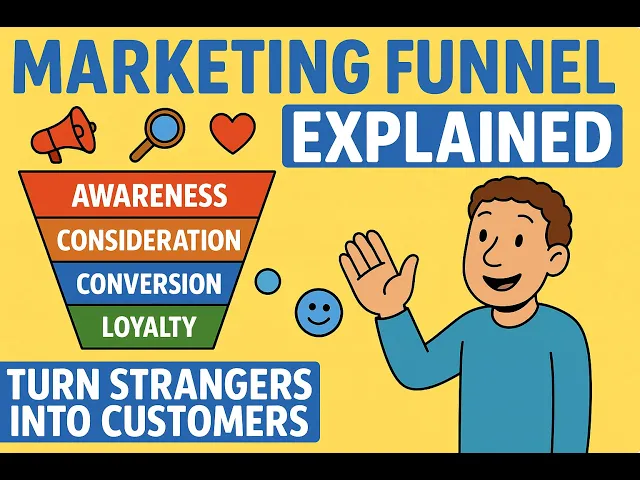
How to Create Website Mockups People Actually Love
Learn how to create website mockups that bridge the gap between idea and reality. Our guide covers tools, principles, and developer handoff.
Build beautiful websites like these in minutes
Use Alpha to create, publish, and manage a fully functional website with ease.
Ever wonder how a total stranger becomes a paying customer? It's not magic; it's a journey. A conversion funnel is simply a map of that journey, showing the path someone takes from their very first interaction with your brand to the moment they take the action you want them to, like making a purchase.
Think of it like an actual, physical funnel. You start by pouring a big, broad audience in at the top. As they move down, some people will naturally drop off, and a smaller, more committed group of customers emerges from the narrow end.
Breaking Down The Conversion Funnel
At its heart, a conversion funnel is all about understanding the customer's mindset. It’s more than just a marketing buzzword; it's a practical blueprint that helps you see your business through your customers' eyes, tracking their evolution from a curious browser into a loyal advocate.
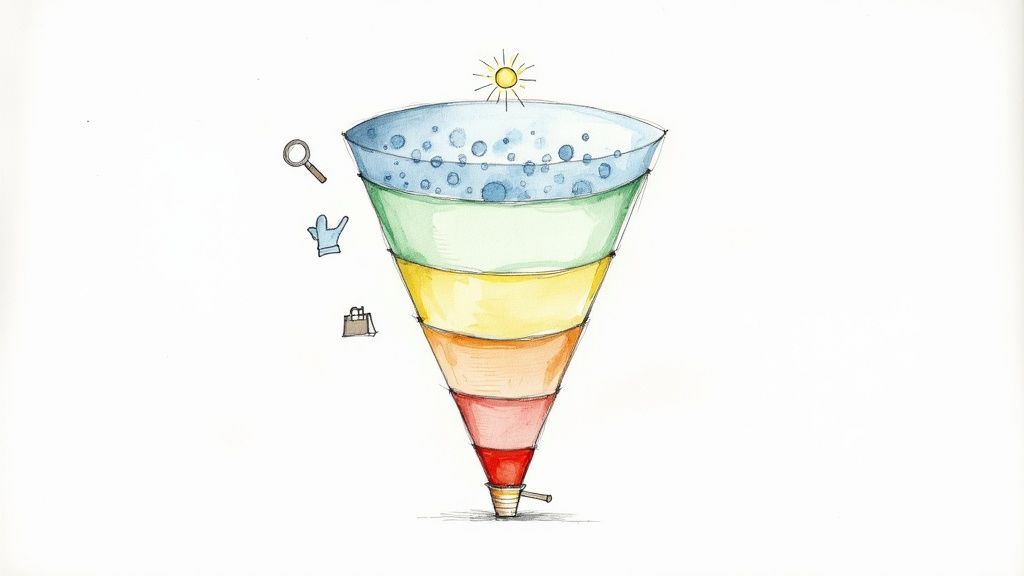
The funnel shape is key. It visualizes the reality that you'll always have more people aware of your brand than you'll have people actually buying from it. This classic AIDA model (Awareness, Interest, Decision, Action) shows this perfectly.
As you can see, the crowd thins out at every step. That's not a bad thing—it's normal. Our job is to make the transition between each stage as smooth as possible.
Why Is This So Important For Your Business?
Understanding this process is a game-changer for growth. Instead of shouting the same message at everyone, the funnel lets you connect with people based on where they are in their decision-making process. You can whisper to the curious and give a gentle nudge to those ready to buy. It turns your marketing from a shot in the dark into a predictable, measurable system.
The real magic of the funnel isn't just in what it shows, but in what it reveals. By seeing exactly where people drop off—the "leaks" in your funnel—you can stop guessing and start making smart, data-backed decisions to fix the problem.
For a closer look at each stage, here’s a quick breakdown:
Stage | What It Means | Example User Action |
|---|---|---|
Awareness | The "first date." This is where someone first discovers your brand. | Seeing your ad, reading a blog post, or finding you on social media. |
Interest | They're intrigued. They're starting to research and evaluate if you’re a good fit. | Subscribing to your newsletter, following you, or browsing product pages. |
Decision | The moment of truth. They're actively considering a purchase and comparing you to others. | Watching a demo, reading reviews, or adding an item to their cart. |
Action | Success! The user completes the desired action. | Making a purchase, signing up for a trial, or booking a consultation. |
Ultimately, the goal is to make the journey through these stages as seamless as possible for your potential customers.
A well-managed funnel tracks these movements, letting you spot the exact points where you’re losing people. Are they abandoning their carts? Are they leaving from a specific landing page? Knowing this tells you exactly where to focus your energy, whether it's tweaking your messaging or improving the user experience.
If you want to dig deeper into building a powerful funnel from the ground up, this guide on how to create a sales funnel that converts is a fantastic resource.
Breaking Down Each Stage of the Customer Journey
To really get a handle on what a conversion funnel is, you have to put yourself in your customer’s shoes. No one goes from being a total stranger to a loyal customer in one giant leap. It’s a journey made up of smaller, distinct steps, each driven by a completely different motivation. The classic AIDA model—Awareness, Interest, Decision, and Action—gives us a fantastic map for this journey.
When you break down the customer experience this way, you can stop shouting one generic message at everyone. Instead, you can start having meaningful conversations, delivering just the right information at precisely the right time. This is how you build trust and make the path to becoming a customer feel helpful, not pushy.
Stage 1: Awareness - The First Hello
This is the very top of your funnel (TOFU), where a potential customer realizes they have a problem or a need. Right now, they probably have no idea who you are. Their goal isn't to buy something; it's to find answers and educate themselves.
They're typing broad questions into Google, trying to get a lay of the land. Your job is to be the helpful expert who shows up with the information they're looking for.
Customer Mindset: "I'm so frustrated with [problem]. How do I fix this?" or "I'm curious about [topic]. Where can I find out more?"
Your Goal: Grab their attention and establish your credibility from the get-go. You want them to walk away thinking, "Wow, that company really knows their stuff."
Effective Tactics: The name of the game is high-value, easily discoverable content. Think blog posts that solve a specific problem, shareable social media updates, insightful infographics, or quick educational videos. SEO is your best friend here, making sure you’re the one they find first.
This visual shows exactly how that broad audience at the top gets smaller and more focused as they move toward making a purchase.
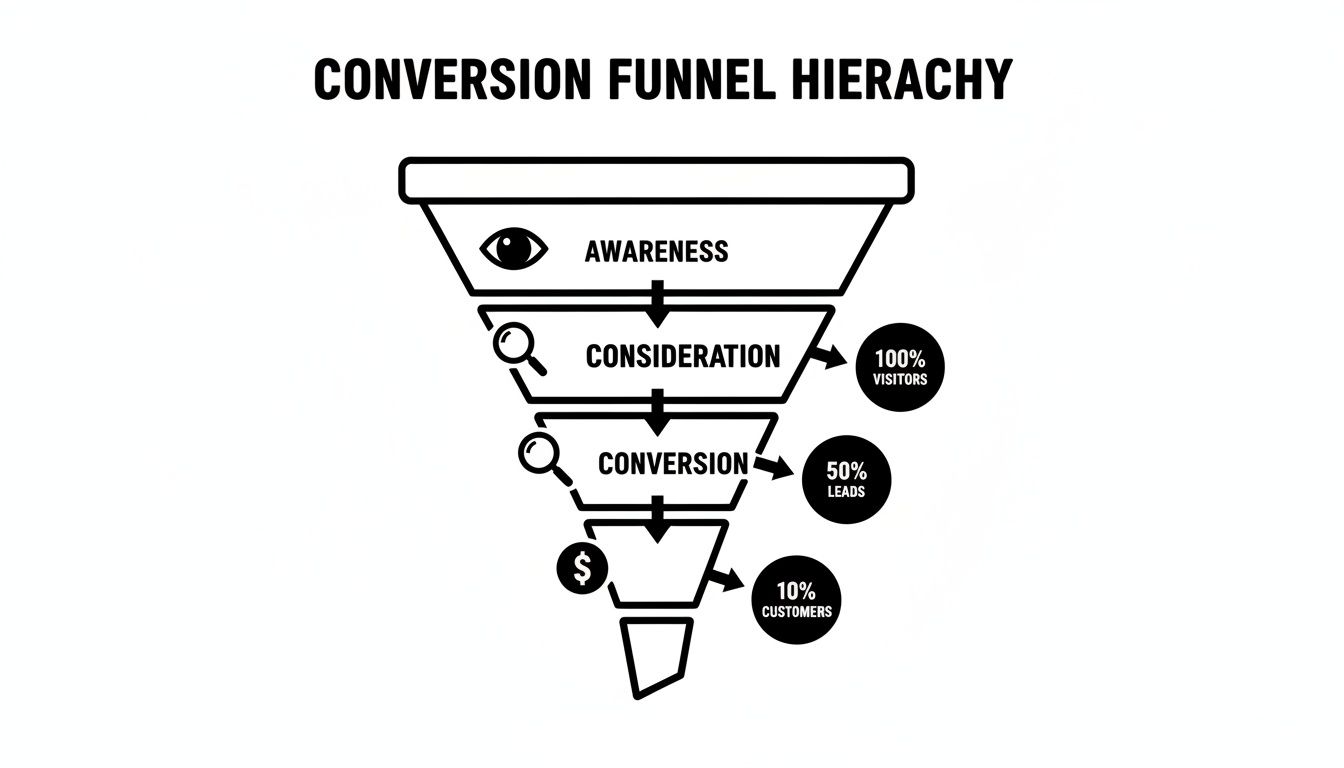
As the infographic makes clear, people naturally drop off at each stage. That's precisely why optimizing every single step is so critical for growing your business.
Stage 2: Interest - Nurturing Curiosity
Once someone knows about their problem and has bumped into your brand, they move into the middle of the funnel (MOFU). This is where they get serious. They're actively researching and comparing different solutions. They’ve gone from just browsing to actively evaluating their options.
At this point, the relationship starts to get a little deeper. You're no longer just a random source of information; you're now a real contender.
This is where you shift from simply attracting an audience to actually building a connection. The goal is to prove you not only get their problem but have a genuinely good way to solve it.
The content you offer here needs to be more specific and go into greater detail.
Customer Mindset: "Okay, I've found a few options. Which one is right for my specific needs? What are the must-have features?"
Your Goal: Keep their interest piqued and clearly show what makes you different (and better).
Effective Tactics: This is the perfect time to offer more substantial resources like webinars, detailed guides, case studies, or checklists—usually in exchange for an email address. Getting that email is a huge micro-conversion that lets you keep the conversation going directly.
Stage 3: Decision - Making the Choice
Welcome to the bottom of the funnel (BOFU). Your potential customer is on the brink of making a choice. They’ve whittled their list down to just a handful of options, and you’ve made the cut. Now, they just need that final nudge to choose you over the competition.
Here, trust and proof are everything. They’re looking for any sign that they’re making a smart decision and won’t regret it later.
Customer Mindset: "I'm ready to pull the trigger, but I need to be 100% sure. Why should I go with this brand over that one? Can I really trust them?"
Your Goal: Build rock-solid confidence and knock down any lingering doubts. You need to make your offer feel both irresistible and completely risk-free.
Effective Tactics: Nothing works better here than testimonials, customer reviews, free trials, product demos, or side-by-side comparison pages. A strong offer, like a limited-time discount, can also create the perfect amount of urgency to seal the deal.
Stage 4: Action - Sealing the Deal
This is it—the final, make-or-break step. The customer is ready to hand over their money or sign up. Your only job at this point is to make this process as smooth and painless as humanly possible.
Any friction—a confusing form, an extra step, a slow-loading page—can make them second-guess their decision and abandon the whole thing. The user experience has to be absolutely perfect.
Customer Mindset: "Let's do this. How do I get this done as quickly and easily as possible?"
Your Goal: Pave a seamless, direct path to the finish line.
Effective Tactics: A clean, simple checkout process, crystal-clear calls-to-action (CTAs), and fast, optimized pages are non-negotiable. This is where a brilliantly designed checkout page or a focused landing page becomes your most important asset. If you want to dive deeper, you can learn all about what is a landing page in our detailed guide.
Why Your Business Can't Grow Without a Funnel
Let's be blunt: if you don't have a conversion funnel, you're not really marketing—you're just guessing. It's the difference between navigating with a GPS and just driving around hoping you'll stumble upon your destination. You're pouring money into ads, content, and social media without a clear picture of what's working or, more importantly, where you're losing people.
A funnel brings clarity to that chaos. It maps out the path a stranger takes to become a paying customer, showing you exactly where your process is strong and where it’s falling apart.
Think of it like a plumber diagnosing a leak. You wouldn't just keep mopping the floor; you'd find the source of the problem and fix it. A funnel shows you precisely where the holes are in your customer acquisition process so you can patch them for good.
From Guesswork to a Predictable System
Once you map out your funnel, you can stop reacting to poor sales numbers and start proactively building a machine that generates them. The entire approach to growing your business shifts from hoping for the best to making data-backed decisions that directly affect your bottom line.
A well-defined funnel helps you:
Pinpoint Leaks: See the exact moment potential customers lose interest and drop off, so you know what needs fixing first.
Optimize Spending: Discover which channels bring you the most valuable customers, allowing you to double down on what works and cut what doesn't.
Improve Customer Experience: Deliver the right message at the right time, answering questions before they're asked and guiding people smoothly toward a solution.
Forecast with Confidence: When you know the conversion rate at each step, you can reliably predict how much revenue a new marketing campaign will generate.
This creates a powerful feedback loop. You can tweak your product page copy, change a button color, or simplify a form and see almost immediately how it impacts the numbers at the next stage. It’s a systematic way to build a better business.
Creating a Better Customer Journey
At the end of the day, the biggest win from using a funnel is that it forces you to put yourself in your customer's shoes. You start thinking deeply about their problems, questions, and hesitations at every single step of their journey.
By understanding the journey from their perspective, you stop selling and start guiding. This shift builds the trust necessary not just for a single sale, but for creating loyal customers who become advocates for your brand.
Without a funnel, your marketing efforts can feel disjointed and confusing to a potential buyer. With one, you build a cohesive experience that feels helpful and natural, making the decision to buy from you feel like the obvious next step. That foundation is absolutely critical for any business serious about scaling.
Tracking the Metrics That Actually Matter
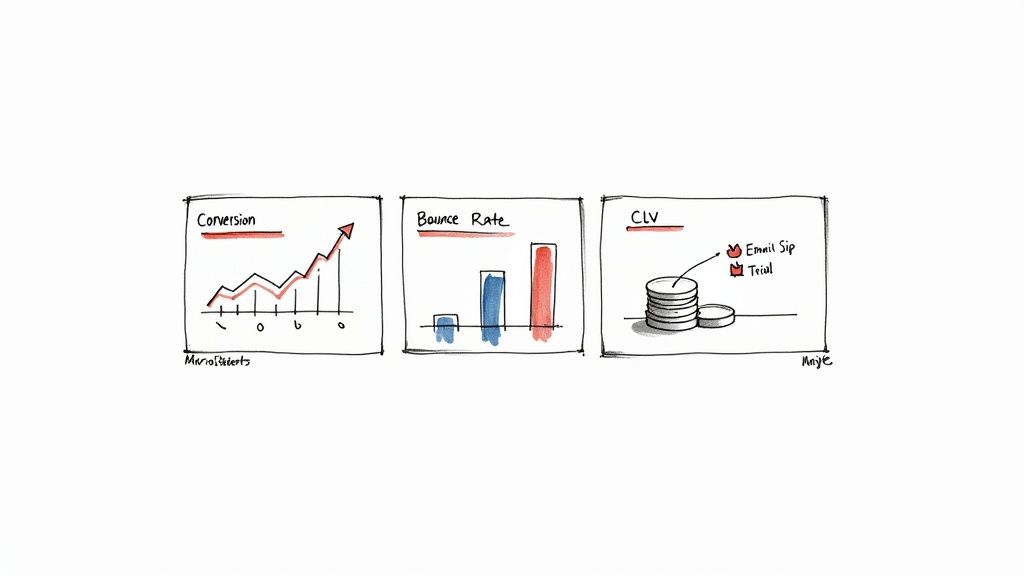
A funnel is just a pretty diagram until you start measuring it. To really see what's working—and what's not—you have to get your hands dirty with data. Without hard numbers, you’re just guessing where you're losing potential customers. Tracking the right metrics is how you turn that guesswork into a clear, actionable plan.
The first step is knowing what kind of actions you're even tracking. It boils down to two types of conversions:
Macro-Conversions: This is the big win. It's the final, primary goal you want someone to achieve, like completing a purchase, signing a contract, or starting a paid subscription. This is what directly drives your revenue.
Micro-Conversions: These are the smaller, essential steps people take along the way. Think of them as signposts of growing interest: subscribing to a newsletter, adding a product to the cart, or downloading a whitepaper. They're strong indicators that someone is moving in the right direction.
Keeping an eye on both gives you the full story. A sudden drop in newsletter sign-ups (a micro-conversion) could be an early warning that something is broken, long before you see a dip in your final sales numbers.
Key Funnel Metrics You Must Track
To get a real diagnosis of your customer journey, you don't need to track a hundred different things. Focus on a few key performance indicators (KPIs) that tell you how people are behaving at each stage.
The single most important metric is your stage-by-stage conversion rate. Instead of just looking at your overall sales numbers, calculate the percentage of people who successfully move from Awareness to Interest, from Interest to Decision, and finally from Decision to Action. This immediately shines a spotlight on the biggest "leaks" in your funnel.
For example, a high exit rate on your pricing page isn't just a random statistic. It's a loud-and-clear signal that your value proposition is weak, your pricing is confusing, or your offer simply isn't compelling. Insights like these are gold because they tell you exactly where to focus your efforts first. If you want to dive deeper into turning data into action, it's worth understanding what is website analytics.
Funnel Stage Metrics and Industry Benchmarks
To help you see where you stand, this table breaks down crucial metrics for each stage of the funnel, along with some typical industry benchmarks.
Funnel Stage | Key Metric | Average Benchmark Range |
|---|---|---|
Awareness | Click-Through Rate (CTR) | 1% - 5% for search/display ads |
Interest | Bounce Rate | 40% - 60% (lower is better) |
Decision | Add-to-Cart Rate | 8% - 12% for e-commerce |
Action | Final Conversion Rate | 1% - 3% for e-commerce |
Remember, these are just averages. Your own numbers will depend heavily on your industry, audience, and offer. The real value is in tracking your own metrics over time and consistently working to improve them.
Interpreting the Numbers for Growth
Once you have the data, the next step is to figure out what it's telling you. A high bounce rate at the top of the funnel could mean your ad copy doesn't match your landing page content. Low engagement with your middle-funnel blog posts might suggest your topics aren't resonating with your audience.
The goal isn't just to collect data, but to use it to ask better questions. Why are people dropping off here? What friction are they experiencing at this specific step?
This data-driven approach is critical because the drop-off at each stage of the funnel can be steep. It’s not uncommon for just a small, single-digit percentage of your initial visitors to become paying customers. In fact, many studies show e-commerce checkout abandonment rates hover between 60% and 80%. That’s a massive amount of potential revenue lost at the very last step.
This is exactly why optimizing each stage is so powerful. A small improvement—even just a 1% or 2% lift in conversions at one leaky stage—can create a ripple effect that leads to a significant increase in your overall revenue. It's how you turn a leaky bucket into a predictable growth engine.
Finding and Fixing Common Funnel Leaks
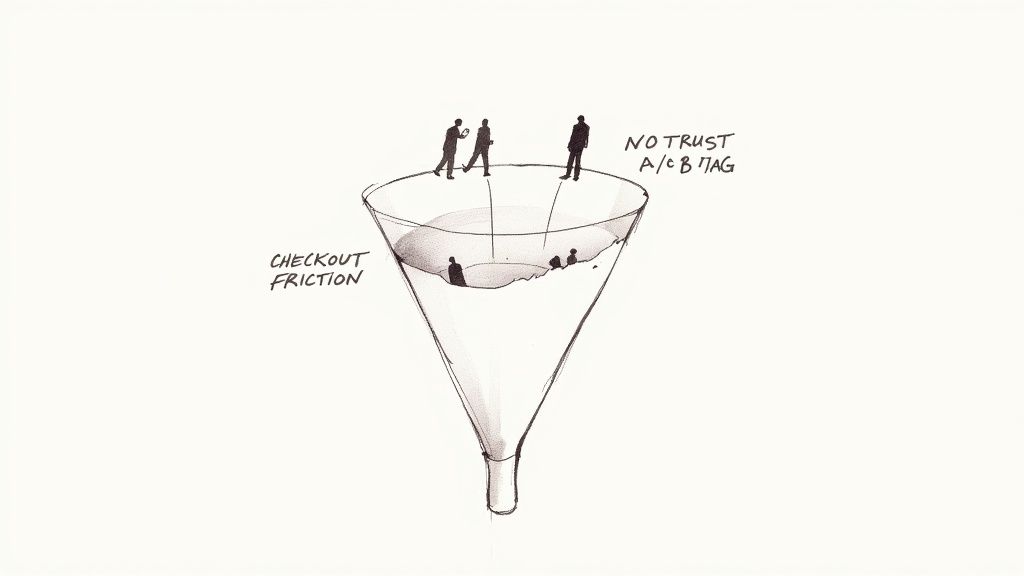
Let’s get one thing straight: there's no such thing as a perfect conversion funnel. Every single one has "leaks"—those points in the journey where potential customers hit a wall, get confused, or just lose interest and disappear. Your goal isn't to build some mythical, leak-proof system. It's to become a master plumber who can spot the drips and fix them fast.
Think of it like being a detective for your own business. By knowing what to look for at each stage, you can roll out targeted fixes that directly boost your bottom line.
Spotting Trouble at the Top of the Funnel
Right at the beginning, most leaks happen because of a mismatch between what you promised and what you delivered. If someone clicks an ad expecting one thing and lands on a page that feels completely different, they're gone in a flash.
Here are the usual suspects at this stage:
Confusing Navigation: Can people find what they need in seconds? If your site feels like a maze, they won’t bother trying to solve it.
Slow Page Load Speed: We're all impatient. A site that crawls is a conversion killer, causing visitors to bounce before you even get a chance to make your pitch.
Mismatched Messaging: Your ad screams about solving Problem X, but your landing page is all about Feature Y. That disconnect creates confusion and kills trust instantly.
One of the best ways to pinpoint these issues is through methodical testing. We actually have a whole guide on this, so you can learn more about A/B testing landing pages when you're ready.
Plugging Leaks in the Middle and Bottom of the Funnel
Once a visitor moves deeper into your funnel, the problems shift. Now, it's all about trust, clarity, and friction. They're seriously considering your offer, and any tiny doubt can send them straight to a competitor.
The most powerful way to fix a leaky funnel is to stop guessing what's wrong and start segmenting your data to find exactly where the highest-value opportunities are.
This is where the pros separate themselves. They don’t just look at the overall conversion rate; they dig into the details. Modern analytics tools let you track user behavior and slice your funnel data by traffic source, device, or country to see what’s really going on. A retailer, for instance, might discover that desktop visitors from one country convert at 2.4%, while mobile visitors from another only convert at 0.8%. That’s a huge gap that tells them exactly where to focus their energy and budget.
One of the biggest money drains for any e-commerce business is a clunky checkout process that causes cart abandonment. You can bring a good chunk of those people back with well-crafted abandoned cart email templates. Other crucial fixes include sprinkling in customer testimonials to build social proof and radically simplifying your forms to make buying as easy as possible.
A Few Common Questions About Conversion Funnels
As you start to wrap your head around conversion funnels, you'll probably have a few questions. That's a good thing. Getting these details straight is what separates knowing the theory from actually putting it into practice to grow your business. Let's dig into some of the most common ones.
What's the Real Difference Between a Conversion Funnel and a Sales Funnel?
You'll often hear these terms used interchangeably, but there's a small yet critical difference. It's best to think of a conversion funnel as the master category. It applies to any action you want a user to take, whether that’s signing up for a newsletter, downloading a free PDF, or booking a demo. The end goal is a conversion, but that doesn't always mean a cash transaction.
A sales funnel is just one specific type of conversion funnel. Its one and only goal is to make a sale. So, while every sales funnel is technically a conversion funnel, not all conversion funnels are about sales. The great news is that the process of tracking user behavior and optimizing each stage is exactly the same for both.
How Long Does It Take to Build a Funnel That Actually Works?
Setting up the basic mechanics—the landing pages, the forms, the automated emails—can be surprisingly fast. With the right tools, you might have the structure in place in just a few days. But here’s the important part: building an effective funnel isn’t a set-it-and-forget-it task. It's a continuous loop of improvement.
The real effort kicks in once your funnel is live. That's when you have to:
Gather real data on how people are interacting with your pages.
Pinpoint the exact spots where potential customers are bailing.
Form a solid guess (a hypothesis) about why they're leaving.
Run A/B tests to see if your proposed fixes actually work.
A top-performing funnel is never really "done." Think of it as a living part of your business that you constantly tweak based on hard data and customer behavior. It has to evolve right alongside your business and your audience.
Can I Have More Than One Funnel on a Single Website?
Not only can you, but you absolutely should. In fact, most smart businesses run multiple funnels simultaneously. Each one is built for a different audience or a different goal, which is far more effective than trying to force everyone down a single, one-size-fits-all path.
For instance, you might run:
A primary sales funnel for your flagship product.
A lead generation funnel that offers a free ebook in exchange for an email.
A very simple subscription funnel focused solely on growing your weekly newsletter.
Each funnel has its own job to do and speaks to visitors who are in different mindsets. By building out these distinct pathways, you can fine-tune each one for maximum impact, leading to much better performance across your entire marketing effort. It’s all about creating relevant experiences that guide different visitors to the specific action that makes sense for them.
Ready to stop losing customers on a confusing website? With Alpha, you can use AI to build a high-converting website in hours, not months. Our smart templates, optimized forms, and easy-to-use analytics are all designed to turn more visitors into customers. Build your conversion-focused website today!
Build beautiful websites like these in minutes
Use Alpha to create, publish, and manage a fully functional website with ease.