How to Create Website Mockups People Actually Love
Learn how to create website mockups that bridge the gap between idea and reality. Our guide covers tools, principles, and developer handoff.
Build beautiful websites like these in minutes
Use Alpha to create, publish, and manage a fully functional website with ease.


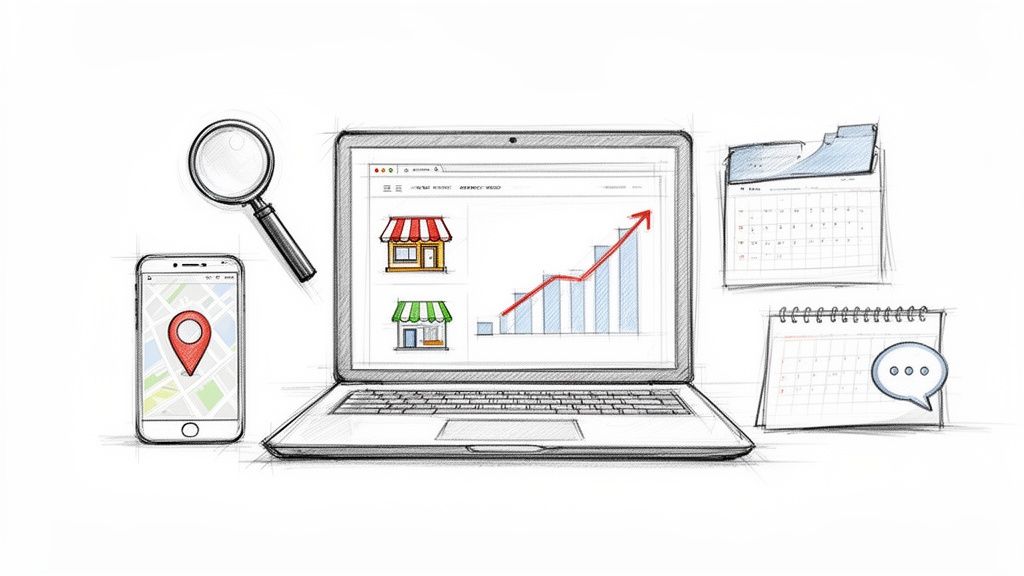
Let's be honest, a basic website just doesn't cut it anymore. If you want to win over local customers, your website needs to be a hard-working, lead-generating machine. Think of it as the central hub for all your digital marketing—the critical link between your social media, your Google Business Profile, and your bottom line. It's your chance to make a powerful first impression that builds trust and nudges visitors to take that next step.
Why Your Business Needs More Than a Basic Website
These days, almost every customer journey starts with a Google search. That means your website is often the very first interaction someone has with your brand. It's your digital storefront. If that storefront looks messy, outdated, or is hard to navigate, people will leave without a second thought.
A modern, well-designed website becomes the core of your entire online identity. It's the one place where you have complete control over your story, where you can truly show off what you do best, and make it ridiculously easy for people to become paying customers. We're talking about turning a passive online placeholder into your single most effective sales tool.
From Digital Brochure to Lead Generation Machine
The real goal is to move beyond a static "About Us" site and create a dynamic sales funnel. A simple website lists what you do; a strategic website guides visitors on a journey from "just looking" to "ready to buy."
It's a predictable path. A potential customer has a problem, they search for a solution online, they find your site, and then they decide to take action.
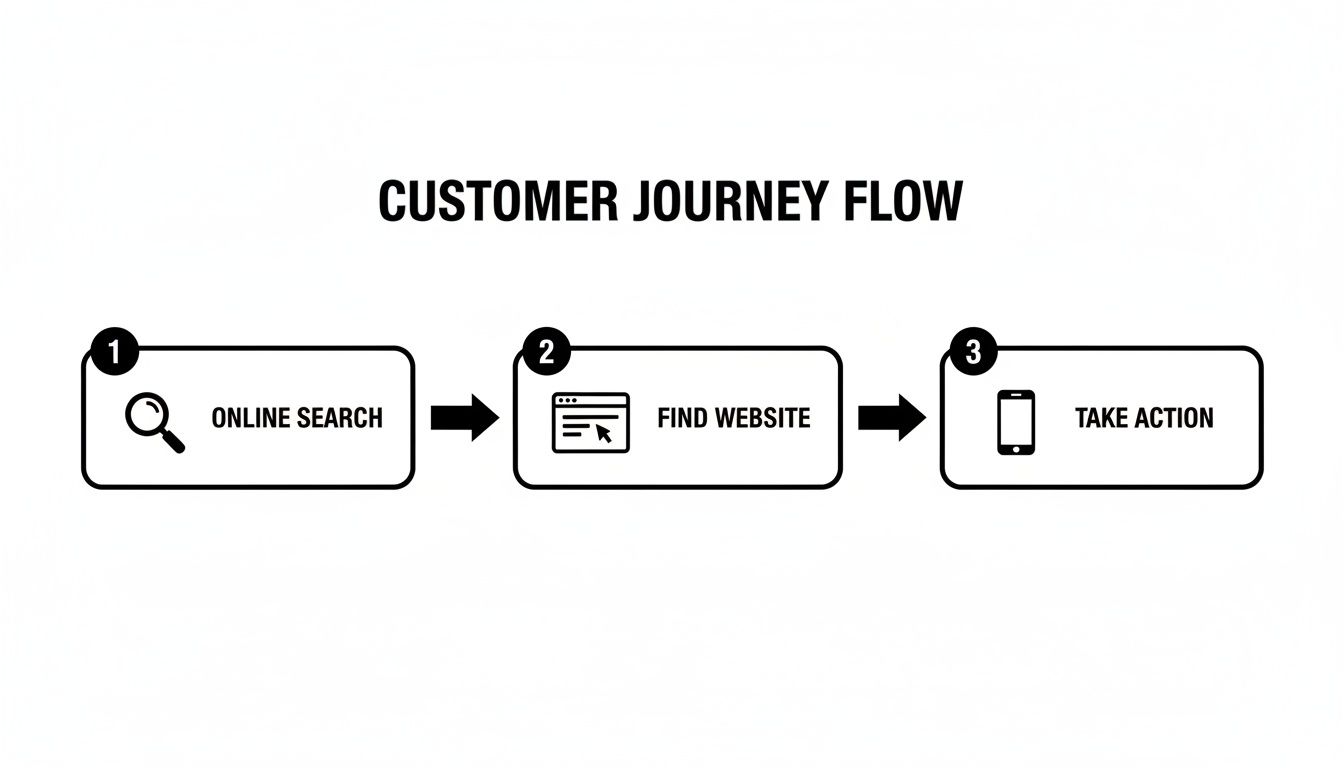
As you can see, your website is the crucial bridge between a potential customer's need and their decision to get in touch.
The numbers back this up, big time. A staggering 99% of people have used the internet to find a local business. On top of that, customers are 2.7 times more likely to trust a business that has a complete and professional online presence. If you're ready to dig deeper into the fundamentals, this comprehensive guide to website design and development is a fantastic starting point.
The Central Hub of Your Marketing Efforts
Your website shouldn't be an isolated island. It's the sun at the center of your marketing solar system, and everything else should orbit around it.
Social Media: Every post should be an invitation, driving traffic back to a specific landing page, blog post, or service page on your site.
Google Business Profile (GBP): A well-maintained GBP can drive hundreds of interactions a month, and a huge chunk of those clicks should be heading straight to your website.
Email Marketing: Your newsletters and special offers are far more powerful when they link back to your site for the full story or to complete a purchase.
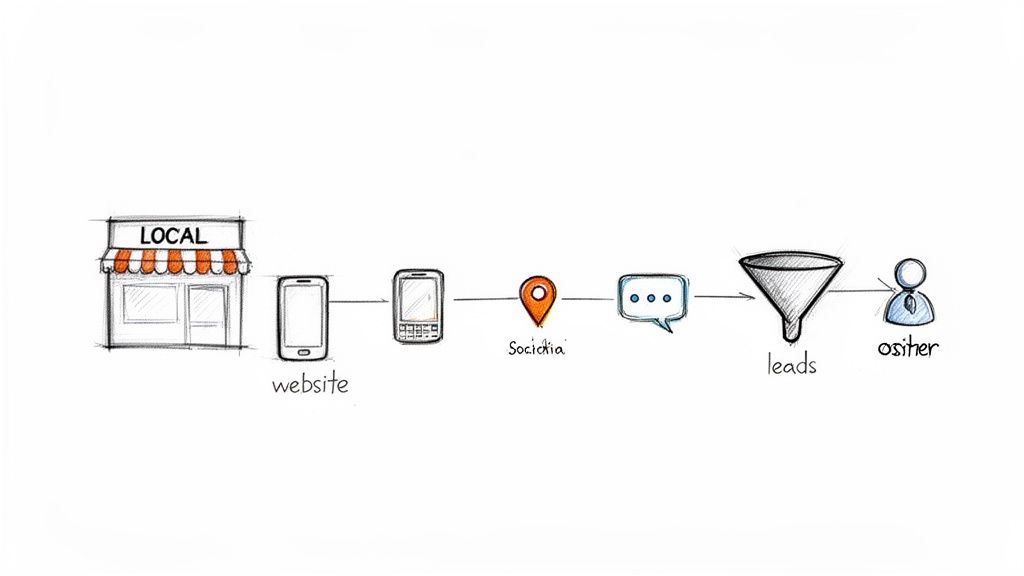
When you integrate all these channels, you create a seamless and professional experience. Someone might find you on Google Maps, check out your glowing reviews, click through to your website to learn more, and later see one of your ads on their Facebook feed. Every touchpoint reinforces your credibility and keeps you top-of-mind.
Thankfully, you don't have to be a tech wizard to make this happen. Modern tools like Alpha’s AI website builder take the complexity out of the equation. They give any business owner the power to build a professional, conversion-focused local business website that works around the clock to bring in new customers.
Nailing Down Your Domain and Hosting
Think of your domain name as the sign above your shop's door—it’s how people find you online. It needs to be memorable, easy to say, and closely tied to your business name or what you do.
For a local business, it’s often a smart play to include your city or service area right in the domain. A plumber in Denver, for instance, might have better luck with denverplumbingco.com than something generic. It instantly signals to potential customers and Google where you operate, giving your local business website a nice little boost from the get-go.
A few pro tips I always share: keep it short and make it ridiculously easy to spell. Steer clear of hyphens and numbers if you can. You want someone to hear your domain once and be able to type it in without a second thought.
What's the Deal with Web Hosting?
Okay, so you've got your address (the domain). Now you need the actual plot of land to build your website on. That's web hosting. It's simply the space on a server where all your website's files, images, and pages are stored.
It's easy to get lost in the weeds with hosting terminology. You’ll hear about shared, VPS, and dedicated hosting, but here’s the simple breakdown:
Shared Hosting: This is like renting an apartment. It's super affordable because you're sharing the building (server) with others. Perfect for starting out.
VPS Hosting: More like a townhouse. You have your own dedicated space and more control, but you're still part of a larger structure.
Dedicated Hosting: This is owning the entire house. All the server's power is yours, which is great for massive traffic but overkill for most.
Honestly, over 90% of local businesses are perfectly fine with a solid shared hosting plan. It gives you plenty of horsepower for local traffic without the headache or the high price tag of bigger plans. Don't pay for what you won't use.
The Simple, All-in-One Route
The easiest path forward? Find a platform that handles everything for you. Modern website builders like Alpha bundle fast, secure hosting right into their plans. They also make registering your domain a one-click affair, automatically connecting it to your site.
This approach lets you sidestep all the technical stuff. No messing with server settings or trying to figure out how to point your domain to your website. You can just focus on what really matters—building a site that actually brings in local customers.
If you want to go deeper on this, we've put together a full guide on choosing a domain name that walks through even more strategies. Using an all-in-one tool means you can get your online foundation set up in minutes, not days.
Designing for Trust and Local Conversions
Your website is your digital handshake. Long before a potential customer reads a single word, they’ve already formed a snap judgment about your business based on what they see. A clean, professional design instantly signals that you're credible and know what you're doing. On the flip side, a cluttered or dated site can send them straight to your competition.
This is about more than just looking good; it's about building immediate trust. You have just a few seconds to convince someone they’ve landed in the right place. An intuitive, professional, and easy-to-navigate design is what gets the job done.
Don't just take my word for it. Research shows that a staggering 75% of users judge a company's credibility based on its website design alone. It’s a huge factor in local SEO because it’s proven to drive conversions from local searches.
Start with a Mobile-First Layout
Let’s be real: more than half of all web traffic is happening on phones. This isn't a trend; it's the standard. Your website absolutely must look and work flawlessly on a small screen. This is what we call a "mobile-first" approach—designing for the phone first, and then scaling that design up for tablets and desktops.
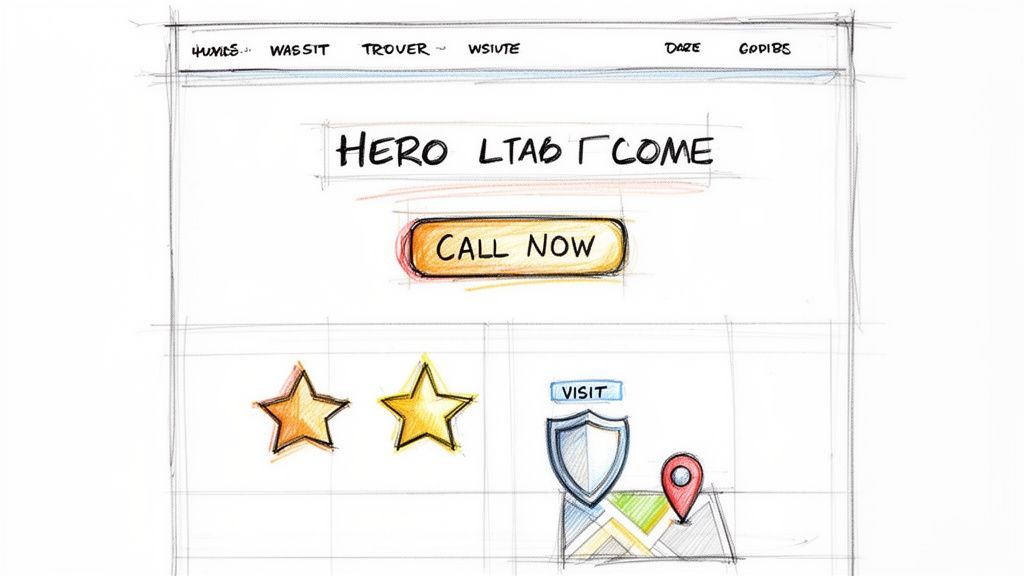
This approach forces you to prioritize what truly matters. There’s no room for fluff on a mobile screen. You have to put your most important information front and center: your phone number, address, and a clear call-to-action (CTA). This focus naturally creates a cleaner, more effective design no matter what device someone is using.
A great mobile experience isn't just a nice-to-have; it's a non-negotiable. If a potential customer has to pinch and zoom to figure out your services or can't tap your phone number to call, you've probably lost them for good.
Create the Essential Pages That Build Trust
Every successful local business website is built on a foundation of a few key pages. These pages work together to answer a visitor's questions, build confidence in your services, and make it incredibly easy for them to take the next step.
Here’s a breakdown of the pages you can't afford to skip:
Essential Pages for Your Local Business Website
Page Type | Primary Goal | Key Elements to Include |
|---|---|---|
Homepage | Make a strong first impression and guide visitors to key information. | Hero section with a clear value proposition, primary CTA, testimonials, service overview. |
About Us | Build a personal connection and establish trust. | Your business story, team photos, mission statement, what makes you different. |
Services/Products | Detail what you offer and why it's the best choice. | Clear descriptions, benefits, pricing (if applicable), high-quality images. |
Contact Us | Make it easy for customers to get in touch. | Phone number, address with map, contact form, hours of operation. |
FAQ | Answer common questions to reduce friction and save time. | Questions about your process, pricing, service area, policies. |
Testimonials/Reviews | Provide social proof and build credibility. | Customer quotes, photos or videos, star ratings, links to review sites. |
Having these pages well-executed tells your customers that you're a professional and established business they can rely on.
The Power of Strong Calls-to-Action
Every single page on your site should have a clear purpose. What do you want the visitor to do next? That prompt is your Call-to-Action (CTA). Vague CTAs like "Learn More" are weak and don't inspire action. Strong, specific CTAs get results.
Think about the difference:
Weak CTA: Submit
Strong CTA: Get Your Free Quote Now
Weak CTA: Contact Us
Strong CTA: Schedule Your Consultation Today
Place these CTAs where people can't miss them. Your main CTA—something like "Request a Free Estimate"—should be "above the fold" on your homepage, meaning visitors see it without having to scroll. For more ideas on this, check out our guide on small business website design tips.
Leverage Design Structures That Already Work
There's no need to reinvent the wheel. One of the smartest moves you can make is to look at what successful competitors in your area are doing online. Study how they structure their homepages, service pages, and contact forms. Chances are, their layouts have been tested and tweaked over time to convert visitors.
This is where a tool like Alpha gives you a massive head start. It has a unique feature that lets you use any existing website as a design reference. Just find a competitor's site you like, drop its URL into Alpha, and its AI will generate a similar, proven structure for your own site. This lets you begin with a battle-tested foundation instead of guessing.
By analyzing what's already effective, you can build a local business website that feels familiar and intuitive to your audience, guiding them smoothly toward becoming a customer.
Mastering Local SEO and Google Business Profile
For a local business, trying to get found online isn't about shouting into the void of the entire internet. It’s about winning your own backyard. This is exactly where local search engine optimization (SEO) comes in. Think of it as the art and science of making sure your business is the first one people see when they search for what you offer, right in your own area.
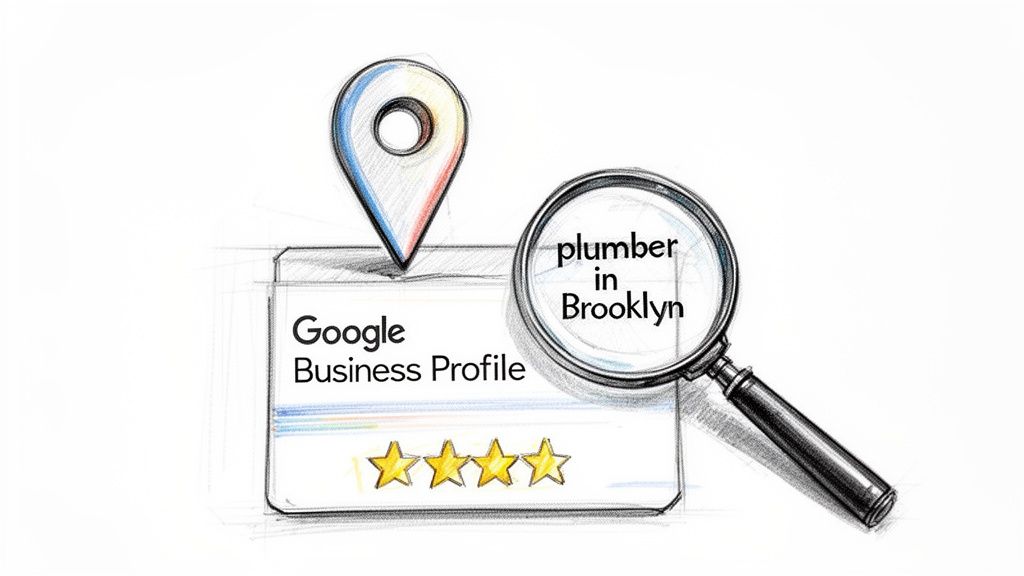
The whole point is to show up when someone nearby types in a search like “best coffee in Austin” or “emergency plumber in Brooklyn.” This isn't just about your homepage, either. It means building out dedicated pages on your local business website for every single service you provide, each one fine-tuned for local searchers. A solid local SEO foundation is what connects you with people who are not only interested but are also just around the corner and ready to buy.
Your Google Business Profile is a Magnet for Local Customers
I like to think of a Google Business Profile (GBP) as a digital storefront that sits right on Google Search and Maps. It’s often the very first impression a potential customer gets of you. A well-tended profile is an absolute powerhouse for driving foot traffic and phone calls, while a neglected one just screams that you don't pay attention to details.
A complete GBP gives someone all the critical info they need in a single glance. In fact, research shows that businesses with a complete profile are seen as 2.7 times more reputable by customers. It’s your digital welcome mat, so it better be a good one.
To really get a handle on your online presence and start pulling in local customers, you need to understand and execute a solid small business SEO strategy. It’s the engine that powers all your visibility and growth.
Optimizing Your Profile for Maximum Impact
Just claiming your GBP and walking away is a huge missed opportunity. The real results come when you treat it like the dynamic marketing tool it is. By consistently updating your profile, you're sending strong signals to Google that your business is active, relevant, and worth showing to searchers.
Here are the key areas I always tell clients to focus on for a profile that truly stands out:
High-Quality Photos and Videos: Show off your work, your team, and what it’s like to be at your location. Profiles with photos get 42% more requests for driving directions and 35% more clicks to their websites. The numbers don't lie.
Detailed Services and Products: Don't just put "Landscaping." Get specific. List "Lawn Mowing," "Garden Design," and "Irrigation Repair." This helps you show up for the exact terms people are searching for.
Regular Google Posts: Use these to share updates, special offers, or even link to your latest blog post. They act like little free ads that keep your profile looking fresh and active.
Q&A Section: Get ahead of the game by populating this section with common questions and your own clear answers. It’s a great spot to naturally work in some of your important keywords.
Your GBP and your website need to work together. The profile is the hook that draws people in, and your website is where you provide the depth to close the deal. Make sure your website link is easy to find and sends people to a page that makes sense.
The Critical Role of NAP Consistency
One of the most foundational, and often overlooked, pieces of local SEO is NAP consistency. That stands for your business Name, Address, and Phone number. Google and other directories use this data to verify that you are who you say you are and that your location is accurate.
Little inconsistencies—like listing "St." in one place and "Street" in another, or having an old phone number floating around—create confusion for search engines and customers alike. It tanks your credibility and can do real damage to your local rankings.
Do a quick audit and make sure your NAP is identical everywhere it appears:
Your website’s header, footer, and contact page.
Your Google Business Profile.
All your social media profiles (Facebook, Instagram, etc.).
Local business directories like Yelp or Angie's List.
This kind of meticulous detail is a simple but incredibly powerful way to build authority for your local business website. If you want to dig deeper, our small business SEO checklist has even more actionable steps. At the end of the day, consistency is how you prove your credibility to Google, and that credibility is what gets you seen in local search.
Launching and Promoting Your New Website
The moment your new website goes live isn’t the finish line—it’s the starting gun. I’ve seen countless business owners treat it like a technical afterthought, but a successful launch is a full-blown marketing event. It's your first, best chance to create a surge of interest that can build real momentum from day one.
Without a solid plan, even the most beautiful local business website can launch to an audience of crickets. By thinking of your launch as a promotional campaign, you ensure that all your hard work starts paying off immediately by attracting actual local customers.
Your Essential Pre-Launch Checklist
Before you shout about your new site from the rooftops, it’s absolutely critical to run through a final quality check. This quick audit prevents those common, cringeworthy issues that can sour a visitor's first impression and hurt your search rankings right out of the gate.
A few minutes spent double-checking can save you from weeks of trying to fix a botched first impression.
Here’s what I always look for:
Mobile Responsiveness: Seriously, grab your phone and navigate every single page. Does it look right? Are the buttons easy to tap with your thumb? Can you read the text without pinching and zooming?
Proofread Everything: Read every headline, service description, and button out loud. You’ll be surprised at what you catch. Typos and sloppy grammar are small details that can instantly erode a new customer’s trust.
Test All Forms and Links: Go fill out your own contact form. Make sure it actually works and that you get the notification email. Click every single link—both internal and external—to ensure none are broken.
Check Page Load Speed: Use a free tool like Google's PageSpeed Insights to get a quick performance check. A slow site is a killer, especially for people browsing on their phones.
This final inspection makes sure your digital storefront is polished and ready for its grand opening.
Announcing Your Launch to the World
Once you’re confident that the site is firing on all cylinders, it's time to make some noise. The goal here is to drive your existing audience and new visitors to the website immediately. This signals to search engines that your site is active, relevant, and valuable.
Start with the people who already know you. Your current customers, social media followers, and email subscribers are your warmest audience, so they should be the very first to know.
A dedicated email blast is a fantastic way to do this. Announce the new and improved online experience, highlight a key feature like an online booking form, and give them a compelling reason to visit—maybe a launch-day special offer.
Don't just launch your site—market your launch. By creating a coordinated promotional push, you transform a simple go-live event into a powerful traffic-generating campaign that kickstarts your online growth.
Spreading the Word Across Your Digital Footprint
Your launch promotion can’t just stop with an email. It’s vital to update every single online touchpoint where your business name appears. Consistency here is key to building authority and making sure customers find the correct, most up-to-date information about you.
Here’s a simple action plan:
Update Social Media Profiles: The first thing you should do is change the website link in your bio on Facebook, Instagram, and any other social profiles you use. Then, create a series of posts showing off the new site's design and features.
Refresh All Business Directories: This is a big one. Immediately update your Google Business Profile with the new website URL. Do the same for Yelp, Angi, and any industry-specific directories you’re listed on.
Submit Your Sitemap to Google: This is how you directly tell Google, "Hey, I have a new site, please come check it out!" Just go to Google Search Console, find the Sitemaps section, and submit your sitemap URL (it's usually
yourdomain.com/sitemap.xml). This simple step encourages faster indexing so your pages can start showing up in search results much sooner.
By following this strategic launch plan, your new local business website won't just appear online—it will arrive with an impact.
Keeping Your Website Sharp: Tracking Performance and Planning for Growth
Getting your new local business website live is a huge win. You've built your digital storefront—congratulations! But here’s something I’ve learned over years of building sites: a great website is never really "done." Think of it as a living part of your business, one that needs to evolve and adapt to keep bringing in customers.
The secret to smart growth isn't guesswork; it's data. You need to understand what's working, what's falling flat, and where your biggest opportunities are hiding. This is where website analytics, like the free and powerful Google Analytics, becomes your best friend. It gives you a direct look at how real people are using your site, so you can stop guessing and start making decisions that actually move the needle.
Focus on the Metrics That Actually Matter
It’s incredibly easy to get lost in the sea of charts and graphs inside an analytics tool. Honestly, for most local businesses, 90% of that data is just noise. You can get a crystal-clear picture of your site's health by focusing on just a handful of key numbers.
These are the metrics I always tell my clients to watch, because they answer the most important questions:
Where are people coming from? This is your Traffic Sources report. Are they finding you through a Google search? Clicking over from your Google Business Profile? Coming from a link you shared on Facebook? Knowing this shows you which marketing efforts are paying off, so you can do more of what works.
What content do they love? Your Most Popular Pages tell you exactly what visitors care about most. If your "Rooftop Deck Installation" page is a hit, you know you should feature that service more prominently or create a blog post with more examples.
Is the site actually doing its job? This is your Conversion Rate—the ultimate measure of success. It tracks the percentage of visitors who take that all-important next step, whether that’s filling out your contact form, clicking to call, or scheduling an appointment.
Are visitors leaving immediately? The Bounce Rate shows you the percentage of people who land on a page and leave without clicking anywhere else. A high bounce rate can be a red flag, often signaling a mismatch between what your page promises and what it delivers.
Don't get bogged down in vanity metrics. By keeping an eye on these core numbers, you get a simple, actionable story about your website's performance. The data's job is to give you clarity, not confusion.
Turn That Data into Smarter Decisions
Once you have this information, you can start making real, tangible improvements. The data gives you a roadmap.
Let’s say you see that your "Emergency Plumbing Repair" page gets a ton of traffic from mobile devices, but very few of those visitors actually call you. That’s a massive clue! Maybe the "Click to Call" button is too small on a phone screen, or the contact form is buried at the bottom. You can test a bigger, more obvious call-to-action right at the top and see if your conversion rate improves.
Or maybe your analytics show that almost all your best leads come directly from your Google Business Profile. That’s a clear signal to double down on your GBP. Spend 20 minutes a week adding new project photos, responding to reviews, and posting updates. It's about listening to what the data is telling you and responding accordingly.
A Little Maintenance Goes a Long Way
Finally, a healthy website needs a bit of ongoing love. Just like you wouldn't let your physical shop get dusty and outdated, your digital presence needs regular upkeep to stay secure and effective.
You don’t need to spend hours on this. Just block out a little time each month for a few simple check-ins:
Keep it Fresh: Add photos from a recent job, write a quick post about a new service, or update your team bios. Fresh content tells Google your business is active and relevant.
Stay Secure: Make sure all your website's software and plugins are up to date. This is non-negotiable for protecting your site—and your customers' trust—from security risks.
Quick Performance Review: Log into your analytics for 15 minutes. How are those key metrics looking compared to last month? Catching a downward trend early is much easier than fixing a major problem later.
This consistent, low-effort maintenance ensures your local business website doesn't just launch strong, but continues to be a reliable, lead-generating machine for your business year after year.
Common Questions Answered
When you're diving into building a new website for your local business, a few questions always seem to pop up. Let's get them answered so you can move forward with a clear plan.
What's a Realistic Website Budget?
This is the big one, and the honest answer is: it depends. You could easily spend thousands on a custom site built by an agency, or you could cobble something together for a couple hundred bucks with a basic DIY builder.
I've found that for most small businesses, the sweet spot is in the middle. AI-powered platforms like Alpha have really changed the game here. They give you that professional, custom-designed feel without the hefty price tag you'd get from a developer.
It’s about being smart with your money. You get a high-quality site that performs well, looks great, and fits a small business budget.
You no longer need a massive budget to build a website that actually brings in customers. The trick is finding a tool that gives you professional-grade features—like solid SEO tools and mobile-friendly design—without breaking the bank.
How Long Will This Take to Build?
If you go the traditional route with a developer, get ready to wait. A typical project can take weeks, sometimes even months, from the first meeting to the final launch.
But if you're using an AI website builder, you can literally have a beautiful, responsive, and SEO-ready website live in a few hours. Seriously. The AI handles the initial design work, and the editing tools are so simple that you can get from a blank slate to a finished site in a single afternoon.
Can I Really Build a Website Myself with Zero Tech Skills?
Yes, you absolutely can. Modern no-code website builders were created for people just like you—business owners who are experts in their field, not in coding.
The whole point is to make it intuitive.
You get AI design suggestions to start.
Editing is as easy as typing in a document.
The interface is designed for beginners.
You just need to bring the knowledge about your business. The platform takes care of all the tricky technical stuff behind the scenes. It puts you in the driver's seat of your online presence, no steep learning curve required.
Ready to build a website that brings local customers to your door, without all the technical headaches? Get started with Alpha today and launch a professional, conversion-focused website in minutes.
Build beautiful websites like these in minutes
Use Alpha to create, publish, and manage a fully functional website with ease.