



How to Create Website Mockups People Actually Love
Learn how to create website mockups that bridge the gap between idea and reality. Our guide covers tools, principles, and developer handoff.
EXAMPLES
Build beautiful websites like these in minutes
Use Alpha to create, publish, and manage a fully functional website with ease.
Ever wonder if your marketing is actually working? You're getting clicks, you're seeing traffic, but is any of it turning into real business? That's the exact question conversion tracking is designed to answer.
At its simplest, conversion tracking is the process of counting when a website visitor takes an action you care about. It’s your way of connecting the dots between someone visiting your site and them becoming a customer, a lead, or a subscriber.
What Is Conversion Tracking and Why It Matters
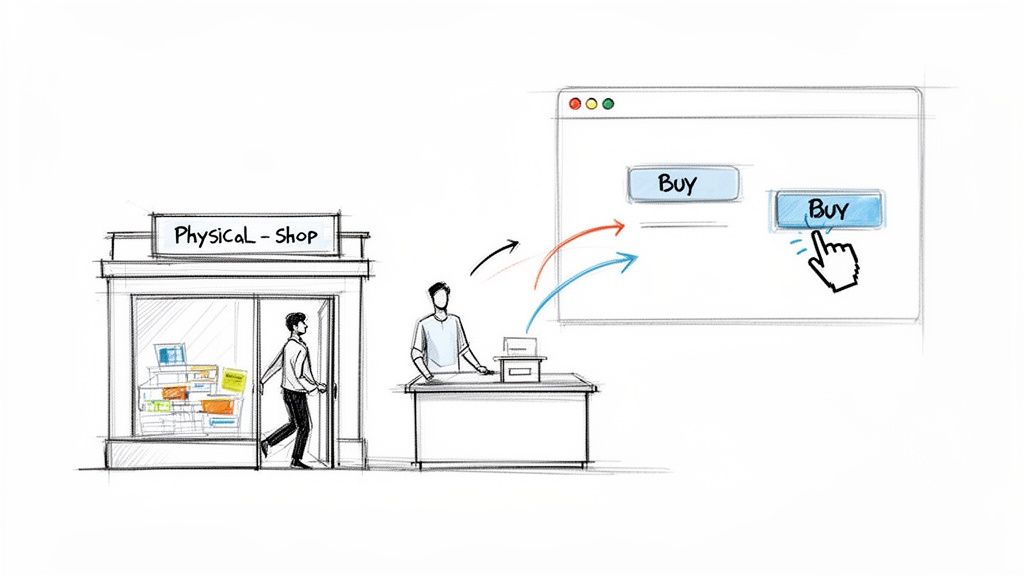
Think about it like running a brick-and-mortar shop. You wouldn't just stand at the door counting how many people walk in. You’d want to know how many people actually bought something, right? Conversion tracking is just the digital version of that. It tells you which of your ads, social media posts, or search keywords are the ones actually bringing in paying customers.
Without it, you're just guessing. You might be spending a fortune on an ad campaign that drives tons of traffic but generates zero sales. Conversion tracking shines a light on what's truly valuable, moving you from simply measuring visitors to measuring results. This all hinges on the idea of a 'conversion'—any meaningful action a user takes on your website.
Defining Your Business Goals
Ultimately, conversion tracking is all about measuring the goals that matter to your business. What that "valuable action" is can look very different from one company to the next. For an e-commerce site, the holy grail is almost always a completed sale. But for others, the goalposts are somewhere else entirely.
Here are a few classic examples of conversions you might track:
A potential client filling out a lead form to get a quote.
Someone signing up for your email newsletter.
A visitor downloading a PDF, like a case study or a free guide.
A user clicking a "call now" button on their phone.
The average global e-commerce conversion rate hovers at a surprisingly low 1.65%. That means for every 100 people who visit, less than two actually buy something. This number alone shows why tracking is so critical—you have to make every single visitor count. You can dive deeper into conversion rate benchmarks to see where you stand.
Each of these actions is a milestone. It’s a sign that someone is moving from a casual browser to a potential customer. By tracking these moments, you get a clear, data-backed view of what's working and what’s falling flat. This lets you stop wasting money on campaigns that don’t perform and double down on the ones that do.
Why Conversion Data Is Your Business Superpower
Knowing what conversion tracking is is one thing. But understanding why it's one of the most powerful tools in your arsenal is where the real magic happens. Without it, you’re just spending money on marketing and crossing your fingers, hoping something sticks.
Think of it this way: you launch two ad campaigns. Campaign A brings in 1,000 visitors who browse for a minute and then leave. Campaign B only brings in 100 visitors, but 10 of them sign up for your newsletter.
At a glance, Campaign A looks like the winner because of the high traffic. But with conversion tracking, you can see Campaign B delivered a 10% conversion rate, making it infinitely more valuable. That’s the kind of clarity that turns your marketing budget from a blind expense into a smart investment.
From Guesswork To Growth
Conversion data gives you a direct, unfiltered look at your return on investment (ROI). It stops you from guessing and starts giving you solid answers to the questions that shape your entire strategy.
Which marketing channels actually make you money? You’ll finally know if your dollars are better spent on Google Ads, social media campaigns, or your email list.
Which keywords are driving sales, not just clicks? Stop wasting your budget on broad terms that only attract window shoppers and double down on the ones that convert.
Where are people getting stuck? Pinpoint the exact spots in your sales funnel where customers are dropping off so you can make targeted fixes.
This shift from guessing to knowing is what empowers you to make genuinely data-driven decisions. You can confidently pour resources into the campaigns that are proven to work and cut the ones that are just draining your budget. It’s not just about saving money—it’s about investing it where it will fuel real growth. For a deeper dive, it helps to learn more about what is website analytics and see how it all fits together.
By tracking conversions, you’re not just collecting numbers; you’re learning the language of your customers. You discover what they respond to, what motivates them to act, and how they navigate their journey with your brand.
Optimize The Customer Journey
Ultimately, your conversion data is a roadmap into your customer's mind. It shows you which ad copy grabs their attention, which landing page design makes them feel confident, and which call-to-action button they just can't resist clicking.
For example, you might discover that visitors who watch your demo video are twice as likely to sign up for a trial. With that single piece of insight, you can decide to feature that video front and center on your homepage, directly boosting your conversion rates.
Every piece of data is a clue. Each one helps you refine and perfect the path someone takes from their very first click to becoming a loyal customer. This cycle of continuous optimization is the absolute key to sustainable growth.
What Kinds of Conversions Can You Track?
Not every action a visitor takes on your site has the same impact. It’s tempting to laser-focus on the finish line—the final sale—but that’s only a tiny part of the story. The real journey is made up of dozens of smaller interactions that lead a person from curious visitor to loyal customer.
This is where it's incredibly helpful to break conversions down into two main categories: macro and micro.
Think of it like planning a cross-country road trip. Reaching your final destination is the macro-conversion; it’s the ultimate goal. But you can't get there without making smaller, crucial stops along the way—booking a hotel, filling up the gas tank, or grabbing lunch. Those are your micro-conversions.
Macro-Conversions: The Main Event
Macro-conversions are the big-ticket actions that directly tie into your primary business goals. They’re the "finish line" moments that often have a clear dollar value and signal a major success.
For an e-commerce shop, the classic macro-conversion is a completed purchase. If you’re a B2B company, it could be a signed contract or a lead submitting a formal "Request a Quote" form. These are the home runs that drive revenue and prove your strategy is working.
Micro-Conversions: The Steps Along the Way
While macro-conversions get all the glory, micro-conversions are the quiet workhorses of your funnel. These are smaller actions that show a person is interested and moving in the right direction, even if they aren't ready to pull out their credit card just yet.
Tracking these smaller steps is absolutely vital. They tell you that your content is resonating and successfully guiding people forward.
Recognizing these smaller wins is critical. A user who downloads a case study or subscribes to your newsletter is showing strong intent. Ignoring these micro-conversions means you're missing a huge piece of the puzzle about what drives your audience to act.
These supporting actions are fantastic leading indicators. They help you understand how people behave on your site and show you where to optimize the path toward the final sale. A high rate of micro-conversions is often a fantastic predictor of future macro-conversions.
To make this crystal clear, let's look at how these goals differ across a few common business types.
Examples of Macro vs Micro Conversions
This table shows how primary (Macro) and secondary (Micro) goals look in different contexts.
Business Type | Macro-Conversion Example (Primary Goal) | Micro-Conversion Example (Supporting Goal) |
|---|---|---|
E-commerce Store | A customer completes a purchase at checkout. | A user adds a product to their shopping cart or signs up for restock alerts. |
B2B Service Provider | A prospect requests a formal price quote. | A visitor downloads a whitepaper or registers for an industry webinar. |
Content Creator/Blog | A user signs up for a paid subscription. | A reader subscribes to the free email newsletter or shares an article on social media. |
By tracking both, you get a complete picture of your performance—not just the final score, but every play that led to it.
How Does Conversion Tracking Actually Work?
So, how does this all happen behind the scenes? Think of it like a digital breadcrumb trail. Every visitor moving through your website leaves faint clues about their journey, and conversion tracking is the technology that helps you read those clues.
At its heart, it relies on a small piece of code, often called a tracking tag or a pixel. You embed this tiny code snippet on your website, but its placement is critical. It needs to go on the page a user sees right after they complete the desired action—the "Thank You" page after a purchase, for example, or the confirmation message after they subscribe.
When someone who clicked your ad lands on that specific page, the tag "fires." It sends a signal back to the ad platform (like Google or Meta) and essentially says, "Hey, that person you sent over just did the thing we wanted them to do!"
The Mechanics of the Magic
The whole process kicks off the instant someone clicks on one of your ads. At that moment, a unique cookie is placed on their web browser. This isn't about collecting personal data; it's more like a temporary ID badge that anonymously links that specific user to the ad they clicked.
Now, if that same user eventually completes your goal—whether it's buying a product or filling out a form—the tracking tag on your confirmation page spots that cookie. It recognizes the ID badge, connects the dots, and reports the conversion back to your analytics platform. This is how you can directly attribute a successful action back to the specific ad campaign, keyword, or creative that brought the user to your site in the first place.
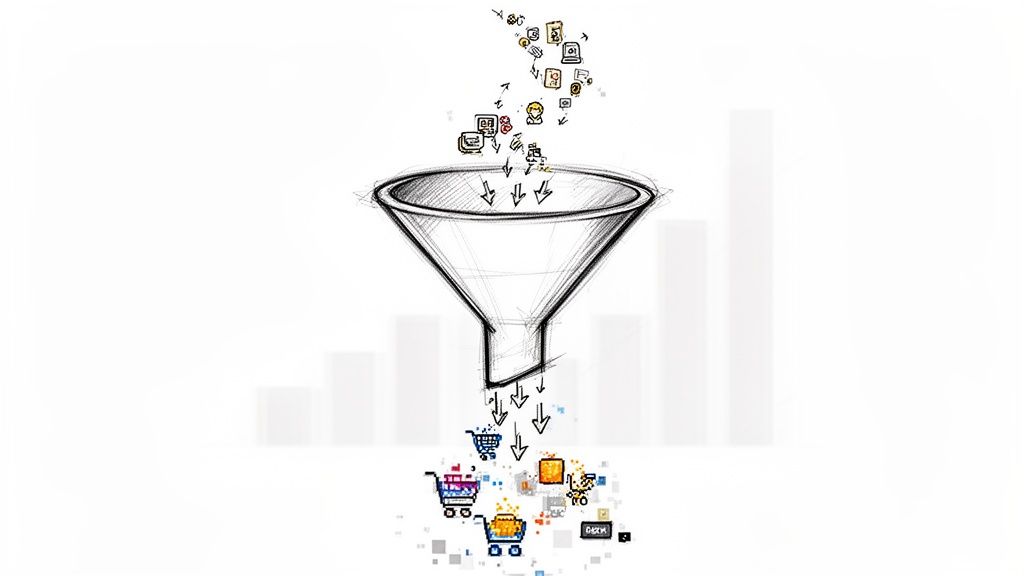
This flowchart shows how smaller steps often lead to the main goal you're tracking.
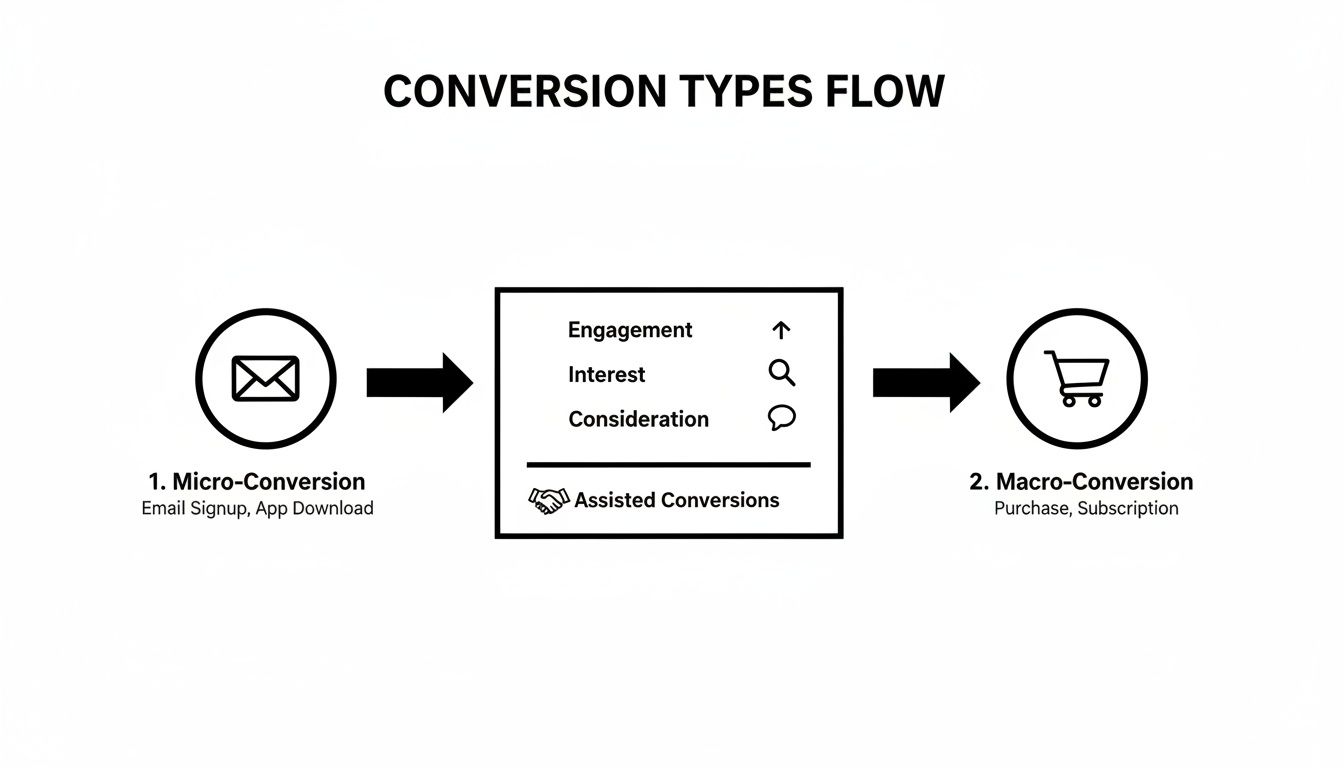
It’s a perfect illustration of the relationship between those smaller wins (micro-conversions) and the ultimate prize (the macro-conversion).
Client-Side vs. Server-Side Tracking
There are two main ways to collect this data, and each has its own set of trade-offs when it comes to accuracy, privacy, and technical effort.
Client-Side Tracking: This is the most common approach. The tracking code runs directly in the user's web browser (the "client"). It’s the standard for tools like Google Analytics and is relatively straightforward to implement. If you're just starting, you can see how it works by reading our guide on how to add Google Analytics to your site. The big downside? It's vulnerable to ad blockers and modern browser privacy settings, which can skew your data.
Server-Side Tracking: This is a more robust method. Instead of relying on the user's browser, data is sent from your website's server directly to the analytics platform. It’s far more accurate and bypasses most ad blockers, but it definitely requires more technical know-how to set up correctly.
We've come a long way from just counting page views. Today, the overall average conversion rate sits around 2.9% across all industries. Interestingly, direct traffic often converts best at 3.3%—these are people who already know your brand—while paid search is right behind at 3.2%, capturing users who are actively looking for a solution.
Of course, a customer's journey is rarely a straight line from ad to purchase. People interact with multiple ads and touchpoints along the way. To truly understand how all these different interactions contribute to a sale, you need to explore multi-touch attribution models. This technology helps you see the whole story, not just the last click.
Putting Conversion Tracking into Practice
Knowing the theory is great, but putting it to work is where the real value lies. Let's walk through how to get conversion tracking up and running, turning abstract data into a clear roadmap for growth. It’s a lot more approachable than it sounds, especially with the right tools.
The very first step is deciding what "success" actually means for a specific page or campaign. Are you hunting for newsletter sign-ups? Contact form fills? Downloads? Whatever it is, make it a clear, measurable action. That becomes your conversion goal.
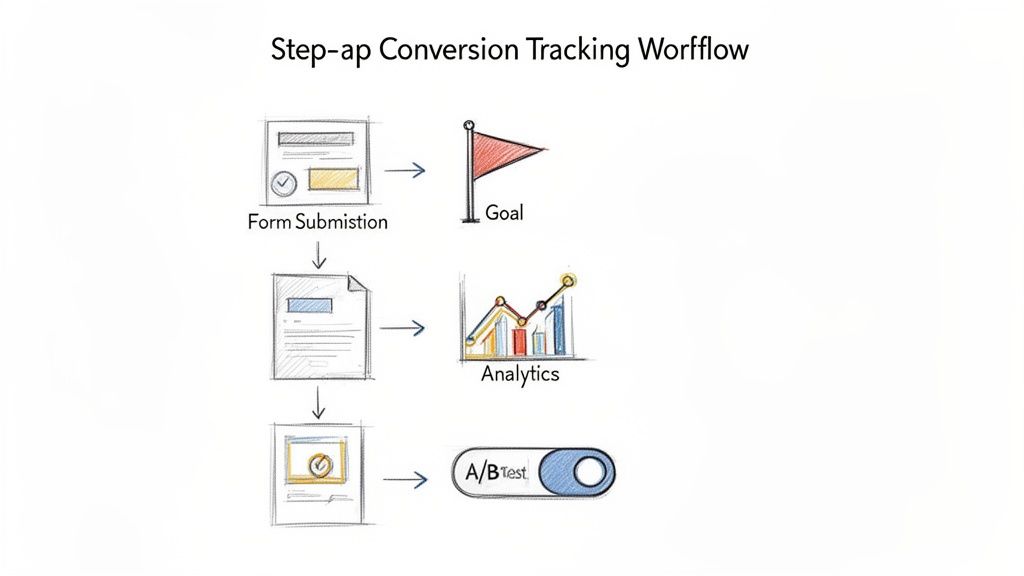
Let’s use a simple example: you want to track how many people fill out your "Contact Us" form. The conversion happens the moment a user submits their details and lands on the "Thank You" page. Setting this up is just a matter of telling your analytics tool to count every visit to that specific confirmation page as a win.
Setting Up Your First Conversion Goal
Platforms like Alpha are built to make this incredibly straightforward, often just a few clicks inside a built-in dashboard. You definitely don’t need a developer on speed dial to get started.
Here’s a basic framework to follow:
Pinpoint the Key Action: Pick one high-value action you want users to take, like signing up for a trial or downloading an e-book.
Find the Confirmation Page: Identify the URL users see right after they complete that action (e.g., yourwebsite.com/thank-you). This page is your tripwire.
Create a New Goal: In your analytics tool, head over to the goals section and create a new goal based on a destination or page visit.
Enter the URL: Just paste the confirmation page URL into the goal’s settings.
Save and Go Live: Save it, and the system will start counting every user who lands on that page as a conversion.
Once your tracking is active, the real fun begins: using that data to make smarter marketing moves. For some hands-on strategies, learning how to improve your ecommerce conversion rates is a great next step.
Interpreting Data to Drive Decisions
With tracking in place, you can finally connect the dots between what people do on your site and what it means for your business. You can A/B test your landing pages—pitting one headline against another or trying out different button colors—and see exactly which version drives more sign-ups. This takes the guesswork out of your marketing and design choices.
Statistically, conversion tracking reveals stark industry benchmarks that guide global strategies, with food & beverage topping at 3.1% and skincare at 2.7%, against a 2% all-sectors average. Data shows automotive and real estate exceeding 2.6%, while high-value B2B e-commerce lags at 1.8%, highlighting different industry challenges.
This kind of insight is pure gold. When you understand what truly clicks with your audience, you can make targeted tweaks that directly boost your bottom line. For a deeper dive, check out our guide on https://www.alpha.page/blog/how-to-increase-website-conversions to start turning more visitors into loyal customers. This cycle of tracking, testing, and tweaking is the engine of any solid growth strategy.
Got Questions About Conversion Tracking? Let's Clear Things Up.
Even after you get the hang of the basics, a few practical questions always pop up once you start digging in. This is the part where we tackle those common head-scratchers, the things people are often thinking but might not ask. Let's get them answered so you can move forward with confidence.
"Isn't This Just a Fancy Way of Saying Website Traffic?"
That's a great question, and it gets to the heart of why this matters so much. They're actually two very different things.
Think of website traffic as counting the number of people who walk into your store. It’s useful to know if you're in a busy location, but it doesn't tell you a thing about what they did once they were inside. Did they just browse and leave, or did they pull out their wallets?
Conversion tracking is like having a cashier who counts every single sale. It measures the valuable actions people take, not just their presence. Traffic tells you how many people you reached; conversions tell you how many you actually persuaded.
Traffic shows you the size of your audience. Conversions show you the quality of that audience and the effectiveness of your message. You can have a million visitors, but if none of them convert, you don't have a business—you just have a popular hobby.
"Okay, So What's a Good Conversion Rate?"
The honest-to-goodness answer? It depends. Anyone who gives you a single number without asking about your business is just guessing. A "good" conversion rate is completely relative and changes dramatically based on your industry, business model, what you're asking people to do, and even where your visitors are coming from.
An e-commerce store might be thrilled with a 2% conversion rate on sales, while a B2B company might consider a 10% conversion rate on a whitepaper download a huge success.
To give you a rough frame of reference, here are some general industry benchmarks:
E-commerce Purchases: The average floats around 1-3%. If you're hitting numbers higher than that, you're doing pretty well.
Lead Generation Forms: Since the ask is smaller (an email for a demo, not a credit card number), rates are often higher, sitting anywhere from 5% to 15%.
Newsletter Sign-ups: This is all over the map. It could be 1% from a small box on your homepage or a massive 20%+ on a dedicated landing page with a killer lead magnet.
Forget about chasing some mythical universal number. The best approach is to figure out your own baseline. Track where you are now, and focus on making it better next month. That steady, consistent improvement is what really moves the needle.
"How Can I Track Things That Don't Happen on My Website?"
This is where things get really interesting. Tracking "offline" conversions—like someone calling your sales team to place an order after seeing an ad, or visiting your physical store—is a bit more advanced, but it's absolutely doable. This is often called offline conversion tracking, and it's the key to connecting your digital marketing spend to real-world revenue.
Typically, this involves linking your ad platform to your Customer Relationship Management (CRM) system. It sounds complicated, but the concept is pretty straightforward:
Tag the Lead: When someone clicks your ad and fills out a form, a unique ID (like a GCLID from Google Ads) is saved along with their contact info in your CRM.
Work the Lead Offline: Your sales team does their thing. They call the lead, have a meeting, and eventually close the deal. In your CRM, they mark that lead as "won" or "customer."
Send the Info Back: You then upload a simple file back to your ad platform that contains that unique click ID and the conversion details (like the sale value).
This little feedback loop tells the ad platform, "Hey, that person who clicked that specific ad a few weeks ago? They just became a customer." Now you can finally see the true ROI of your campaigns, even when the final sale happens over the phone.
"How Long Do I Need to Wait Before I Change Anything?"
It is so tempting to check your stats every day and start tweaking things based on what you see. Resist that urge! Making big decisions based on a day or two of data is one of the fastest ways to mess up a perfectly good campaign.
You need to let your campaigns run long enough to gather what's called "statistical significance." In simple terms, you need enough data so that you know you're looking at a real trend, not just a random blip.
A solid rule of thumb is to wait until you have at least 100 conversions for a particular campaign or ad group before you make any major changes. If you have a business with lower conversion volume, a good alternative is to wait for at least 1,000 clicks or let things run for a full buying cycle (which could be a week for a simple product or a month for a considered purchase). This ensures you're acting on reliable patterns, not just noise.
Ready to stop guessing and start growing? With Alpha, you get a powerful AI website builder with built-in analytics designed for one thing: conversions. Track your performance, optimize your pages, and turn more visitors into customers—all without writing a single line of code. Build your high-converting website today.
EXAMPLES
Build beautiful websites like these in minutes
Use Alpha to create, publish, and manage a fully functional website with ease.